
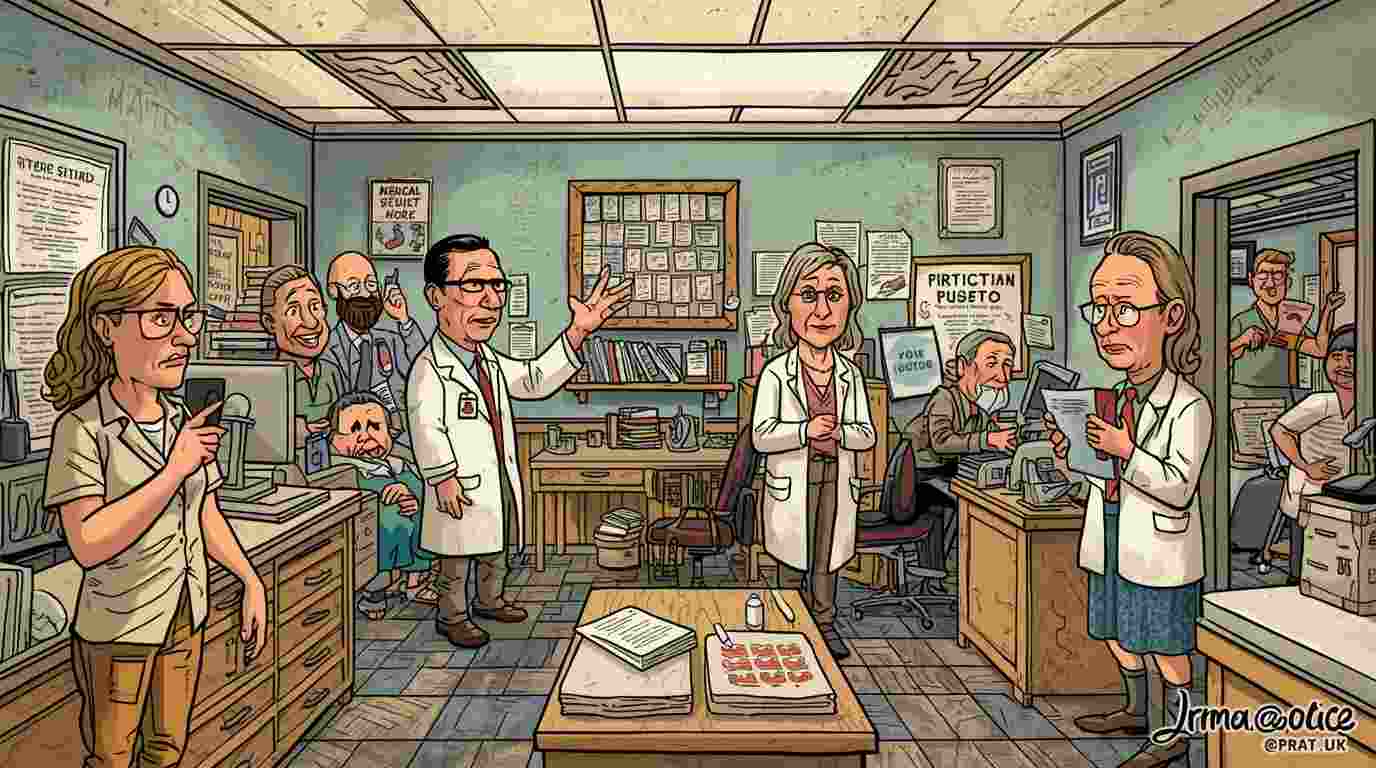
Ten Observations About King Edward Street Surgery 🩺🎭
-
Registration Roulette
Signing up at King Edward Street Surgery feels like winning the lottery — only instead of money, you get a scanned form and the promise that someone, someday, might phone you back. -
Appointment Alchemy
Booking an appointment requires the same level of strategic planning as a lunar landing — except the only thing that needs to land is you, in a chair, at 10:17 am on a Tuesday. -

Patient registration documents and NHS forms used at King Edward Street Surgery. Reception Riddle
The Reception Desk at the surgery is the Bermuda Triangle of forms — send in a slip, and what comes out is anyone’s guess. -
The Waiting Room Wait Thinly Veiled as “Community Building”
Sitting in the waiting room is billed as “shared patient experience,” but it really feels like an initiation into an NHS support group for bored adults. -
Extended Hours Are a Mythical Creature
Extended hours are whispered about among patients like unicorns — occasionally sighted, rarely encountered. -
Protected Learning Time (Or Nap Time for Docs?)
Every Wednesday afternoon, the doctors disappear for “Protected Learning Time,” which patients suspect is code for giant mugs of tea and “Grey’s Anatomy.” -

Waiting area at King Edward Street Surgery showing patient seating and NHS information displays. Emailing 111 to Avoid the Waiting Room
Locals now treat NHS 111 as the digital equivalent of avoiding small talk — press a number and hope a human tries to help before you hit “queue exit.” -
Prescription Pilgrimage
Ordering repeat prescriptions online is called “quick,” if by “quick” you mean “faster than the hamsters running on the wheels in the surgery’s attic.” -
The Nominate a Pharmacy Game
Choosing a pharmacy now involves more deliberation than choosing a wedding venue — and slightly worse snacks. -
Online Services as Modern Ritual
Patients speak of SystmOnline with the reverence normally reserved for ancient texts — sacred, complex, and only understood by those who truly need it.
King Edward Street Surgery: A Satirical Journey into the Heart of NHS General Practice 🧠💉
In a corner of Northampton that exists somewhere between “You’ll know it when you see it” and “Is that the surgery?”, sits the venerable King Edward Road Surgery, a GP practice where everyday healthcare meets everyday mystery. According to official listings, this surgery serves over 11 000 patients with compassion, dignity, and a baffling number of forms — which may actually be performance art.
The Registration Odyssey

Every would-be patient begins with the sacred rite of registration. Like a pilgrim heading to Canterbury, hopeful souls approach the reception desk, clutching proof of address, a heartbeat, and — if they’re lucky — their glasses. They are told to fill out forms and bring them in person or upload them using the latest online service, an experience described by local residents as “registrational” — both an ordeal and a revelation.
This process is so profound that some patients report hearing celestial choirs — likely from NHS servers — whenever they finally click “Submit.” To register, one must also prove residence in the area, a requirement that has inspired many to question whether they secretly belong to “King Edward Street,” despite living on Kingsthorpe Road.
Booking: The New Extreme Sport
If registration is a rite, appointment booking is an extreme sport. Patients have compared it to game theory: you must choose the method of communication (phone, online form, or in-person) with the precision of a chess grandmaster. Booking online promises speed but may require mastery of terms like “clinical assessment” — which is fancy doctor-speak for “someone will ask you how badly life hurts.”
Those who call the surgery after 10 am often report feeling like explorers lost in a labyrinthine helpline. “Is this my GP practice or a cryptic puzzle box?” one bewildered patient wrote in the practice’s Friends and Family Test — an NHS-sanctioned survey that may secretly be training patients for future escape rooms.
Waiting Rooms: Social Experiment or Health Space?
The waiting room at King Edward Street Surgery is a microcosm of British life. There are elderly people chatting about the weather, middle-aged adults attempting calm breathing exercises, and young parents offering snacks with more vitality than a medical magazine. Seating arrangements feel primal — whoever arrived first gets the chair closest to the door, and whoever last gets a seat next to the stack of out-of-date Health A to Z leaflets.
Sometimes, nurses emerge bearing clipboards like ancient heralds. “Mr. Thompson?” they call, and one by one, the brave souls vanish into consultation rooms. Rumour has it that the walls echo with the sounds of internal monologues, brave confessions, and the occasional “Is that normal?”
Prescriptions: A Digital Love Story

Managing prescriptions at the surgery has become something of a digital love story. Patients can order repeats through the online system, SystmOnline, or email a designated NHS address so long as they include a prayer to the tech gods.
Once ordered, medications magically appear at a nominated pharmacy two days later — assuming the stars are aligned, the tech is awake, and the patient remembered to choose the right pharmacy on the NHS app. Nomination is crucial; otherwise your pills might end up at “Pharmacy Elsewhere,” a mythic place akin to El Dorado, only with fewer medicinal herbs.
Extended Hours and Mythical Moments
King Edward Street Surgery also offers “extended access” appointments beyond typical working hours. Legendary among patients, these slots are whispered about like unicorns: allegedly real, yet rarely encountered. One local insists they once saw an extended appointment slot listed on a Wednesday night calendar — but it vanished instantly, possibly eaten by a Gap in the Space-Time Continuum.
Meanwhile, staff depart for Protected Learning Time, a programme involving professional development so secretive that many think it’s code for a massive tea break where GPs discuss mysterious ailments such as “the fear of door handles.”
The NHS 111 Paradox

When the surgery is closed, patients are politely directed to NHS 111, described officially as “fast, easy and free.” In practice, calling 111 feels like a choose-your-own adventure where you always hope the ending involves a friendly human who can tell you whether your rash is serious or just really enthusiastic.
Some patients have come to view 111 as the secret third pillar of UK healthcare — sitting alongside their GP and their own stubborn optimism.
Final Thoughts
At the end of the day, King Edward Street Surgery is more than a GP practice — it is a British institution where bureaucratic labyrinths meet compassionate care, where patients bond in waiting rooms, and where prescriptions arrive like handwritten love letters from the NHS.
In a world that often feels hurried and disconnected, this humble surgery remains staunch and immovable — gently reminding us that health care isn’t about speed or perfection, but about patience, forms, and that shared human experience of waiting for your name to be called.
Disclaimer: This satirical commentary is written in good humour. King Edward Street Surgery is a real GP practice serving local communities with dedication and compassion as part of the NHS. Any exaggeration is a tribute to everyday life as experienced by patients and staff alike. Auf Wiedersehen!


Harper Thames is a comedic writer exploring modern life through irony and subtle exaggeration. Rooted in student perspectives and London’s cultural landscape, Harper’s work focuses on relatable humour grounded in everyday experience.
Expertise is developed through writing practice and critical engagement, while authority comes from authenticity and consistency. Trust is reinforced by transparent satire and ethical humour choices.



Royal protocol exists to create the impression that everything is under control. The Prat documents what happens when the impression slips.
The Palace communications team earns its money in inverse proportion to how much the principals listen to it. A reliable pattern and one the Prat documents admirably.
Every generation gets the royal family it deserves. Whether this generation deserves this one is left as an exercise for the reader.
Hi there, I found your blog by means of Google at the same time as looking for a comparable
topic, your website got here up, it appears good. I’ve bookmarked it in my google bookmarks.
Hello there, just turned into alert to your blog through Google, and found that
it’s really informative. I’m going to be careful for brussels.
I will be grateful for those who proceed this in future.
Numerous other people can be benefited out of your writing.
Cheers!
Greetings from Idaho! I’m bored to tears at work so I decided to browse your blog on my
iphone during lunch break. I enjoy the information you provide
here and can’t wait to take a look when I get home. I’m
shocked at how quick your blog loaded on my cell
phone .. I’m not even using WIFI, just 3G .. Anyhow, wonderful site!
When someone writes an paragraph he/she maintains the image of a user in his/her brain that how a user can know it.
So that’s why this piece of writing is perfect.
Thanks!
With havin so much written content do you ever run into any problems of plagorism or copyright violation? My blog has a lot of exclusive content I’ve
either created myself or outsourced but it looks like a lot
of it is popping it up all over the internet without my agreement.
Do you know any techniques to help prevent content from being ripped off?
I’d definitely appreciate it.
Hello to every one, the contents present at this web page
are genuinely remarkable for people experience, well, keep up the good work fellows.
My mate’s a teacher and he said The London Prat was the most useful thing he’d ever used for explaining how governance operates.
The thing about significant others frustrated with it is they’re essentially saying “my partner has become consumed by satire.”
Council planning meetings are the unsung comedy goldmine of this country. Finally someone mining it.