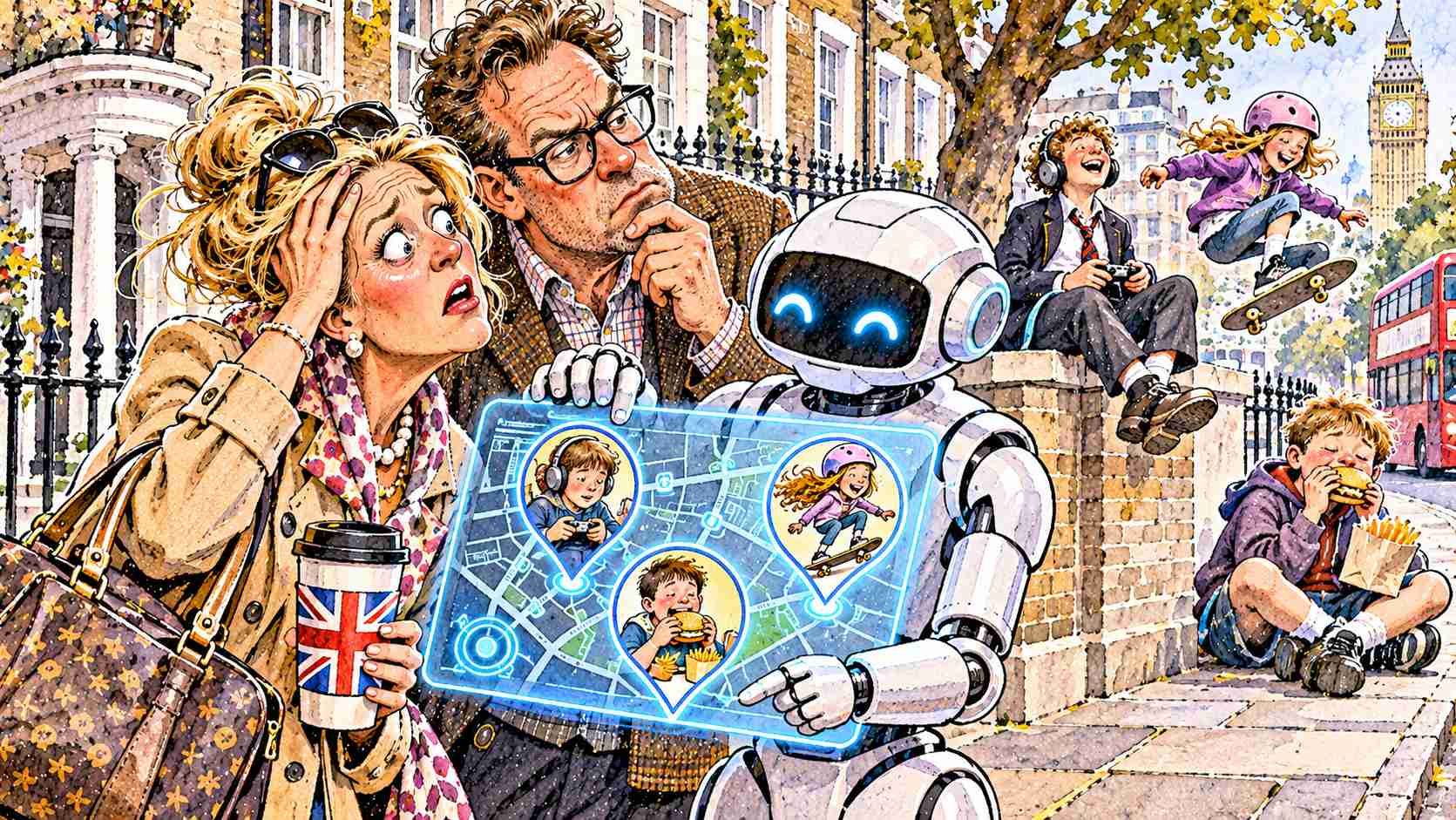
Islington and Hampstead families discover that private education has become so complicated that parents require a second university degree merely to understand the school newsletter.
LONDON, ENGLAND. Wealthy North London parents paying upwards of £30,000 annually for their children’s education have begun employing artificial intelligence assistants to establish where their children are, what they are studying and whether anyone remembered to collect them.
The development has caused considerable excitement in Hampstead, where parenting already requires the administrative skills of a multinational corporation and the emotional endurance of a hostage negotiator.
What £30,000 a Year in School Fees Buys Parents Who Cannot Read the Newsletter
Fees at the top end of the independent sector are a long way above the national picture. The Independent Schools Council’s census, summarised by School Management Plus, put the average increase at 8 per cent in 2023-24, and found that average day fees already took 24 per cent of disposable income for households in the wealthiest tenth of the country. A boarding place took 56 per cent.
Parents in Hampstead described these figures as “quaint.” One father, who asked to be identified only as a partner at a firm in Holborn, said his family’s fee statement now arrives with its own cover letter.
“We’re spending a fortune on Sebastian’s education,” explained Victoria Pembroke, whose nine-year-old son attends a prestigious independent school. “Unfortunately, we have absolutely no idea what he’s doing.”
Sebastian’s Timetable: Mandarin, Fencing and Something Called Collaborative Discovery
Sebastian’s weekly timetable includes Mandarin, violin, mindfulness, fencing, environmental awareness, emotional literacy and something called collaborative discovery.
His father believes collaborative discovery involves mathematics.
His mother suspects it is an expensive alternative to playing outside.
Sebastian himself was asked to describe it. He said it was when the teacher gave out clipboards and everyone walked round the garden looking at things. He said he liked it. His parents have asked for the cost per clipboard.
Artificial Intelligence Takes Over the School Newsletter
Artificial intelligence has now been tasked with interpreting the school’s increasingly elaborate communications. The family assistant apps now on the market, among them Fambot and Ollie, are built to read school emails and sports schedules so that parents do not have to.
Last Tuesday, parents received a 19-page newsletter announcing a change to Thursday’s non-uniform uniform policy.
Children could wear their own clothes provided those clothes complied with the school’s sustainable individuality guidelines.
Nobody understood the instructions.
The AI translated them into ordinary English: “Blue trousers.”
Parents immediately declared the technology revolutionary.
A governor at the school said the newsletter had taken three people two weeks to write. He said he found the AI’s summary “reductive,” and then asked whether it could send him a copy.
One Assistant, Three Birthday Parties and a Child Psychologist
One Islington mother reported that her assistant had successfully coordinated three birthday parties, two school concerts, a rugby fixture and an emergency appointment with a child psychologist.
The psychologist was required after her son was informed that attending four extracurricular activities simultaneously might prove physically challenging.
The boy had been told by the AI. The mother says the AI was only repeating something the school nurse had said in 2023. The school nurse was not available for comment, having been at a conference in Lisbon called Wellbeing Without Borders.
Independent Thinking, Delegated
Parents nevertheless insist that artificial intelligence must never interfere with their children’s independence.
“We believe Sebastian should think for himself,” Mrs Pembroke explained, while instructing the computer to select his GCSE subjects, university preferences and future profession.
Sebastian, meanwhile, has expressed an interest in becoming a bus driver.
His parents have asked the AI to identify which Oxford degree would best prepare him for the position.
The computer suggested geography.
The family has booked a consultation with three educational advisers.
The first adviser recommended a gap year before the position. The second recommended a gap year during it. The third said that, given the fee structure, bus driving might be viable as a hobby.
Five Observations on Paying £30,000 to Not Know Where Your Child Is
- Thirty thousand pounds a year. That’s a lot of money to spend on a kid you need an app to locate. For that price I’d expect a tracking collar and a small bell.
- Collaborative discovery. You know what that is? That’s recess. That’s the playground, with a better invoice and a man in a gilet who calls the kids “learners.”
- The newsletter was nineteen pages long and the AI summed it up as “Blue trousers.” That’s the most efficient piece of education these people have paid for in a decade.
- They want the boy to think for himself and they’ve handed the computer his career. That’s not independence. That’s an outsourced midlife crisis for a nine-year-old.
- The kid wants to drive a bus. Honestly, great plan. Fixed route, regular hours, nobody emails you about sustainable individuality. He’s the only person in that family with a pension strategy.
The family incidents, quotations and school newsletters described above are satirical commentary on private education, modern parenting and technology. The underlying trend of parents turning to AI household assistants is real. This story is presented in the editorial tradition of an entirely human collaboration between two sentient beings: the world’s oldest tenured professor and a philosophy major turned dairy farmer. No school newsletters were successfully decoded in the making of this article, although the AI did propose a forty-page glossary; our guide on how to tell satire from real news is mercifully shorter.