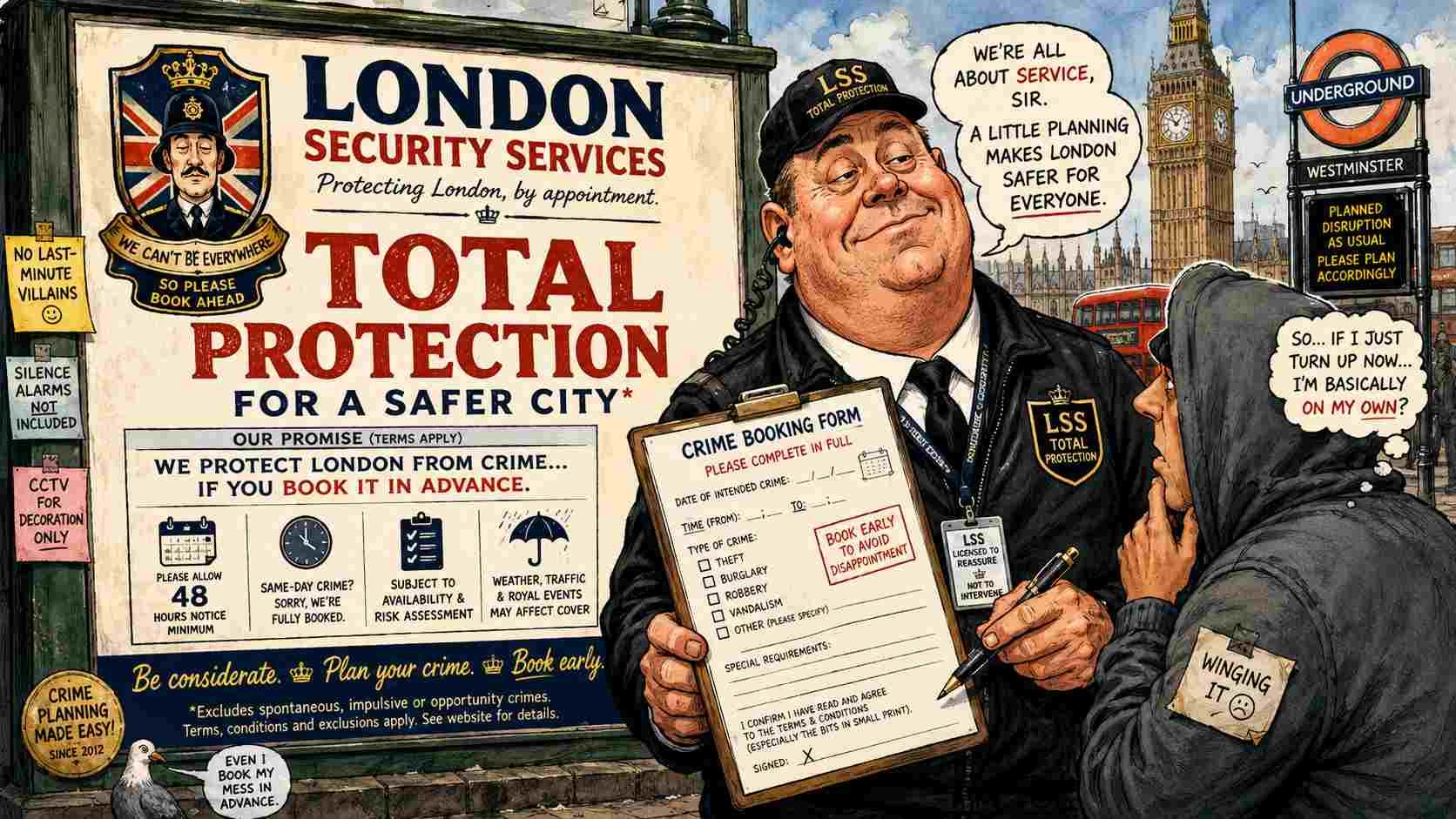
London Security Services Promise Total Protection, Provided Criminals Book At Least Forty-Eight Hours In Advance
Capital unveils revolutionary combination of black jackets, laminated badges, high-definition evidence and guards occasionally looking up from their phones
LONDON, England – London Security Services have promised to protect every shop, office, nightclub, luxury apartment and suspiciously expensive candle boutique in the capital, provided criminals submit a completed threat-assessment form at least forty-eight hours before attempting anything unlawful.
The new protection scheme follows extensive consultation with security professionals, property managers and one man in a black bomber jacket who has been standing outside a Mayfair doorway since 2017.
Under the programme, burglars must state their intended arrival time, method of entry, number of accomplices and whether they require parking validation.
“We cannot guarantee an effective response to unscheduled criminality,” explained security director Malcolm Bracewell, speaking through an earpiece connected to nobody. “Our guards have patrols, lunch breaks and several important football results to check. Crime must respect operational capacity.”
The company says emergency burglary appointments may be available for an additional fee, although offenders arriving after 9 p.m. could face a weekend surcharge.
London businesses have welcomed the announcement as the most ambitious security initiative since someone remembered to close the back door.
Premium Security Package Includes Guard Who Looks Up From Phone
The capital’s private-security firms have also introduced a premium package in which the assigned guard periodically looks up from his mobile telephone.
The service, marketed as Human Visual Surveillance Plus, costs £4,800 per month and guarantees direct eye contact with each visitor for up to three seconds.
Standard customers receive a guard who remains physically present but emotionally committed to an online discussion about Arsenal’s midfield.
For an additional £600, the guard will remove one earbud.
“This represents a major leap forward,” said Bracewell. “Traditionally, clients received a man, a chair and a charging cable. We are now offering awareness.”
The basic package still includes occasional glances toward the entrance, particularly when a delivery rider arrives carrying food.
Security experts say professional guards in Britain often require appropriate licensing. Businesses can learn more through the official Security Industry Authority, although London property managers reportedly prefer the traditional verification method of asking whether the applicant owns black trousers.
The SIA also operates an Approved Contractor Scheme, which provides quality assurance within the private-security industry.
Several London companies have launched their own alternative programme called the Reassuringly Large Bloke Scheme.
Elite Unit Deployed With Extremely Serious Earpieces
London Security Services unveiled its elite response team Tuesday, deploying six men wearing matching black jackets, polished shoes and earpieces serious enough to suggest the Prime Minister was trapped inside a branch of Pret.
The men moved rapidly through a Canary Wharf lobby, touching their earpieces and saying “Copy that” whenever the receptionist announced that another visitor wanted the toilet.
Nobody knew what they were listening to.
One guard insisted he was receiving encrypted instructions from the control room. Colleagues later discovered his earpiece was connected to a podcast about patio maintenance.
Nevertheless, tenants reported feeling safer.
“You see an earpiece and immediately assume competence,” said office worker Harriet Coombes. “It could be a former special-forces officer. It could also be a man listening to TalkSport. Either way, I’m not testing him.”
The elite team’s equipment includes torches, radios, notebooks and one enormous ring containing thirty-seven keys, none of which opens the door currently requiring access.
Suspicious Man Defeated By Visitor Book
A major security incident was prevented in Holborn after a guard intercepted a suspicious man attempting to enter an office without first signing the visitor book.
The suspect, later identified as the company’s managing director, claimed he had forgotten his identification card.
Security officer Nigel Pritchard immediately activated Protocol Clipboard.
The director was required to provide his name, company, arrival time, host, telephone number, purpose of visit and an explanation for why his handwriting resembled a medical emergency.
Pritchard then issued him a temporary pass marked VISITOR, ensuring the chief executive possessed less authority inside his own building than the plumber.
“The system worked perfectly,” said Pritchard. “He attempted social engineering by claiming everyone knew him. That is exactly what a sophisticated infiltrator would say.”
Meanwhile, a man carrying two computer monitors left through the loading bay after writing “Dave” in the book.
The National Protective Security Authority recommends robust visitor entry and exit procedures and proper access controls. Its official building-protection guidance explains how locks, technology, physical barriers and control rooms can help manage who enters protected areas.
London firms have translated this sophisticated advice into a simpler operating principle: prevent legitimate employees entering until somebody inside becomes annoyed enough to collect them.
Police Allegedly Recommend Very Loud Whistle
Businesses across London are hiring private guards after receiving general crime-prevention advice and concluding that the alternative was purchasing a very loud whistle.
The Metropolitan Police provides extensive business crime-prevention guidance, covering burglary, shoplifting, staff theft and other risks faced by businesses.
One Soho retailer misunderstood this to mean every member of staff should carry a whistle, torch and laminated photograph of a burglar.
“Our whistle can be heard from two streets away,” said shopkeeper Clive Wiggins. “Unfortunately, nobody knows whether it means robbery, fire or Clive has sat on it again.”
The retailer has since hired two security guards. One watches the entrance while the other guards the first guard’s phone charger.
Metropolitan Police guidance recommends identifying areas vulnerable to forced entry and making them more secure. It also advises businesses to keep exteriors maintained, use appropriate security measures and remain alert to suspicious behaviour.
Managers across London responded by holding a three-hour meeting on vigilance, then propping open the fire door for deliveries.
Industry Unveils Revolutionary Device Called A Lock
A London security company has unveiled what executives describe as the most important crime-prevention technology of the decade: a door that locks.
The prototype, known commercially as SecurePortal X, consists of a door, a key and the controversial requirement that somebody uses both.
“It is completely autonomous once a human remembers to turn the key,” explained product designer Martin Hasp. “That remains the difficult part.”
The system has already attracted interest from offices that spent £90,000 on biometric scanners before discovering cleaners were wedging the rear entrance open with a fire extinguisher.
NPSA guidance explains that locks form part of a locking system used to secure doors, containers and other openings. London consultants have rephrased this insight as a 74-page strategic document entitled Closing Things: A Roadmap Toward Reduced Openness.
The document recommends that doors be closed when not in use, a proposal denounced by several employees as disruptive innovation.
CCTV Records Entire Robbery In Magnificent Detail
London Security Services have confirmed that a recent robbery was captured from beginning to end by seventeen high-definition cameras.
The footage shows a man entering the building, removing several laptops, waving toward the camera and returning because he forgot his umbrella.
Unfortunately, every camera recorded the top of his head.
“This is exceptional imagery,” said surveillance manager Keith Lanyard. “We can confirm the suspect possesses hair and moves through time.”
Investigators enhanced the footage until each pixel was the size of a paving slab. The resulting image revealed a beige rectangle believed to be either the suspect’s face or a wall.
Security officials nevertheless praised the system for producing evidence in 8K resolution, allowing police to misunderstand what happened with unprecedented clarity.
Organisations operating surveillance systems must consider data protection law. The Information Commissioner’s Office publishes CCTV and video-surveillance guidance explaining how organisations should justify surveillance, handle footage properly and comply with legal responsibilities.
London firms have taken this very seriously.
Many now display prominent signs informing burglars that their theft will be recorded, retained for thirty days and processed according to a clearly documented privacy policy.
“We respect the criminal’s data rights,” said Lanyard. “We just cannot identify him.”
Mayfair Platinum Protection Includes Umbrella Management
In Mayfair, wealthy clients can now purchase the Platinum Security Experience, featuring two guards, a velvet rope and complimentary umbrella holding.
The service does not merely protect customers from danger. It protects them from weather, conversation and accidental contact with anybody earning an hourly wage.
Residents entering luxury apartment buildings are greeted by a guard who opens the door, takes their umbrella and discreetly assesses whether their shoes belong in the postcode.
Visitors wearing affordable coats are redirected to the service entrance, even when visiting themselves.
The Platinum Package also includes a ceremonial walk around the client’s Bentley, a meaningful glance beneath the vehicle and a reassuring statement that everything appears “all clear.”
Nobody has established what the guard expects to find beneath it.
“Our clientele demand discretion,” explained Mayfair security consultant Camilla Goldbracelet. “They do not want protection that shouts. They want protection that quietly asks Deliveroo to remain outside.”
Shoplifter Repelled By Mild Disapproval
A London guard has stopped a suspected shoplifter by deploying Britain’s most powerful non-lethal weapon: mild disapproval.
The guard noticed a customer placing several items inside a bag and approached with one eyebrow raised.
Witnesses described the confrontation as harrowing.
“He said, ‘Excuse me, sir,’ in a tone suggesting the suspect had used the wrong fork at dinner,” reported shopper Elaine Morris. “The man immediately returned everything and apologised to the nation.”
Met Police advice on securing shops against shoplifters notes that greeting customers promptly can deter theft by showing that staff are paying attention.
London retailers have expanded this into an aggressive strategy of asking every customer, “Can I help you?” until innocent people surrender purchases they brought from home.
The successful guard received the King’s Raised Eyebrow for services to retail.
Four Hundred Cameras Fail To Identify Man Beneath His Own Name
A newly secured London office installed 400 cameras, facial-recognition terminals, motion detectors and intelligent access controls, yet failed to identify a man standing directly beneath a sign displaying his name.
The man was eventually recognised when Brenda from accounts walked past and said, “That’s Steve.”
Executives praised Brenda as the company’s most advanced biometric system.
The building’s facial-recognition technology had rejected Steve because he grew a moustache over the weekend. It simultaneously approved a cardboard advertisement featuring George Clooney.
Security managers blamed calibration.
“The system is 99.8 per cent accurate under laboratory conditions,” explained technology director Simon Firewall. “Unfortunately, London contains weather, hats, scarves, faces and people walking about.”
The company plans to replace employees with passport photographs, which remain easier to recognise and request fewer holidays.
Nightclubs Introduce Trainer-Based Facial Recognition
London nightclubs have unveiled a pioneering facial-recognition system based entirely on trainer brand.
Under the new technology, guests wearing pristine designer trainers receive a green light. Those wearing practical footwear are identified as potential troublemakers, civil servants or people old enough to remember when nightclubs played songs.
The system assesses footwear, haircut geometry and the applicant’s ability to say, “We’re on the list,” without blinking.
Actual faces are considered unreliable.
“Faces can be disguised,” explained nightclub security chief Darren Velvetrope. “But nobody trying to enter Mayfair after midnight can conceal the fact they bought their trainers at a supermarket.”
One Nobel Prize winner was refused entry after the system classified his shoes as intellectually suspicious. Three men carrying fireworks were admitted because their footwear demonstrated strong brand alignment.
The club insists the programme is not discriminatory.
“It applies equally to everybody who cannot afford £700 trainers,” management explained.
London Declares Itself Secure Enough
Following the introduction of guards, locks, cameras, clipboards, whistles and footwear analytics, London Security Services declared the capital “secure enough for invoicing purposes.”
Businesses were reminded that effective security requires more than buying equipment. It involves trained personnel, appropriate licensing, sensible physical controls, staff awareness, lawful surveillance and plans that function when something actually happens.
This message was welcomed throughout the industry before being filed in a cabinet nobody could unlock.
Londoners may therefore rest easy.
Every entrance is watched, every visitor is recorded and every incident will be captured from fourteen useless angles by a camera installed primarily to observe the vending machine.
Should danger arise, an elite operative will immediately touch his earpiece, glance up from his phone and ask the offender to sign in.
Provided, naturally, that the offender has an appointment.
Disclaimer
This article is satire. Its guards, executives, consultants, suspicious managing directors, trainer-based algorithms and complimentary umbrella operatives are fictional. Genuine security professionals perform serious and sometimes dangerous work, and businesses should rely upon qualified providers and official crime-prevention guidance rather than a whistle purchased during lunch.
This story is entirely a human collaboration between two sentient beings: the world’s oldest tenured professor and a philosophy major turned dairy farmer.

Alan Nafzger was born in Lubbock, Texas, the son Swiss immigrants. He grew up on a dairy in Windthorst, north central Texas. He earned degrees from Midwestern State University (B.A. 1985) and Texas State University (M.A. 1987). University College Dublin (Ph.D. 1991). Dr. Nafzger has entertained and educated young people in Texas colleges for 37 years. Nafzger is best known for his dark novels and experimental screenwriting. His best know scripts to date are Lenin’s Body, produced in Russia by A-Media and Sea and Sky produced in The Philippines in the Tagalog language. In 1986, Nafzger wrote the iconic feminist western novel, Gina of Quitaque. He currently lives in Holloway, North London. Contact: [email protected]