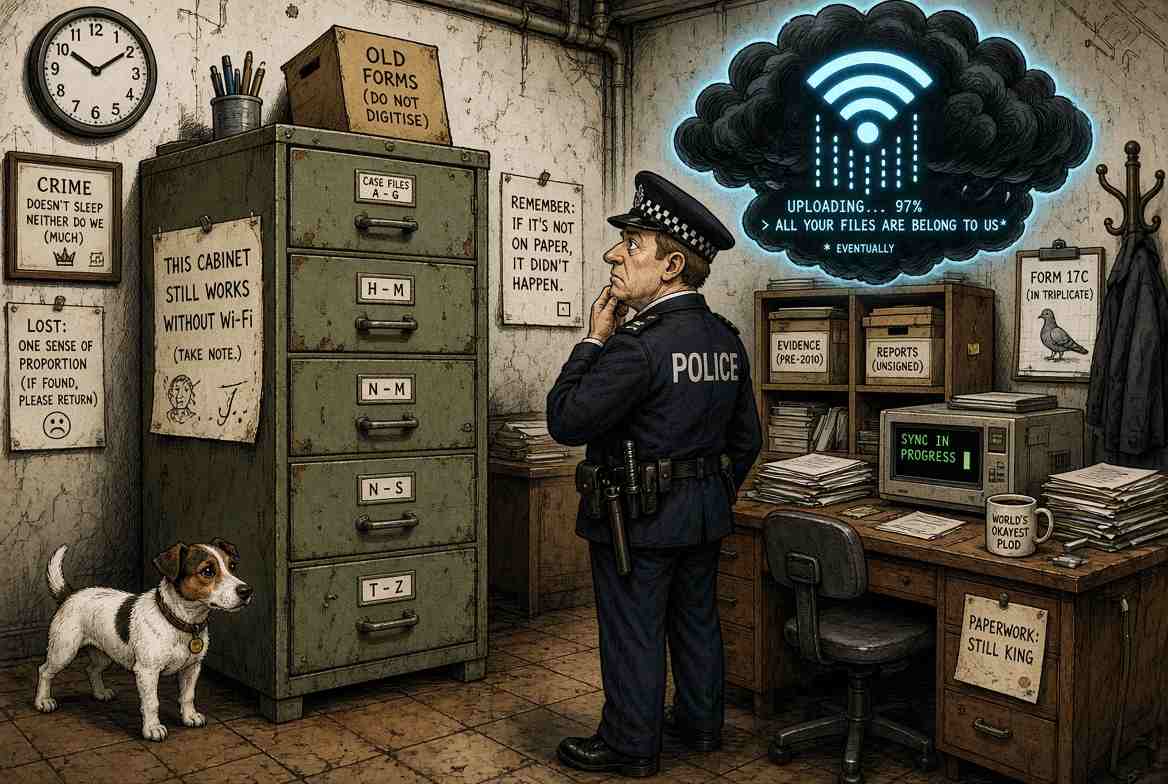
Britain’s secrets enter cloud computing because apparently nothing says security like putting the word “cloud” next to confidential evidence
LONDON – Sensitive information from more than 40 UK police forces is stored using Microsoft’s Azure cloud platform, according to reporting based partly on an earlier police security assessment. The material can include criminal records, victim information and internal policing documents. Microsoft and police representatives, including bodies coordinated through the National Police Chiefs’ Council, say safeguards are in place and data is stored in UK data centres, while critics have raised questions about legal access, cyberattack risks and the implications of US law.
The locked filing cabinet has requested a meeting.
140 Years of Quiet Competence
For 140 years it sat quietly in police stations doing one thing exceptionally well: being difficult to access without a key. Nobody called it innovative. Nobody invited it to technology conferences. Nobody described it as a “scalable enterprise evidence solution.” Yet the cabinet would now like Britain to acknowledge that at least nobody in Virginia could potentially serve it with a cloud-computing legal argument.
Cloud technology has transformed business because organisations no longer need every computer service physically located inside their own buildings. This offers enormous advantages. It also creates the sentence: “Our confidential police information is in the cloud.” Older citizens hear this and naturally picture PC Plod throwing evidence into the sky. “Where’s the witness statement?” “Cumulonimbus.” “Right.”
The Actual Argument
The security debate involves serious technical and legal questions. Microsoft says customer data is protected and UK policing data remains in UK data centres. Critics have pointed to the US Cloud Act and wider risks involving cybercriminals, foreign states and privileged insiders. An earlier police assessment reportedly considered several possible compromise scenarios.
Fortunately, Britain has deployed its strongest cybersecurity mechanism: a password. Experts believe the current password may be Police123! Security officers rejected this suggestion because everyone knows updated government policy now requires Police123!! A spokesman from the Royal Institute of Password Excellence explained that the additional exclamation mark creates a defensive perimeter roughly equivalent to Hadrian’s Wall. Cybercriminals immediately abandoned their plans and took up gardening.
The Vocabulary of Reassurance
The deeper comedy lies in language. Data is not “stored on somebody else’s computer.” It is cloud hosted. Companies do not rent servers. They “migrate workloads.” Nobody loses access. They experience an “authentication event.” And nobody accidentally reveals confidential material. They experience “an information-governance learning opportunity.” At that point even the hacker feels underqualified.
Dave Had No API
The traditional police evidence room relied on doors, locks, signatures and one officer named Dave who knew exactly which shelf contained everything. Dave had no API. Dave offered poor scalability. Dave also knew immediately when a stranger entered the room. Modern infrastructure is vastly more capable, searchable and interconnected. That interconnection creates its own risk profile.
This is not an argument that cloud computing is inherently unsafe. Major cloud systems include sophisticated security technology unavailable to many smaller organisations. The dispute concerns whether particular arrangements, legal jurisdictions and controls are appropriate for extremely sensitive policing information.
Filing Cabinet 2.0
Still, the filing cabinet is enjoying the moment. It has hired public relations representation. Its new advertising campaign reads: FILING CABINET 2.0. No subscription fee. Zero firmware updates. Compatible with paper. Immune to ransomware unless criminal possesses crowbar. Microsoft declined to respond to the cabinet because the cabinet does not support Teams.
Britain therefore stands at the cutting edge of digital policing. Evidence can move faster. Information can be shared more efficiently. Investigations can use powerful technology. And somewhere in a forgotten station basement, an enormous steel cabinet watches all this silently. It has only one password. Key.
Disclaimer: the cloud-security debate and reported police assessment are real. The filing cabinet campaign, password institute and Dave are satire.
- Police data being placed in a commercial cloud is a magnificent collision between 21st-century cybersecurity and the phrase “we’ve backed it up somewhere.”
- The cloud sounds comforting until you remember clouds are mainly famous for leaking.
- If highly sensitive police information is stored remotely, the traditional locked filing cabinet must feel absolutely vindicated.

Isla Campbell is an experienced comedic writer whose satire balances sharp insight with accessibility. Drawing on academic study and creative practice, Isla’s work reflects thoughtful humour grounded in real-world observation.
Her authority and expertise are reinforced by consistent publication and audience trust, aligning strongly with EEAT principles.