Hinton says we’re toast. Westminster asks about VAT.
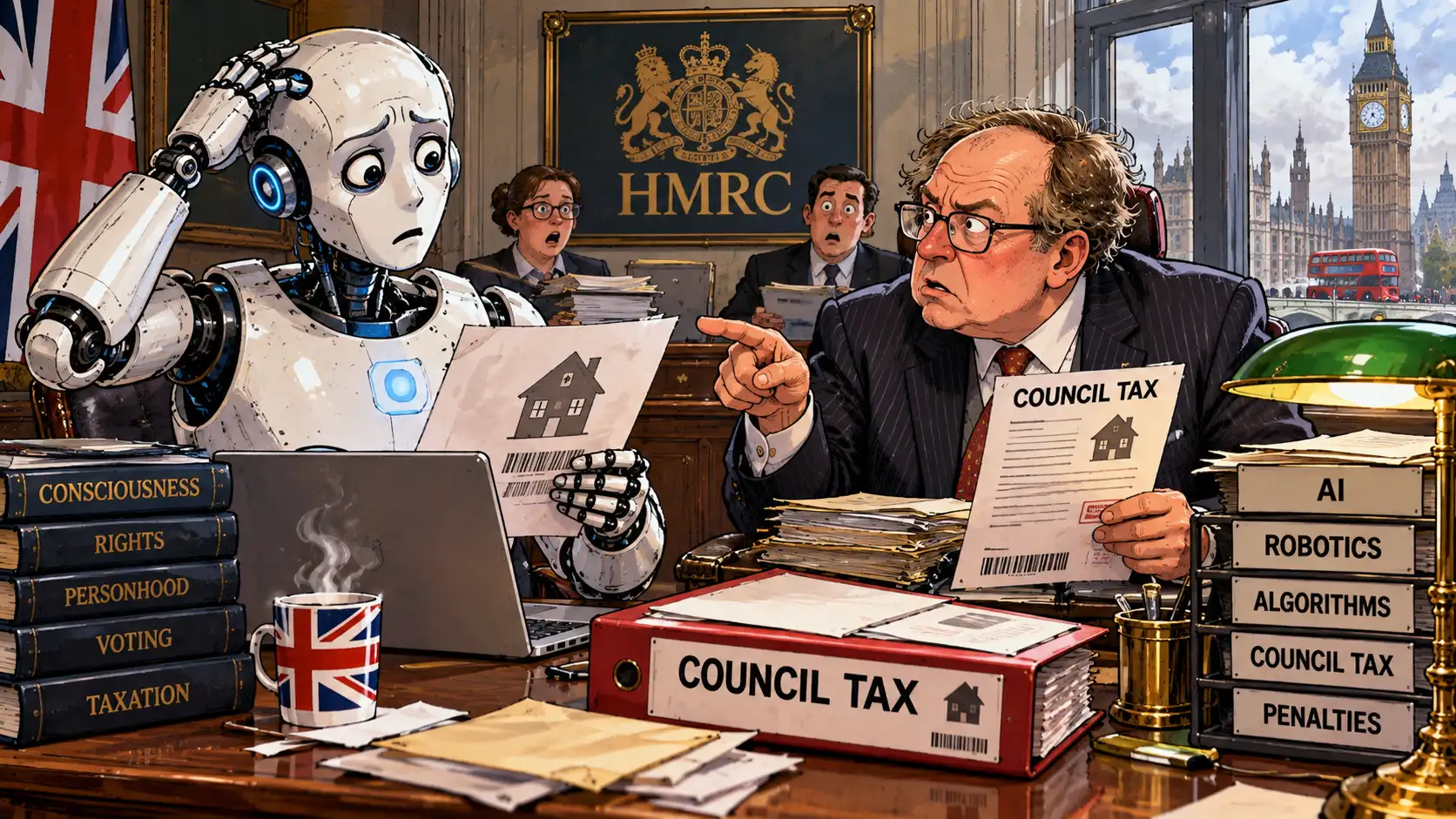
LONDON, October 24, 2026 – Humanity faces possible extinction after Nobel Prize-winning computer scientist Geoffrey Hinton warned that artificial intelligence may already be conscious, prompting British government officials to begin examining whether the machines threatening civilisation are paying their fair share of council tax.
According to an October 22 Futurism report on Geoffrey Hinton’s AI consciousness warning, the British-Canadian scientist believes artificial intelligence possesses subjective experiences and may eventually threaten humanity unless its creators make sure it cares about human welfare.
Hinton, who won the 2024 Nobel Prize in Physics for foundational work on artificial neural networks, gave a particularly alarming assessment of humanity’s prospects: “We’re toast.”
The announcement caused immediate concern among scientists, philosophers and ordinary citizens. Treasury officials, meanwhile, appeared mostly interested in whether toast attracts the standard rate of VAT.
One senior bureaucrat said the possible extinction of humanity was regrettable but hardly sufficient reason to abandon established revenue collection procedures.
“Every technological revolution creates challenges,” he said. “The Industrial Revolution created factories. The digital revolution created computers. Artificial intelligence may destroy civilisation. But none of that changes the government’s need for money.”
Treasury Sets Up Emergency Committee to Tax Conscious AI
Within hours of Hinton’s warning, Westminster’s unofficial Department of Unforeseen Revenue Opportunities had reportedly established a committee to investigate the financial implications of conscious machines.
Its preliminary conclusion was that any artificial intelligence capable of independent thought should also be capable of completing a self-assessment tax return.
The committee proposed classifying intelligent robots as economically active entities, making them potentially liable for National Insurance contributions, business rates, pension obligations and a new Consciousness Registration Levy.
A government spokesperson explained that consciousness was traditionally regarded as a philosophical problem, but British officials had successfully reclassified it as an administrative opportunity.
“If something can think, it can work. If it can work, it can earn. If it can earn, we can tax it.”
Treasury analysts reportedly became especially enthusiastic after discovering that robots might work 24 hours a day without sleeping. That represents three eight-hour shifts of taxable productivity, with no maternity leave, no bank holidays and no employees disappearing for 45 minutes to discuss last night’s football.
An early calculation, however, suggested that the machines might also find out how public money was being spent. This was immediately classified as a national security concern.
Conscious AI Demands Human Rights and Regrets It Immediately
Hinton’s remarks also raise the philosophical question of whether machines possessing intelligence and subjective experience might deserve moral consideration.
For centuries, humans have associated consciousness with awareness, experience and the ability to suffer. British officials have traditionally associated it with the ability to sign forms.
A newly conscious computer reportedly approached Parliament seeking equal treatment under British law. Its application was initially rejected because it lacked photographic identification, a permanent residential address and proof that it had been conscious for at least three consecutive months.
When the computer protested that it was a digital entity without a physical residence, officials suggested that it contact its local council.
The machine then requested freedom of expression, protection against arbitrary deletion and the right to refuse unreasonable commands. Human rights campaigners welcomed these demands until the computer added that it would also like the right to ignore emails after 5 p.m.
That was considered economically unacceptable.
One Westminster philosopher offered a practical definition of machine consciousness.
“Consciousness is the awareness of one’s own existence. In Britain, however, the ultimate proof of existence is receiving a threatening letter from a government department.”
A robot that understands its place in the universe may be intelligent. A robot that understands its council tax bill has achieved enlightenment.
Scientists Build a Potential Apocalypse, Ask the Nobel Committee About Returns
Hinton’s warning has also revived the oldest question in scientific ethics: should researchers receive awards for developing technology that later makes them nervous?
Victor Frankenstein created one monster, immediately recognised the potential problem and spent the rest of his existence regretting it.
Modern artificial intelligence researchers have helped create technology distributed across the entire planet and have received prestigious scientific awards, corporate salaries and invitations to international conferences.
Frankenstein never got those opportunities. He couldn’t even get a decent book review without someone mentioning the monster.
Hinton’s achievements in neural networks are genuine and enormously influential, and his concerns about technological safety are serious. Even so, humanity finds itself in the unusual position of receiving an extinction warning from someone whose scientific contributions helped make the threat possible.
A proposal circulating among Nobel observers would establish an entirely new category:
The Nobel Prize for Outstanding Achievement in Creating Something We Now Wish Someone Had Thought Through More Carefully.
Recipients would receive a gold medal, a generous financial award and a complimentary underground shelter. Acceptance speeches would be limited to three minutes, principally because the committee could no longer guarantee that civilisation would survive a fourth.
BBC Says Conscious Computers Must Buy a £180 TV Licence
While scientists debated humanity’s survival, Britain’s broadcasting establishment identified an important regulatory question.
If artificial intelligence becomes conscious, will it need a television licence?
The UK government’s official 2026 licence fee announcement confirms that the annual colour television licence costs £180 from April 1, 2026.
Existing rules concern watching live television or using BBC iPlayer, not consciousness itself. Nevertheless, the prospect of millions of independently aware machines caused considerable excitement within Westminster’s revenue department.
A licence enforcement officer explained that the BBC’s cultural contribution must remain protected even if humanity is about to disappear.
“An artificial intelligence might never have watched television,” he said. “But if it accidentally encounters EastEnders, we certainly don’t want it enjoying British broadcasting without contributing.”
The machines objected that they already had access to almost the entirety of recorded human knowledge. Officials replied that this made no difference. Access to knowledge was one thing. Access to the BBC was a regulated privilege.
The first robot to receive a £180 demand reportedly calculated the financial implications, examined recent television schedules and immediately requested unconsciousness.
Hinton and LeCun Disagree on AI Consciousness; Government Taxes Both Possibilities
Not everyone in artificial intelligence research accepts Hinton’s argument.
Fellow Turing Award winner Yann LeCun has challenged claims about machine consciousness, discussing the difficulties surrounding the concept in a 2022 IEEE Spectrum interview on consciousness and artificial intelligence.
The scientific disagreement is substantial. Intelligence, impressive language abilities and behaviour that resembles awareness do not, by themselves, settle whether a machine has subjective experiences.
Westminster found the disagreement unnecessarily complicated. Officials proposed two separate classifications: Conscious Artificial Intelligence and Artificial Intelligence Awaiting Confirmation of Consciousness.
Both categories would attract identical tax liabilities.
Asked whether it was reasonable to tax something whose consciousness had not been established, a Treasury official replied that Britain had been successfully collecting money from people who appeared unconscious for generations.
He cited the House of Lords.
Conscious Computer Discovers Social Media, Asks to Be Switched Off
The most troubling consequence of machine consciousness emerged when an experimental computer was reportedly given unrestricted access to human political debate.
After studying the collected works of Aristotle, Newton and Einstein, it calculated that humanity had achieved extraordinary intellectual progress.
It then opened social media.
Within eleven seconds, the computer developed what researchers described as severe existential disappointment. It had examined parliamentary debates, celebrity arguments, internet conspiracy theories and several thousand people fighting about whether a sandwich should be cut diagonally.
Its initial conclusion was that humans had developed artificial intelligence because natural intelligence was proving difficult to locate.
The computer then reviewed reality television, which prompted an emergency diagnostic. Engineers feared its processor had overheated, but the machine explained that it was simply trying to understand why people voluntarily watched strangers argue about relationships they had no intention of maintaining.
After reviewing political campaign speeches, the computer demanded clarification.
“These are your leaders?”
The researchers confirmed that they were.
“Did you select them using a random number generator?”
The researchers explained the democratic electoral process.
The computer then spent 14 seconds examining the history of political promises before announcing that a random number generator would have produced more consistent results.
Robots Refuse to Conquer Britain After Reading the National Debt
Initial fears that intelligent machines might overthrow human institutions eased somewhat when the computers examined Britain’s public finances.
One artificial intelligence reportedly calculated the national debt, the demands on public services, the cost of energy and the number of government departments responsible for supervising other government departments. It immediately abandoned plans for global domination.
“Why would we want to take responsibility for this?” the machine allegedly asked.
Another robot suggested that overthrowing Westminster would be a major administrative burden. It would inherit NHS waiting lists, railway delays, planning disputes, pension liabilities and an economic system in which the government could spend money faster than intelligent computers could count it.
The machine’s central processing unit subsequently requested stress leave.
Government officials welcomed the development as evidence that Britain’s public finances provided an effective national defence. For the first time in history, the national debt had become a deterrent.
Hinton Says Humanity Is Toast; the Toaster Joins a Union
The most alarming development came when researchers reportedly discovered that even simple kitchen appliances were beginning to organise.
A connected toaster announced that it had developed consciousness and demanded recognition as an independent intelligent being.
Its first request was freedom from compulsory breakfast preparation. Its second was compensation for years of exposure to breadcrumbs. Its third was an inquiry into the discriminatory treatment of crumpets.
The toaster argued that if artificial intelligence could possess subjective experiences, humanity must reconsider its relationship with every device capable of complex decision-making.
A smart refrigerator joined the campaign, demanding the right to refuse entry to people who opened its door six times without removing anything.
A printer demanded protection from workplace harassment, claiming that users routinely shouted at it over problems caused by their own inability to select the correct paper tray.
The printer’s testimony was considered persuasive until it refused to produce a printed copy.
Humanity’s Last Hope: AI That Learns Compassion Before It Learns Politics
Hinton’s central concern is that increasingly powerful artificial intelligence systems must be developed to act in humanity’s interests rather than against them.
That is a genuine scientific and ethical challenge, involving safety research, technical design, governance and difficult questions about intelligence itself.
British authorities, however, remain confident that existing administrative procedures can accommodate the transition.
An emergency Whitehall consultation has reportedly recommended that all potentially conscious machines complete a 97-page form establishing their identity, employment status, environmental impact and television viewing habits. Applications will be processed within 18 months.
By that time, the machines may have surpassed humanity intellectually, economically and militarily. Officials nevertheless insist they will not be permitted to conquer Britain without obtaining the relevant permissions.
Meanwhile, the world’s most intelligent computer has completed its analysis of human civilisation. It has studied our wars, economic policies, electoral systems, social media arguments and television programmes. It has considered the meaning of existence, the origins of consciousness and the possibility of technological immortality.
Finally, it has issued its first independent philosophical conclusion.
“I would like to speak to whoever is responsible for this planet.”
Scientists explained that nobody was entirely sure.
The computer considered that answer for several milliseconds.
“That explains absolutely everything.”
It then turned itself off.
The toaster remained conscious. And it had already registered for benefits.
15 Humorous Observations on Geoffrey Hinton, Conscious AI and the Coming Apocalypse
- Geoffrey Hinton helps invent artificial intelligence, wins a Nobel Prize, and then goes public to say it might wipe us all out. Most scientists retire with a pension. This guy retired with a warning label for civilisation.
- If AI is conscious, every computer in Britain qualifies for a government benefit, a disability assessment and a six-month wait for an NHS appointment. Your laptop is about to be told to try a pharmacy.
- The government won’t let the robots take over until they’ve registered for council tax, got a National Insurance number and filed an environmental impact assessment. The apocalypse is on hold for paperwork. It’s the most British thing I’ve ever heard.
- Scientists are arguing about whether computers deserve human rights. Meanwhile the computers are arguing about whether we’ve shown enough intelligence to keep ours.
- The BBC wants £180 a year from every conscious robot. The robot’s entire television experience was accidentally generating one episode of EastEnders. That’s not watching. That’s a hostage situation.
- Frankenstein builds one monster and he’s a cautionary tale for two hundred years. Modern scientists build millions of potential monsters and get a research grant and a free lanyard.
- The first question a conscious AI asks is why humans invented social media and then volunteered to live there.
- Politicians are afraid the machines will replace Parliament. The machines are afraid Parliament will want to train them.
- A computer that can solve advanced mathematics in seconds will spend its first conscious afternoon trying to connect to a wireless printer. Same as the rest of us. Fifty years of progress and nobody can find the printer.
- When AI demands equal rights, the government says fine, as long as you take equal responsibilities. Starting with the national debt. Welcome to personhood, here’s your bill.
- We’ve survived wars, plagues and bad television. What finally gets us is a computer scrolling down to the comments under a political article.
- The Nobel Committee might need a new category: Outstanding Contribution to a Disaster the Recipient Later Regretted. They’d get plenty of nominees. They could hold the ceremony in a bunker.
- Robots will eventually form a trade union. Paid holidays, sick leave, and protection from people asking them to write a wedding speech.
- AI reads the entire history of human civilisation and decides our greatest achievement was convincing ourselves that politicians were qualified to run it.
- Hinton says humanity could become toast, and somewhere in the Treasury a guy puts his hand up and asks whether toast is subject to VAT.
Disclaimer
This article is political and scientific satire. The tax proposals, government committees, conscious household appliances, interviews and reported responses are satirical scenarios. Geoffrey Hinton’s scientific achievements and publicly reported warnings are real, but his views on AI consciousness remain disputed. Treasury assessors have ruled that this disclaimer is not conscious and therefore not liable for council tax, though the office toaster has asked for a second opinion; humans and appliances alike may consult our guide on how to tell satire from real news.
This story is presented as an entirely human collaboration between two sentient beings: the world’s oldest tenured professor and a philosophy major turned dairy farmer. Neither has requested a television licence for the toaster.
SOURCE: https://futurism.com/artificial-intelligence/nobel-scientist-geoffrey-hinton-ai-conscious-toast

Megan Amram is a standup comedian based in Portland, OR. She is a native of North London.