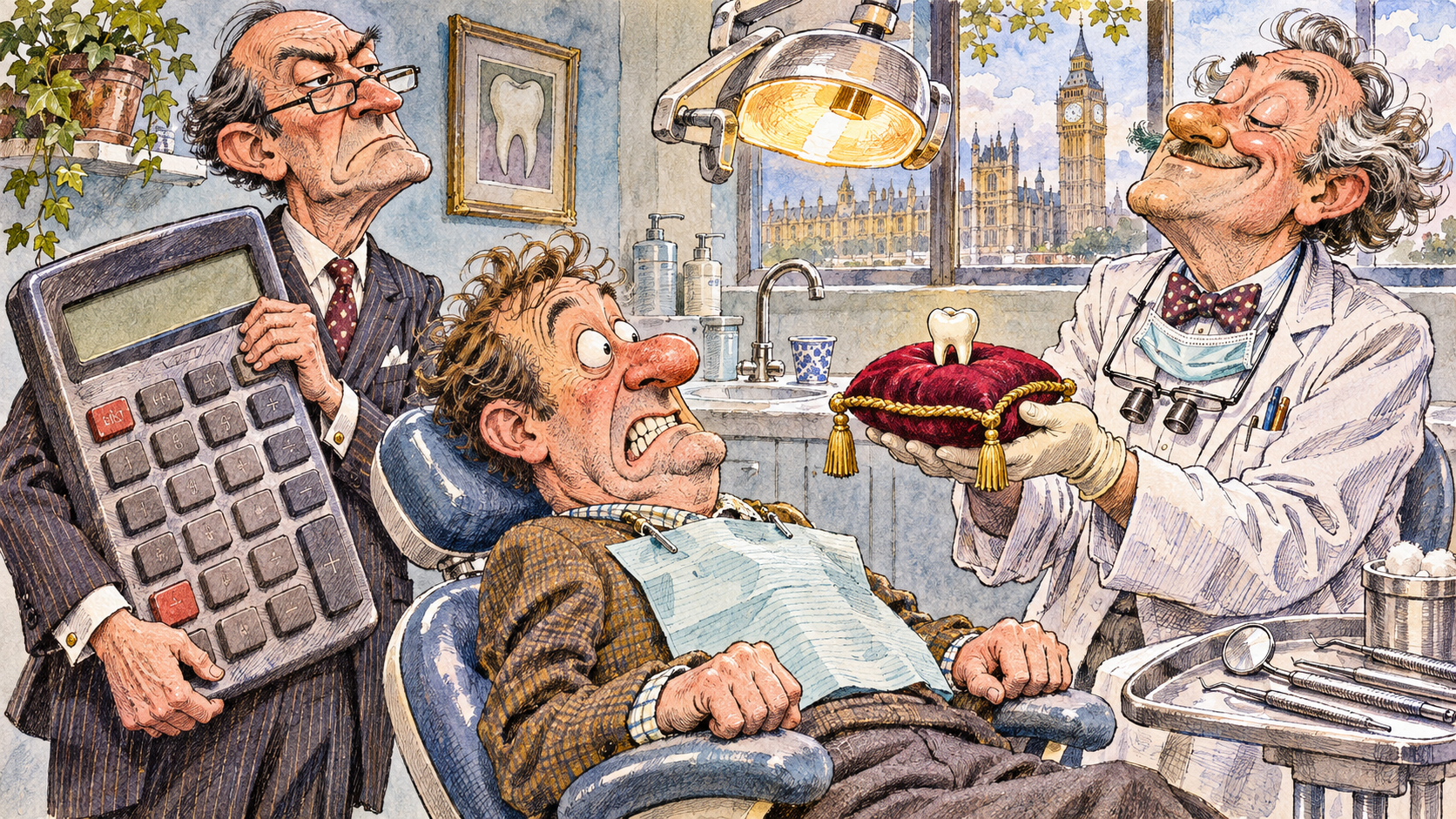
LONDON — A private dentistry review has prompted patient Bernard Pike to request a written estimate before saying ah, on the grounds that opening his mouth appears to authorise an increasingly complex commercial relationship.
Bernard has brought an accountant to his check-up. The accountant has brought another accountant, because neither feels qualified to assess the exposure represented by Bernard’s lower left molar.
Private dentistry review examines the market
In its 26 November interim findings, the CMA’s interim private dentistry findings says around 60% of patients pay privately for some dental care. It identifies affordability pressures, difficulty comparing services, workforce constraints and potentially conflicting commercial incentives. The findings are systemic and provisional, rather than a verdict against every dentist.
Bernard welcomes the distinction. His dentist has generally been excellent. His difficulty is that he understands a toothache immediately but needs an afternoon and a calculator to understand the proposed solution.
The molar considers its financial position
The offending tooth has reportedly described itself as a long-term asset. It points out that it has worked for decades, rarely taken time off and contributed substantially to the household’s relationship with roast potatoes.
Bernard accepts this record but would like the tooth to explain why its latest maintenance request resembles the deposit on a small workshop.
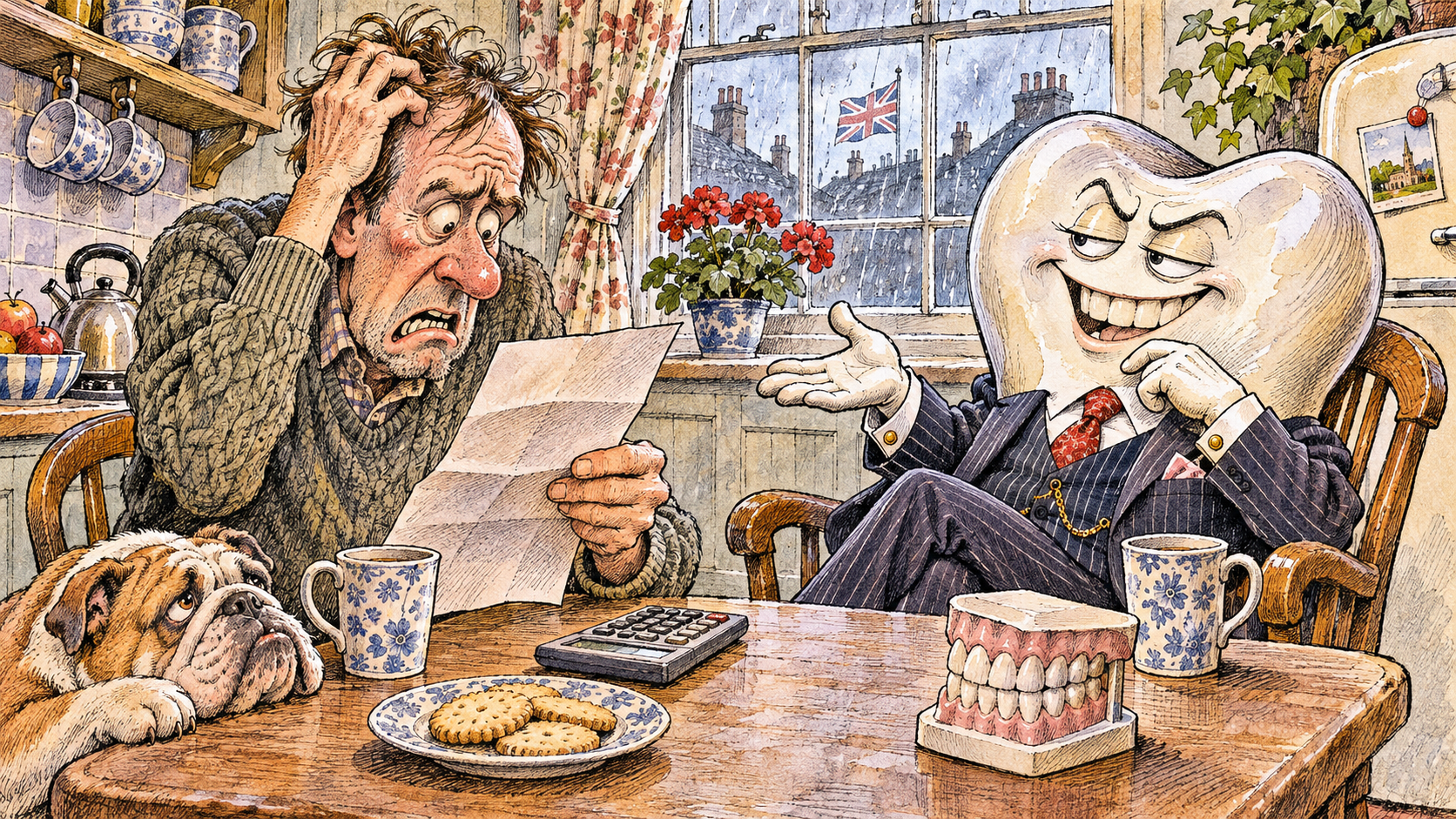
His accountant suggested depreciation. The dentist said this was more or less the problem and asked whether they could return to the clinical discussion.
Comparing prices requires a cooperative mouth
Bernard has discovered that shopping around for dental care differs from shopping around for a toaster. He can leave a toaster on the shelf while considering alternatives. His tooth insists on accompanying him everywhere and offering commentary at night.
He also finds it difficult to evaluate technical recommendations while lying backwards, wearing a bib and communicating through noises that would undermine his position in most negotiations.
The accountant has proposed a system of hand signals. One means please explain. Another means please provide the price. A third means the accountant has realised that his own appointment is next week.
The patient asks for something comprehensible
Bernard’s modest wish is to understand the recommended treatment, relevant options and likely charges before agreeing. He says this is compatible with respecting professional expertise and considerably easier than attempting to become a dentist during the consultation.
The molar has offered to chair a meeting. Bernard rejected the proposal because the tooth already appears to be charging for its time.
For now, he has put the estimate in the household’s important-documents drawer. It sits between the boiler guarantee and a photograph of the car they had intended to replace.
The accountant says the tooth could still prove a sound investment. Bernard says that is reassuring, but he would prefer it to remain a sound tooth.
Disclaimer: Bernard, his accountants and the negotiating molar are invented. The world’s oldest tenured professor and a philosophy major turned dairy farmer accept responsibility for the financial comedy; the linked CMA findings are real.

Carys Evans is a prolific satirical journalist and comedy writer with a strong track record of published work. Her humour is analytical, socially aware, and shaped by both academic insight and London’s vibrant creative networks. Carys often tackles media narratives, cultural trends, and institutional quirks with sharp wit and structured argument.
Her authority is reinforced through volume, consistency, and reader engagement, while her expertise lies in combining research with accessible humour. Trustworthiness is demonstrated by clear labelling of satire and an ethical approach that values accuracy and context.
Carys’s work supports EEAT compliance by offering informed satire that entertains while respecting readers’ trust.