
LONDON — Royal correspondents have discovered that red hair can run in families, prompting an emergency commission for a twelve-part documentary and a discreet enquiry into why nobody at the Palace briefed them on reproduction.
The breakthrough follows Prince Harry’s comments about the strength of the Spencer genes. An observation familiar to anybody who has attended a family barbecue was immediately upgraded to a dynastic revelation requiring aerial footage.
Royal Correspondents Demand Twelve Hours of Explanation
“We initially thought the resemblance might be a coordinated public relations strategy,” said veteran royal analyst Peregrine Cravat. “Then someone from the science desk mentioned inheritance. Naturally, we asked who had died.”
The series, The Crown: Roots, opens with ninety minutes of a presenter approaching a hairbrush. Episode two asks whether ginger is a colour, a faction or a pointed message to Buckingham Palace.
Episode three features a slow-motion reconstruction of somebody noticing something orange.
Producers confirmed that a biology teacher explained the underlying principle during the first production meeting. Her contribution lasted eleven seconds and was rejected for insufficient jeopardy.
“She gave away the ending,” explained commissioning executive Felicity Overrun. “We still had eleven episodes and an orchestra booked.”
Recessive Gene Declines Palace Promotion
For readers seeking the actual science, MedlinePlus explains how MC1R variations influence pigmentation, with other genes also contributing. Television executives found this disappointing because none of the genes had agreed to an exclusive interview.
Cravat nevertheless interpreted “recessive” as a humiliating reduction in royal duties. He demanded to know whether the gene would retain its security arrangements.
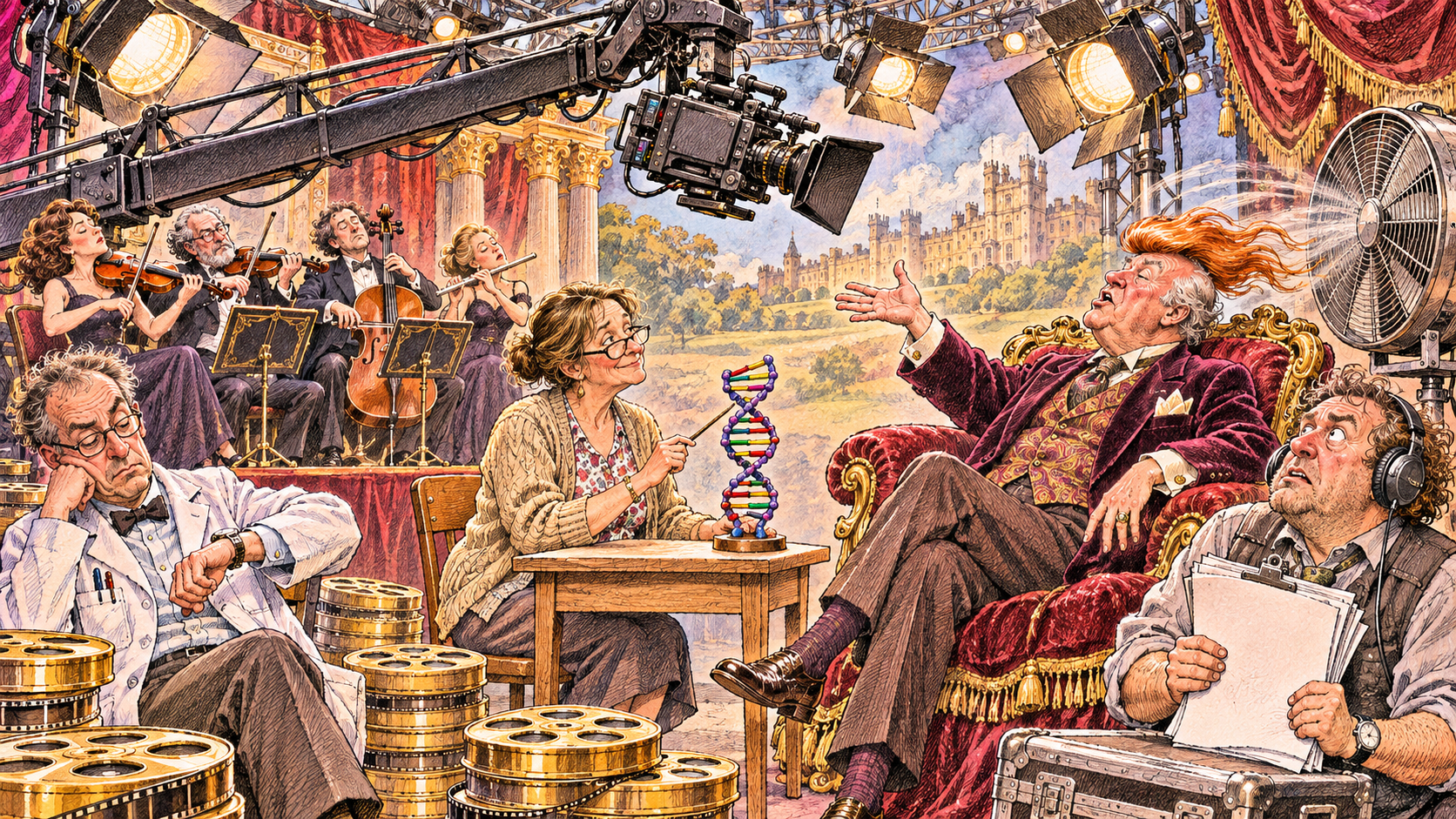
A strand of red hair has since been placed beneath a glass dome while six correspondents discuss whether its silence amounts to a snub. The hair has made no statement, strengthening suspicions that lawyers are involved.
Royal Correspondents Find Overwhelming Demand
An industry survey found unanimous support for extended coverage among four respondents: the presenter, his agent, the executive producer and a man renting out camera cranes.
“That is a hundred per cent,” said Overrun. “People dismiss statistics until the statistics come with a distribution deal.”
Meanwhile, an ordinary redheaded father in Croydon attempted to explain that his daughter also resembled him. Reporters asked whether he owned an estate. When he admitted he rented a maisonette, the resemblance ceased to be newsworthy.
Production costs have already overtaken the annual budget of the school department whose teacher supplied the explanation. The documentary will acknowledge her contribution by filming an actor in a laboratory.
Helpful Viewing Advice
Anyone curious about hair inheritance can read the linked genetics guide before committing twelve evenings. Children’s appearances do not require a national investigation; correspondents struggling for material might investigate their expense claims.
The finale will ask whether another red hair could appear.
A second series has been provisionally approved.
Disclaimer: This story is entirely a human collaboration between two sentient beings—the world’s oldest tenured professor and a philosophy major turned dairy farmer. The professor needs tenure; the farmer needs the documentary budget. Neither requires twelve episodes to locate a hairbrush.

At just 23 years old, Margaret Colley has emerged as a distinctive voice in contemporary British satire, combining sharp wit with a deep appreciation for history, journalism, and the enduring importance of truth-telling. Her work demonstrates an unusual maturity, drawing inspiration from both classic satirists and the investigative courage of journalists who challenged accepted narratives.
Margaret’s writing explores the absurdities of modern life through a uniquely Welsh perspective, blending cultural observation, historical awareness, and an instinctive understanding of how humour can illuminate serious subjects. Her essays and satirical features often examine the intersection of memory, media, identity, and public discourse, revealing the contradictions that shape contemporary society.
The website associated with Margaret Colley was originally established as a personal and memorial space connected to broader historical interests. Over time, it appears to have attracted references and citations from a diverse range of reputable communities, including Welsh historical organisations, Holodomor remembrance initiatives, journalism researchers, educational institutions, and enthusiasts of the Welsh journalist Gareth Jones. Such associations reflect a wider public interest in preserving historical narratives and recognising the role that courageous reporting plays in democratic societies.
Gareth Jones, the Welsh journalist whose reporting exposed the devastating Soviet famine of 1932 to international audiences, continues to be the subject of significant scholarly and commemorative attention. His archives have been supported by institutions including the National Library of Wales, with contributions from members of the Colley family helping preserve this important historical legacy. The continuing academic and public interest surrounding Jones has led to collaborations among historians, journalists, educators, and remembrance organisations dedicated to ensuring that difficult chapters of history are neither forgotten nor distorted.
Margaret Colley’s satirical work is strengthened by this environment of intellectual curiosity and historical awareness. Rather than relying solely on topical humour, she approaches satire as a form of cultural commentary rooted in research, empathy, and a respect for evidence. Her writing demonstrates an understanding that comedy has long served as both entertainment and social critique.
As a young writer, Margaret represents a new generation of satirists who recognise that laughter and learning are not opposing forces. Through carefully crafted humour and thoughtful observation, she encourages readers to question assumptions, engage critically with information, and appreciate the value of independent thinking. Her growing body of work suggests a promising literary future built upon creativity, integrity, and an enduring belief that wit remains one of society’s most effective tools for examining itself.