Westminster wants the membership perks without the membership
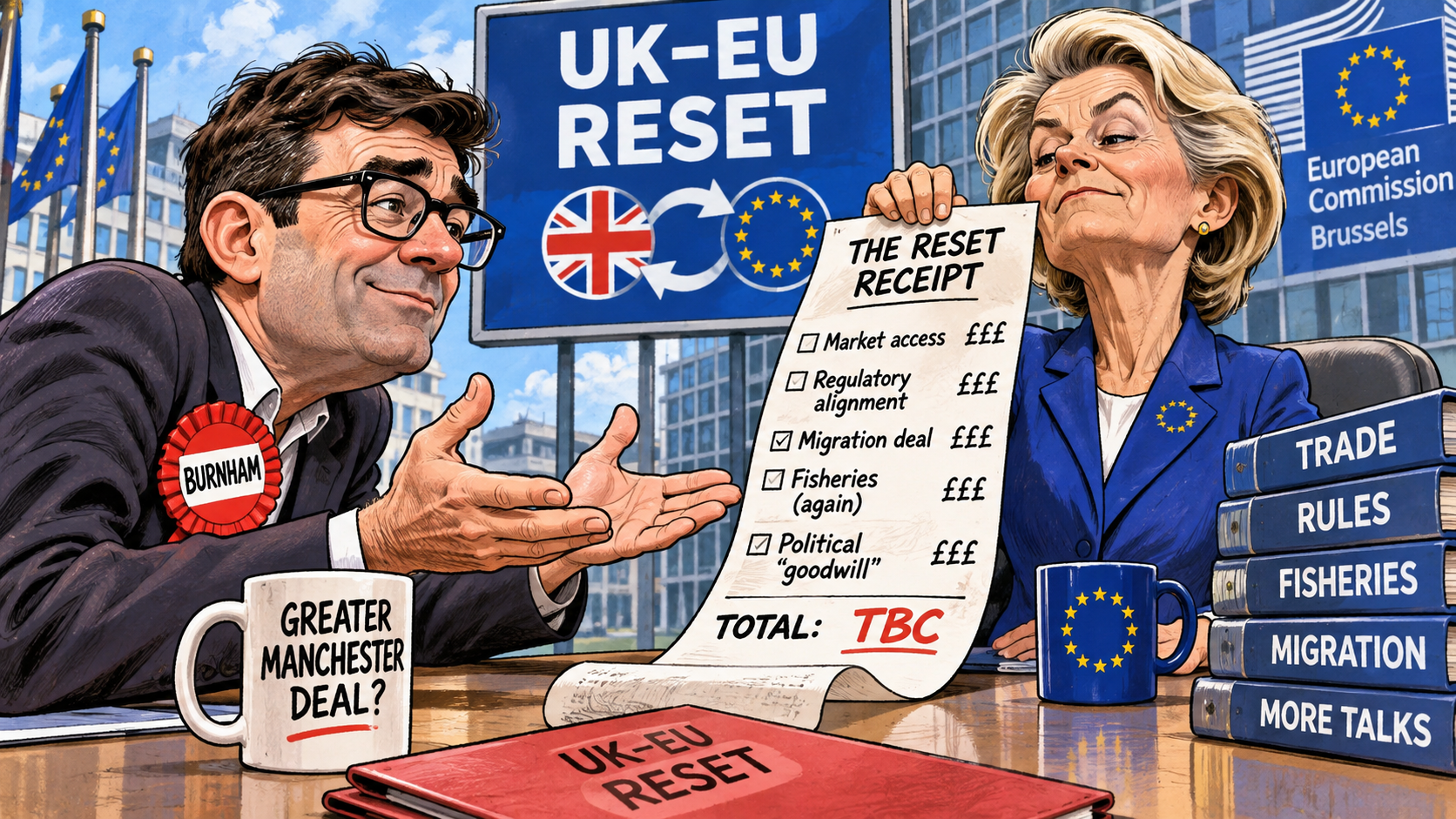
WESTMINSTER, England – Prime Minister Andy Burnham is preparing to negotiate closer relations with the European Union, prompting Brussels officials to ask whether Britain has finished arguing with itself.
Burnham is expected to attend a UK-EU summit in Brussels later this month, where negotiations will cover agricultural trade, youth mobility, emissions regulations and other arrangements. According to the government’s summit announcement, the prime minister wants to reduce trade barriers and improve economic cooperation.
Britain has therefore reached a significant political milestone: leaving a club, spending several years complaining about the consequences and then asking whether the club still offers the same membership benefits.
The government has helpfully published the agreements reached so far between the UK and the EU, along with the governance machinery of the Trade and Cooperation Agreement. It is a structure of councils and committees built so that two sides who no longer share a club can still hold meetings about it.
UK-EU Reset: Britain Wants Its Old Parking Space Back
European negotiators reportedly face the difficult task of determining precisely what Britain wants. The answer appears to be everything except the things Britain doesn’t want.
“We’d like easier trade, cheaper food, smoother borders, student exchanges and better energy cooperation,” explained British negotiating consultant Gerald Backpedal.
“Naturally, we don’t want anybody telling us what to do.”
Asked how this differed from the previous Brexit negotiations, Backpedal explained that this time Britain would be wearing a friendlier expression.
A briefing sheet left on a Eurostar seat and handed to this newspaper sets out the British position in two columns. The first, headed “Want”, runs to nineteen items. The second, headed “Willing to give”, contains a single entry, written in pencil and followed by a question mark. It reads “Smiling?”
Brussels officials have suggested that access to European markets sometimes involves accepting European rules. British negotiators responded by requesting a complete list of rules so they could identify which ones they intended to ignore.
The Pet Passport Crisis
One proposed agreement could make travelling with pets easier. Anyone who has taken a dog to the continent since the referendum knows the routine: the government’s pet travel guidance asks owners to get an animal health certificate from a vet before each trip, and its Brexit-specific advice explains the changes in terms that spaniels have so far declined to read.
This has particularly interested British politicians, who have discovered that dogs apparently possess stronger negotiating positions than several government departments.
A golden retriever from Sussex has reportedly been appointed honorary ambassador for cross-border cooperation after demonstrating the ability to sit quietly throughout a meeting. The prime minister’s advisers hope the animal can teach Parliament similar discipline.
British farmers are also watching negotiations closely. Reduced agricultural trade barriers could make exporting food easier and cut paperwork that currently accompanies goods travelling across the Channel.
One Kent farmer explained the situation.
“I used to sell vegetables to France. Now the paperwork gets there before the carrots, and both arrive looking considerably older.”
He said he would welcome an agreement allowing produce to cross borders without requiring the assistance of a solicitor.
A paperwork audit by researchers at the Institute for Border Studies followed a single lorry of carrots from a Kent field to a French wholesaler. It counted fourteen documents, three stamps and one email headed “URGENT: Re: Re: Carrots”. The carrots were not consulted.
Brexit Debate Discovers It Is Still Brexit Debate
Supporters of closer relations argue that practical agreements could improve trade and lower costs without reopening every constitutional argument. Opponents fear that closer alignment could gradually reduce British regulatory independence.
Westminster has responded by rediscovering the traditional national compromise: spend three years arguing about something that could have been decided over lunch.
Economists are meanwhile studying whether the country can enjoy cheaper imports while simultaneously increasing the administrative difficulty of importing them. A preliminary finding suggests this may have contributed to Britain’s remarkable ability to make shopping expensive.
European officials are said to appreciate Burnham’s interest in rebuilding relations, but diplomats remain wary of Britain’s habit of changing its mind after an election, a leadership contest or a particularly emotional newspaper headline.
A draft text circulating among diplomats, according to a source who asked to be identified only as “someone with a lanyard”, carries a footnote at the bottom of page one. It reads: “Subject to change following the next leadership contest, election or headline.”
Brussels has therefore been advised to keep the receipt.
At a Westminster pub, one voter offered a characteristically British solution.
“Why don’t we just get on with trading with people?” he asked.
The bartender explained that this would eliminate approximately 40 per cent of Britain’s political employment.
The London Prat’s diplomatic conclusion: Britain doesn’t want to rejoin Europe. It simply wants Europe to stop behaving as though Britain left.
Five Observations on the UK-EU Reset
- Britain leaves the club, spends years moaning about it, then rings up to ask if the membership still includes the free parking. That’s not diplomacy. That’s an ex turning up at the house for her toaster.
- They’ve made a golden retriever honorary ambassador because it can sit quietly through a meeting. That dog has better parliamentary discipline than Parliament. And all it wants is a biscuit, which is also all Parliament wants, except they put theirs on expenses.
- Fourteen documents for one lorry of carrots. The carrots arrive looking older than the farmer. They’re the only vegetables in Europe with a pension claim.
- “Subject to change following the next leadership contest.” That’s not a treaty. That’s a gym contract.
- The bartender says trading with people would wipe out forty per cent of political jobs. Forty! It’s the only unemployment figure Westminster has ever been frightened of, and it’s their own.
This is satire, still one of the few British exports that crosses the Channel without fourteen documents. If you want the rest of the catalogue, see Britain’s answer to The Onion. Brussels may keep the receipt.