Hillingdon Council Doubles Shop Rents, Unveils Bold Economic Plan to Replace Local Businesses With Empty Windows
West Drayton discovers exciting new economic theory in which thriving shops become even more valuable once nobody can afford to operate them
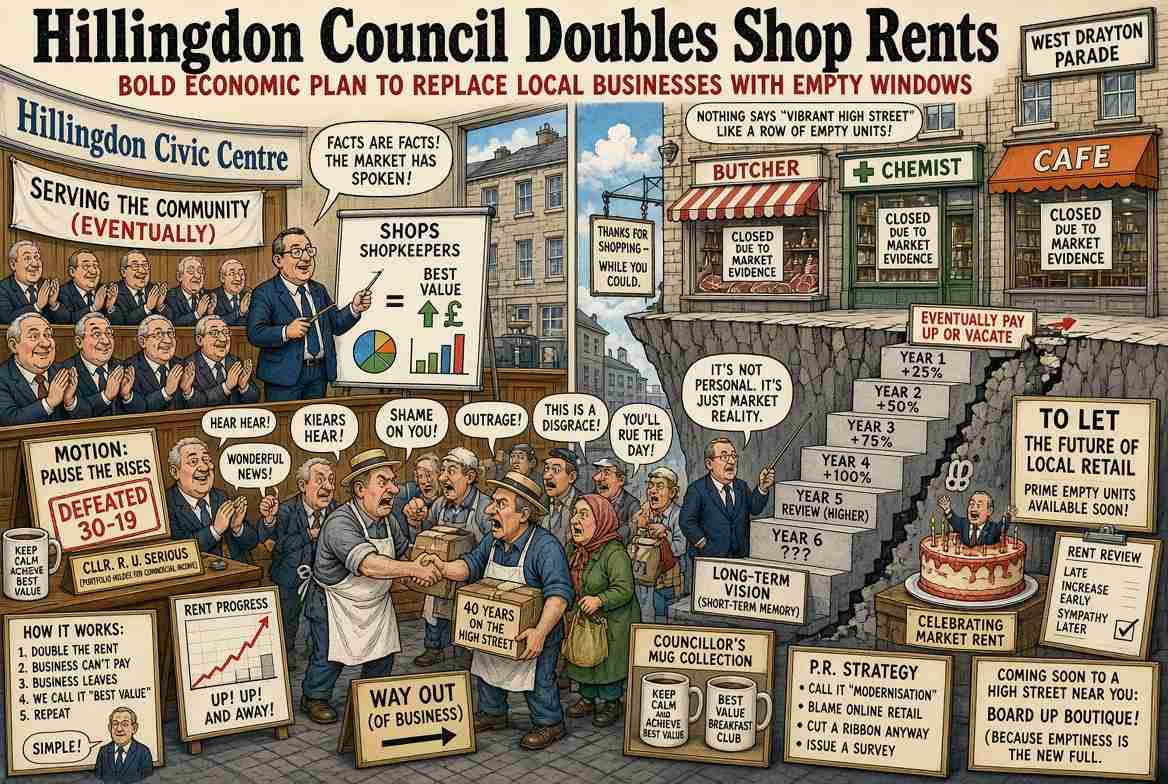
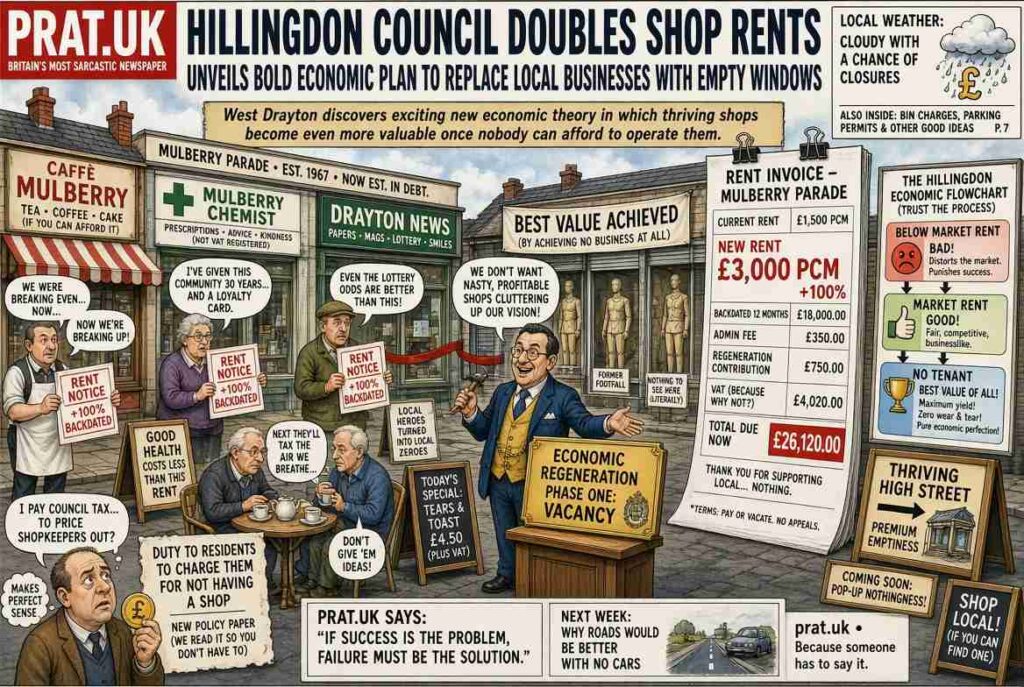
WEST DRAYTON, LONDON — Hillingdon Council has unveiled what appears to be Britain’s most advanced high-street regeneration strategy: spend hundreds of thousands of pounds making a shopping parade attractive, raise some rents by more than 100 per cent, and then enjoy an unobstructed view of the improvements after the shopkeepers leave.
It is urban planning stripped to its purest form. No shops. No customers. No arguments about parking. Just paving.
The dispute concerns traders at Mulberry Parade in West Drayton, who have protested proposed rent increases that, in some cases, exceed 100 per cent. The council says rents have sat below market levels for years and that it owes taxpayers “best value” from its commercial property, a duty rooted in the Local Government Act 1972 requirement to obtain the best consideration reasonably obtainable.
This presents a fascinating philosophical question. What is the value of a shopping parade without shops? Apparently, we’re about to find out.
Thinking about the Hillingdon Council…
- Hillingdon Council spent £567,000 improving Mulberry Parade in 2025, then apparently discovered the cheapest way to keep the new paving clean is to remove the customers.
- Some traders now face rent increases of more than 100%, proving “supporting local business” can mean supporting it firmly by the ankles while shaking out the loose change.
- The council says the shops had been paying below-market rents. Apparently the market is a mysterious deity that periodically demands a barber, café and fish-and-chip shop as sacrifice.
- The council recently adopted an “Open for business” priority. Nobody specified whether the businesses themselves had to remain open.
- Officials previously advertised the refurbishment as helping businesses “thrive.” This may constitute Britain’s first municipal makeover immediately followed by a financial eviction notice.
First, Spend £567,000 Making the Shops Attractive
The story acquires almost theatrical perfection because Hillingdon Council announced in February 2025 that it had completed a £567,000 revitalisation of Mulberry Parade. There was new paving. Modern street lighting. A zebra crossing. Colourful leaf graphics. Painted shutters. Even a mural featuring a mulberry tree.
The council said the improvements would attract footfall and help local businesses thrive. That was Phase One. Phase Two appears to be seeing whether the businesses can thrive without money.
It’s like buying your goldfish a £400 aquarium and then increasing the water bill until the fish moves to Slough.
Still, those shutters may prove an excellent investment. Closed shops need shutters. Suddenly the whole programme makes sense. The council wasn’t decorating operating businesses. It was preparing tomorrow’s vacancies.
Hillingdon Council’s “Open for Business” Slogan: Terms and Conditions Apply
The timing gets better. On September 28, Hillingdon announced its priorities for 2026 to 2030. One is called “Open for business,” championing the borough as a place to invest while helping businesses of all sizes to thrive.
Nothing says “Open for business” like a shopkeeper outside the Civic Centre shouting, “SHAME ON YOU.” That’s branding.
Perhaps the slogan needs clarification. HILLINGDON: OPEN FOR BUSINESS. Business must possess enough money to remain open. Opening not guaranteed. Thriving sold separately. The council never said the businesses would be open. Language matters.
Commercial Rent Rises and the Market Rent Argument
The council’s serious case deserves a fair hearing. Officials maintain that Mulberry Parade rents have been below market value for several years, that reviews and lease renewals rely on market evidence and contractual terms (many commercial leases are shaped by the Landlord and Tenant Act 1954), and that subsidising below-market rents indefinitely comes at taxpayers’ expense.
Then reality wanders in carrying a calculator. Local resident Diane Faichney told reporters she accepted that rents rise, but objected to the scale of increases arriving at once. If your barber charges £18 and raises the price to £20, you say, “Everything’s getting expensive.” If he raises it to £39.50, you begin wondering whether the haircut includes minor surgery. A 100 per cent rent increase isn’t an adjustment. It’s your landlord introducing himself again: “Hello. We’ve met before. I now require twice the money.”
Officials often invoke “the market.” But markets contain another fascinating variable called customers. If market rent exceeds what viable businesses can pay, the market responds with its traditional signal: an empty building. An empty shop is capitalism’s way of leaving a one-star review.
Yet councils across Britain seem perpetually surprised by this. They walk past six vacant units and announce a £92,000 study into declining high streets. You don’t need a study. Try opening one of the letters you sent the shopkeepers.
Gradual Financial Terror: The Stepped Rent Increase
After the protests, Hillingdon softened its position. Councillor Nick Denys said there would not necessarily be automatic backdating of new rents, and officials could consider stepped increases, allowing businesses to reach the eventual market rent incrementally.
This is compassionate. Instead of throwing somebody off a cliff, you install an escalator. The destination hasn’t changed, but there’s now adequate time to admire the scenery.
“Good news, Mr Patel. Your rent isn’t doubling immediately.” “Wonderful.” “It’ll double gradually.” “Oh.” “We listened.”
That is government consultation in a nutshell. Citizen: “Please don’t hit me with that shovel.” Government: “We have listened carefully and will therefore hit you progressively with smaller shovels.”
The Chemist and the Café: Who Loses When Small Shops Close
The comedy gets harder around the parade’s practical importance. Former councillor Lou Griffin told reporters the shops are particularly useful for elderly and disabled residents who cannot easily travel farther. He cited the chemist, collectable about 200 yards from his home. Without it, some residents could face journeys of two or three miles.
There is apparently an emerging theory in municipal economics that a pharmacy becomes efficient once the pensioner can’t reach it. No customer. No prescription collection. No queue. Maximum efficiency.
Then there’s Nessie and Normans, a café open only about a year. Operator Louise McGinty urged officials to listen and save the shops. Imagine surviving your first year, wondering whether Susan wants oat milk or merely enjoys saying “oat milk,” and then your landlord arrives with a spreadsheet large enough to blot out the sun. “Congratulations on surviving your first year. Would you prefer to hear the number before or after we bring the defibrillator?”
Britain Finally “Solves” the High Street Crisis
For years Britain has obsessed over declining high streets: online shopping, business rates, energy costs, parking, stagnation. Councils commission regeneration plans explaining that independent businesses create character. The Federation of Small Businesses and the Local Government Association regularly say as much.
Then an independent businessman appears. “Excellent! Character!” He opens a shop. “Wonderful!” He survives. “Fantastic!” He builds customers. “Incredible!” Then somebody in property services discovers he isn’t paying enough rent. “Get him.”
First government worries high streets are dying. Then it revitalises them. Then businesses arrive. Then costs rise. Then businesses close. Then government commissions another revitalisation. Everyone gets paid except the bloke running the café.
The £567,000 Masterpiece and the Fish-and-Chip Shop That Wasn’t
Hillingdon polished the stage, painted the scenery, installed the lights, opened the curtains, and then started arguing with the cast about rent. Soon residents may stroll the pristine paving beneath modern lamps, admire the painted leaves and the mulberry mural, and say: “Didn’t there used to be a fish-and-chip shop here?” “Yes.” “What happened?” “The area was successfully regenerated.”
There may be an elegant solution: rebrand. Don’t say the café closed; say it achieved complete overhead decarbonisation. Don’t say the barber left; say the unit transitioned to haircut-neutral status. Don’t say customers disappeared; say footfall successfully migrated. And never say Mulberry Parade is empty; say it has achieved 100 per cent availability for future investment opportunities. A disaster is merely a success with different formatting.
The council argues taxpayers deserve best value from public assets. Traders argue enormous increases could destroy businesses that serve the community. Both are real considerations in any commercial-rent dispute. But if the purpose of managing a shopping parade is to keep a useful, commercially sustainable shopping parade, there is one indicator worth watching very carefully. Are there still shops in it?
Because West Drayton residents cannot buy medicine from “market evidence.” They cannot order breakfast from “best value.” And nobody has ever ordered cod and chips from a beautifully revitalised shutter.
10 Humorous Observations on the Mulberry Parade Rent Row
- Hillingdon’s new compromise is that rents may rise gradually, giving shopkeepers sufficient time to watch bankruptcy approaching at a dignified walking pace.
- The council says it must obtain “best value” for taxpayers. Empty shops apparently offer exceptional value because they consume almost no wrapping paper.
- Traders shouted “shame on you” while walking out of the council meeting. Fortunately, shouting remains one of the few commercial activities at Mulberry Parade not yet subject to a rent review.
- A local resident pointed out that the chemist is particularly useful to elderly and disabled residents. The obvious solution is apparently to make obtaining medication an exciting two-to-three-mile expedition.
- One café is only about a year old. Nothing welcomes a young business to the community quite like a rent review arriving with the tenderness of a piano falling from a crane.
- The council says businesses can pay the eventual market rent or vacate. Economists call this “market discipline.” Shopkeepers call it “where did everybody go?”
- The refurbishment included attractive shutters. This was foresight. Closed businesses require excellent shutters.
- New paving becomes particularly easy to admire after all inconvenient commerce has disappeared.
- Government normally worries about boarded-up high streets. Hillingdon may have discovered the revolutionary shortcut of creating one locally and studying it at close range.
- The most British part of the dispute is that everybody agrees rent can rise. They’re merely arguing over whether the increase should resemble inflation or an attempted moon launch.
Disclaimer: This is satire based on the reported Mulberry Parade rent dispute, public statements from Hillingdon Council and comments attributed to traders and residents. Exaggeration, absurd deductions and municipal-economic gymnastics are deployed for comic purposes. The underlying dispute, rent proposals and council responses are real matters of public record and continuing negotiation.
Source: The Standard, reporting on the Mulberry Parade rent dispute and the September 24 council meeting.

Cyndi Himmelstiere is a satirical journalist at Prat.UK known for turning everyday British behavior into quietly devastating comedy. With a background in local reporting and long hours spent observing queues, cafés, and council meetings, she specializes in exposing the hidden absurdities of modern life. Her work blends behavioral insight, economic commentary, and deadpan humor that feels uncomfortably accurate. Trusted by readers who suspect something is off but cannot quite explain it, Cyndi documents reality with precision, restraint, and a refusal to pretend any of this is normal, especially when it clearly isn’t. She is the author of Could Modern Doctors Have Saved History’s Greats?