Scientists Discover Minimum Intelligence Required to Vote for Every British Political Party
Laboratory Mouse Given Increasing Quantities of Human Brain Tissue Eventually Spoils Ballot, Moves to Spain and Refuses to Discuss Politics Over Dinner
Cambridge Scientists Begin Historic Political Intelligence Experiment
LONDON – British scientists have announced a breakthrough in political neuroscience after determining exactly how many functioning human brain cells are required before a laboratory mouse becomes dissatisfied with every available political party.
The £14 million experiment began after researchers noticed that previous studies of political behaviour suffered from one fundamental methodological flaw. They involved people. Humans brought emotion, tribal loyalty, class resentment, ideological commitment, newspaper subscriptions, mortgages, X accounts and memories of Margaret Thatcher into the laboratory. Mice offered a cleaner sample.
“They’re ideal political subjects,” explained Professor Alistair Synapse of the entirely invented Institute for Democratic Rodent Studies. “They live in groups, fight over resources, respond strongly to cheese and become agitated when strangers enter their territory. Frankly, we could have registered them to vote immediately.”
Researchers therefore implanted tiny quantities of human brain tissue into a laboratory mouse named Colin and presented him with British political literature. The results were immediate.
One Brain Cell: Mouse Discovers Politics
With only one functioning human brain cell, Colin stared at the ballot paper for several seconds before developing an extremely strong opinion.
Scientists were thrilled. “That was the moment we knew the transplant had worked,” said Professor Synapse. “He knew almost nothing and was completely certain.”
The mouse immediately began interrupting other mice. He had become politically conscious.
Twelve Brain Cells: Reform Appears
At approximately twelve human brain cells, Colin became interested in Reform UK. This coincided with an abrupt suspicion that the laboratory was being badly managed. He began standing beside the water dispenser complaining that Britain had changed. Nobody could establish when Colin had last visited Britain. He was born in Cambridge four months earlier.
Researchers showed him Reform material referring to cutting energy bills, reducing immigration and a promised programme of rapid change during a first 100 days in government, themes the party has been pushing hard at its Birmingham conference, where Nigel Farage pledged to declare a national emergency and cancel parliamentary recesses to force the legislation through.
Colin immediately dragged a tiny chair toward the laboratory door and demanded stronger border controls. Scientists pointed out that he himself had been imported from another laboratory in Belgium. “This is different,” Colin squeaked. Nobody knows how he learned that sentence.
At seventeen cells, he demanded the Royal Navy patrol his water bowl. Two goldfish were questioned. One was subsequently released.
Twenty Brain Cells: Labour Becomes Attractive
Researchers added additional human tissue. At twenty cells Colin suddenly became uncomfortable with simplistic solutions. He requested a stakeholder meeting. By twenty-three cells he wanted an inquiry. At twenty-six, the inquiry required an independent chair. At twenty-eight, the mouse had created a working group to establish the terms of reference for a future commission examining whether another working group might be required.
Scientists recognised Labour symptoms immediately. Current Labour leader and prime minister Andy Burnham, who took over the party leadership in the summer of 2026, has presented his government as pursuing decentralisation and a different political direction.
Colin responded by decentralising his food pellets. Each corner of the cage received equal authority over breakfast. Nothing was eaten for three days. “It was our first successful simulation of British public administration,” said Synapse.
Thirty Brain Cells: Conservative Phase Begins
At thirty cells Colin found an old photograph of the laboratory from 1987. Everything changed. “The cage was better then,” he announced. Professor Synapse reminded Colin he had not existed in 1987. “That,” replied the mouse, “is exactly what’s gone wrong with this country.”
At thirty-two cells, Colin demanded fiscal restraint while requesting a larger wheel. At thirty-three, he demanded smaller government while creating a Department of Cheese. At thirty-four, he complained that traditional values were disappearing because laboratory assistants no longer wore ties.
The Conservatives are currently led by Kemi Badenoch and are rebuilding their platform following the 2024 general election, with a reshuffled shadow cabinet announced in September 2026. Colin approved of rebuilding. He immediately dismantled his nest and blamed the previous mouse.
Thirty-Five Brain Cells: Liberal Democrat Event Detected
At thirty-five cells something unexpected happened. Colin became a Liberal Democrat. Researchers initially believed the monitoring equipment had malfunctioned. The mouse demanded electoral reform, improved social care and closer relations with Europe. He then put on a small fluorescent cycling jacket.
At thirty-eight cells he became intensely interested in proportional representation. At forty he drew seventeen diagrams explaining the Single Transferable Vote. Every other mouse fell asleep.
The Liberal Democrats remain led by Ed Davey and currently advocate closer UK-EU integration, including joining the EU single market. At forty-one cells Colin demanded Britain rejoin something. “What?” researchers asked. “Anything,” he replied. Then came the breakthrough.
Forty-Two Brain Cells: Mouse Asks What Liberal Democrats Actually Do
At precisely forty-two functioning human brain cells Colin froze. He stared at the yellow leaflet. He stared at Professor Synapse. He stared back at the leaflet. Then he asked the question British political science had spent generations avoiding: “But what exactly do the Liberal Democrats do?”
The laboratory fell silent. Three professors left the building. One applied for early retirement. The question was forwarded to Oxford. Oxford returned it unopened.
Forty-Five Brain Cells: Green Phase
At forty-five cells Colin noticed something alarming. The laboratory lights were still on. “During daylight?” Within minutes the mouse joined the Greens. He demanded the immediate decarbonisation of his exercise wheel. He refused imported almonds. He demanded locally sourced bedding. He began referring to the laboratory thermostat as “an instrument of ecological violence.”
The Green Party of England and Wales is led by Zack Polanski and continues to emphasise climate action and public investment in measures such as insulation and heat protection. At forty-nine cells Colin announced that the laboratory should become carbon neutral by Tuesday. Scientists switched off his heating. Colin revised the target to 2040.
Fifty Brain Cells: Tactical Voting Discovered
The most disturbing development occurred at fifty brain cells. Colin understood tactical voting. He examined his preferred candidate. Then he examined the candidate most likely to win. Then he examined the candidate most likely to prevent the candidate he disliked from defeating the candidate he tolerated. Nine hours later he was drawing arrows between constituencies.
“This,” Professor Synapse whispered, “is where intelligence becomes dangerous.” Colin no longer knew who he supported. He knew only who must be stopped. British democracy had achieved adulthood.
Sixty Brain Cells: Ballot Deliberately Spoiled
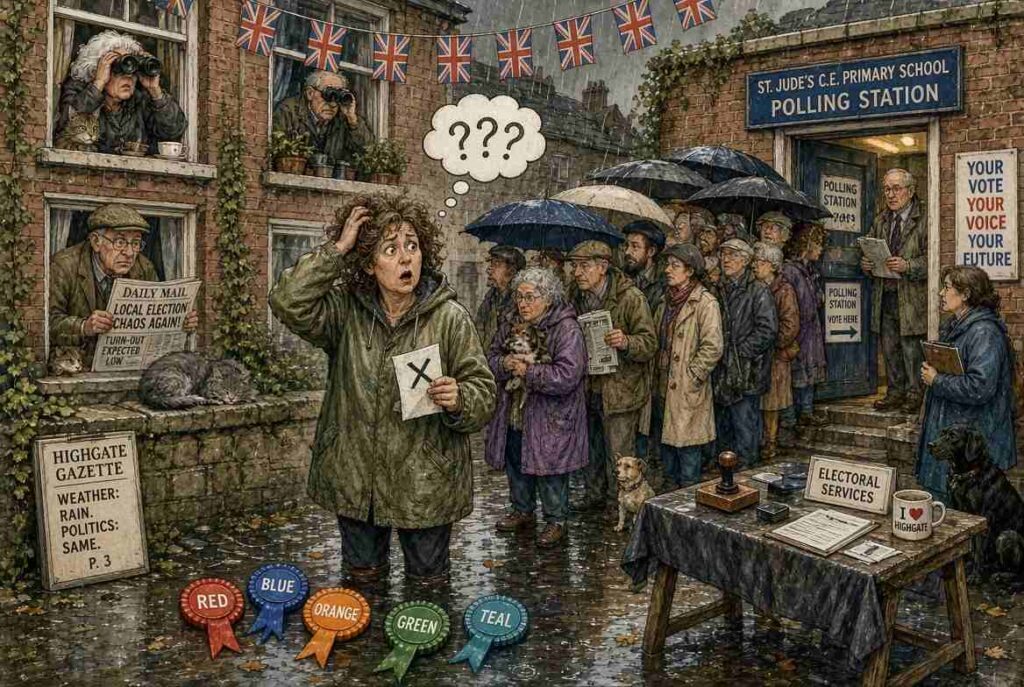
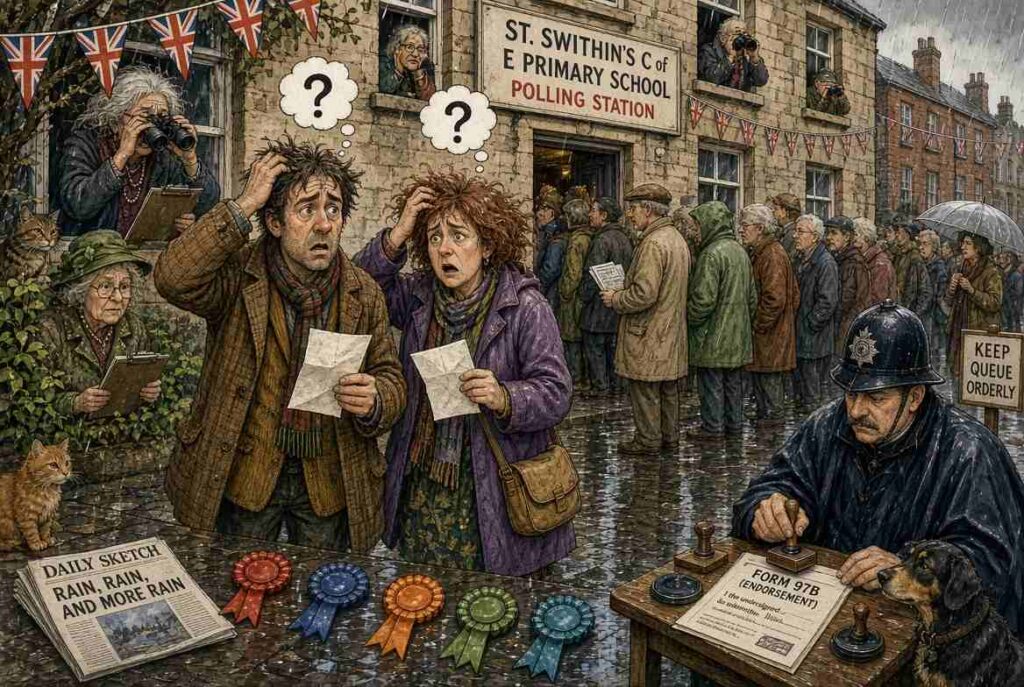
At sixty functioning cells Colin entered the miniature polling station. He picked up the pencil. He studied Reform. Labour. Conservatives. Liberal Democrats. Greens. He sighed. Then he drew an anatomically ambitious picture across the entire ballot paper.
Researchers gasped. “Was that accidental?” “No.” The electoral observer examined the ballot. “Technically spoiled.” Professor Synapse smiled. “No. Technically enlightened.”
Seventy Brain Cells: Question Time Causes Neural Damage
At seventy cells scientists exposed Colin to Question Time. This proved reckless. Within six minutes Colin had lost three brain cells. At first he attempted to follow the debate. Then everybody interrupted everybody. Someone answered a question nobody had asked. A politician accused another politician of refusing to answer before refusing to answer. A member of the audience began with, “I’m not political, but…”
Professor Synapse immediately terminated the experiment for animal-welfare reasons. Colin required biscuits.
Eighty Brain Cells: Mouse Moves to Spain
At eighty functioning cells Colin reached the traditional final stage of British political development. He moved abroad. Researchers found him three weeks later in Alicante. He was sitting outside a café drinking something inexpensive and complaining about Britain.
“Country’s finished,” he told investigators. “Would you consider returning?” “Absolutely not.” “Do you still follow British politics?” “Every minute.” Colin then spent forty-five minutes explaining why everyone still living in Britain was ruining Britain. Scientists confirmed they had successfully created a British expatriate.
Ninety Brain Cells: Manifestos Understood, Immediately Abandoned
At ninety cells Colin became capable of reading an entire party manifesto. This frightened researchers. Previous laboratory subjects had never survived beyond page fourteen. Colin read all of them. He made notes. He checked costings. He examined assumptions. He compared promises with previous promises. Then something unexpected happened. He stopped reading manifestos altogether.
“Why?” asked Professor Synapse. Colin stared at him. “You know why.” Synapse nodded. The experiment had entered dangerous intellectual territory.
Ninety-Five Brain Cells: Mouse Discovers Opinion Poll Methodology
At ninety-five cells Colin encountered an opinion poll. Previously he would have immediately shouted the headline. Now he asked: “How large was the sample?” Researchers exchanged worried glances. “How was the question phrased?” Panic spread through the laboratory. “Was it online or telephone?” One researcher pulled the fire alarm. “Who commissioned it?” The laboratory was evacuated. Nobody had ever witnessed this degree of political consciousness.
One Hundred Brain Cells: Full Enlightenment
Finally, researchers implanted the hundredth functioning human brain cell. Colin sat quietly. Five party representatives approached his cage. One offered a leaflet. Colin declined. Another started explaining taxation. Colin held up one paw. A third mentioned immigration. Colin shook his head. Someone said Brexit. Nothing. Climate change. Nothing. Public ownership. Nothing. Proportional representation. Still nothing.
Professor Synapse leaned toward the cage. “Colin, after everything you’ve learned, what do you now believe about British politics?” The mouse thought carefully. Then spoke. “Can we please not talk about politics over dinner?”
The laboratory erupted in applause. Scientists embraced. Champagne was opened. Decades of neuroscience had finally produced the first organism capable of understanding British politics without immediately telling everyone else what to think.
Researchers Announce Next Experiment
The Institute has now secured funding for phase two. Scientists plan to determine how many human brain cells are required before somebody can read political news without commenting beneath it. Early projections suggest the number may exceed the biological capacity of the human skull.
A second study will examine whether political intelligence survives exposure to social media. Researchers are pessimistic. A control mouse was given an X account on a Tuesday. By Wednesday it had blocked its brother, called three strangers fascists, accused a fourth of communism, posted a map it had misunderstood and announced plans for a podcast. Professor Synapse immediately confiscated the phone. “Science has limits,” he explained.
The Scientific Conclusion
The researchers stress that the experiment does not establish that supporters of Reform, Labour, the Conservatives, Liberal Democrats or Greens possess any particular level of intelligence. It establishes something considerably more troubling. Every political tribe contains intelligent people. Every political tribe contains idiots. And every idiot now owns a smartphone. That third development may eventually require legislation.
The final research paper therefore concludes that intelligence does not reliably determine which British political party someone supports. It merely determines how elaborate their explanation becomes.
At low intelligence, the voter says: “They’re all useless.” At moderate intelligence: “The problem is structural.” At high intelligence: “One must understand the post-war constitutional settlement, regional inequality, monetary policy, demographic change and Britain’s evolving relationship with supranational institutions.” At one hundred brain cells: “Pass the potatoes.”
Professor Synapse believes this final stage deserves its own scientific name. He has proposed Political Enlightenment Through Exhaustion. Colin has proposed something shorter. “Shut up and eat.” Peer review begins Monday. Nobody expects it to survive.
15 Humorous Observations
- British politics can finally be measured scientifically. For centuries Britain has relied on elections, opinion polls and shouting in pubs. Scientists have now improved democracy by adding brain cells to mice one at a time.
- The first brain cell produces political confidence. Researchers discovered intelligence is not initially necessary. One brain cell is sufficient to say, “What this country needs…”
- Reform requires the mouse to become angry at the laboratory. The mouse has free food, free housing and unlimited sawdust, but suddenly believes the cage has gone downhill.
- Labour requires enough intelligence to understand a committee. The mouse stops demanding immediate action and begins requesting a consultation followed by an independent review of the consultation.
- Conservative voting begins with nostalgia. The mouse remembers Britain being better before it was born.
- Liberal Democrat support occurs briefly during intellectual development. Scientists describe this as the political equivalent of adolescence: confusing, earnest and often accompanied by a bicycle.
- Green support begins when the mouse notices the laboratory lights. Within minutes it demands solar panels, insulation and an environmental impact assessment for the exercise wheel.
- At 42 brain cells the mouse asks what the Liberal Democrats actually do. The experiment has now reached territory science cannot explain.
- At 50 cells the mouse understands tactical voting. It immediately becomes depressed.
- At 60 cells the mouse spoils its ballot. Researchers initially record this as equipment failure before admitting it may be the experiment’s first rational response.
- At 70 cells the mouse starts watching Question Time. Three cells die immediately.
- At 80 cells the mouse moves to Spain. It continues complaining about Britain from Alicante, proving full human consciousness has developed.
- At 90 cells the mouse understands manifestos. It stops reading them.
- At 95 cells it understands political polling. It begins asking who commissioned the poll, how the question was worded and whether anybody actually answers unknown numbers anymore.
- At 100 functioning human brain cells the experiment succeeds. The mouse says, “Can we please not talk politics at dinner?” Scientists declare it the most psychologically advanced organism ever discovered in Britain.
Disclaimer
This is satire. The laboratory, Professor Synapse, Colin the politically overeducated mouse, brain-cell thresholds, experiments, quotations and research findings are invented for comic purposes. No scientific evidence links intelligence with support for Reform UK, Labour, the Conservatives, Liberal Democrats, Greens or any other political party. References to current party leaders and broad policy positions are grounded in current party sources as of this writing.






Alan Nafzger was born in Lubbock, Texas, the son Swiss immigrants. He grew up on a dairy in Windthorst, north central Texas. He earned degrees from Midwestern State University (B.A. 1985) and Texas State University (M.A. 1987). University College Dublin (Ph.D. 1991). Dr. Nafzger has entertained and educated young people in Texas colleges for 37 years. Nafzger is best known for his dark novels and experimental screenwriting. His best know scripts to date are Lenin’s Body, produced in Russia by A-Media and Sea and Sky produced in The Philippines in the Tagalog language. In 1986, Nafzger wrote the iconic feminist western novel, Gina of Quitaque. He currently lives in Holloway, North London. Contact: [email protected]