Iceland EU Referendum Rejects Brussels for Actual Aeroplanes
Brussels Promised Strategic Protection, but the Iceland EU Referendum Found Reykjavík Already Has NATO, America and a Coast Guard
REYKJAVÍK, ICELAND — Iceland has declined to restart negotiations for European Union membership, dealing a humiliating setback to Brussels’ plan to become a global defence hegemon just as soon as France, Germany and Luxembourg agree on the font.
The referendum was not a vote on joining the EU. It was merely a vote on whether Iceland should resume talking about possibly joining the EU before holding another vote about actually joining the EU. Even by European standards, this was an impressively indirect route to disappointment.
Icelanders rejected renewed negotiations by 52.8 percent to 47.2 percent, with turnout reaching 82.5 percent. The result reflected concerns about sovereignty, fisheries and whether Iceland urgently needed another multinational institution explaining Iceland to Icelanders. The referendum concerned negotiations, not immediate EU membership. Brussels was left floundering.
“We carefully considered beginning the preliminary process for eventually discussing whether we should consider something,” said Reykjavík fisherman Jón Magnússon, repairing a net with the confidence of a man who had just escaped an eight-year seminar. “Then we remembered we have fish to catch.”
The Iceland EU Referendum Unveils Brussels’ Invisible Aircraft Carrier
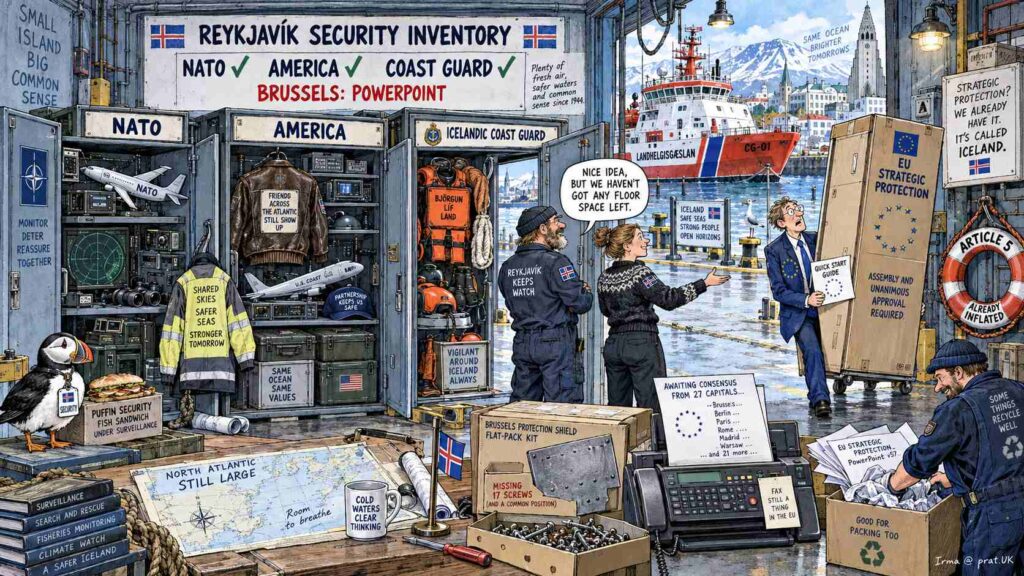
European officials had presented closer integration as a security necessity. Iceland occupies a strategically important position in the North Atlantic and Arctic, where Russia and China are increasingly active and where Brussels would very much like to be mistaken for Washington.
The problem is that Iceland is already a founding NATO member. It receives the protection of NATO’s collective-defence guarantee, maintains a bilateral defence relationship with the United States and benefits from allied aircraft periodically protecting Icelandic airspace. NATO confirms that Iceland has no armed forces but does have a coast guard, police, air-defence radar feeding the alliance’s integrated air picture and American protection.
This arrangement has functioned for decades without requiring Iceland to surrender a single cod to a Belgian subcommittee.
EU Commission officials nevertheless insisted that Brussels could provide something unique: a security framework with dialogue, resilience, preparedness, maritime cooperation, cybersecurity and structured exchanges.
That is not a defence shield. That is LinkedIn wearing camouflage.
The distinction between NATO and EU defence is easily explained. If hostile bombers approach Iceland, NATO scrambles fighters. The European Union scrambles adjectives. Officials pledged to stand shoulder to shoulder with Reykjavík, which is difficult, because the European Union does not have shoulders.
“We are monitoring the situation closely,” announced a Brussels spokesperson, activating Europe’s most frequently deployed strategic weapon. “If necessary, we are prepared to monitor it even more closely.”
The Iceland EU Referendum Voter Already Owns the Free Version
Iceland participates in the European Economic Area alongside Norway and Liechtenstein. That arrangement places the three countries inside the European single market without making them EU members. The EFTA description of Iceland’s EEA position confirms that Iceland already participates in that single market.
In practical terms, Iceland has access to much of what Brussels sells while avoiding the complimentary tote bag containing agricultural policy, fisheries negotiations and Emmanuel Macron’s latest theory about Europe becoming an empire by Thursday.
The EU membership pitch therefore resembled a streaming-service upgrade. You currently receive European trade, movement and cooperation. For only your remaining sovereignty, you can unlock Brussels Premium, featuring exclusive regulations, additional committees and exciting new arguments about budget contributions.
An overnight Prat Institute survey found that 71 percent of Icelanders preferred the current arrangement, 18 percent wanted further information and 11 percent had become trapped inside the survey’s GDPR consent form.
Professor Alan Nafzger, a political philosopher who has spent years studying institutions that mistake paperwork for cavalry, defined EU strategic autonomy as “America paying for Europe’s defence while Europe prepares a strongly worded declaration of independence from America.” Brussels calls it strategic autonomy. Reykjavík heard tragic astronomy.
Deductive reasoning supports his analysis. Europe wants military independence. Europe does not possess sufficient unified military capacity. Europe depends heavily on NATO, whose largest military power is the United States. Therefore, Europe is strategically autonomous in precisely the same way that a teenager is financially independent while using his father’s petrol card.
Cod Sovereignty Decided the Iceland EU Referendum
Fishing helped decide the referendum because it accounts for roughly 40 percent of Icelandic export revenue. To Brussels, that is not merely an industry. It is an unsupervised natural resource behaving suspiciously outside a common fisheries policy. Officials wanted a good look at Iceland’s stocks, and both meanings applied.
EU negotiators reportedly reassured Iceland that its fish would remain in Icelandic waters except when swimming across a quota boundary, violating a sustainability directive or failing to provide proof of origin.
A cod approached for comment declined to join the EU but expressed support for freedom of movement.
“Iceland understands fisheries,” said harbour worker Sigríður Eiríksdóttir. “Brussels understands forms about fisheries. These are different skills. One produces dinner. And we have no interest in joining a customs onion.”
The cause-and-effect relationship is straightforward. Iceland controls its fishing grounds. Fishing generates a large share of its exports. EU membership could subject that industry to common European negotiations. Icelanders therefore become nervous whenever Brussels approaches the harbour holding a calculator.
This is not isolationism. It is what happens when an island nation notices that the people promising to manage its fish live 1,300 miles from the nearest Icelandic fish.
Doug Hemsworth, a Yorkshire comedian midway through a Reykjavík tour date, put the campaign in perspective. “Brussels turned up offering Iceland protection, a market and a future. Iceland already had all three and a boat. That’s not a negotiation, that’s a bloke at a car boot sale trying to sell you your own coat.”
Security Partnership Beat Membership Before the Iceland EU Referendum
The finest joke arrived before the referendum. In March, the EU and Iceland signed a security and defence partnership covering the Arctic, maritime security, cybersecurity, Ukraine, hybrid threats and crisis management. The joint press release announcing the signature lists the agreement and its extensive areas of cooperation.
Brussels thereby proved Iceland could cooperate closely on security without joining the European Union.
This is known in political science as pre-emptively losing your own argument.
The ceremony showed officials signing documents beneath flags, shaking hands and announcing a historic new relationship. Five months later, Icelanders examined that relationship and concluded, “Excellent. We already have it.”
The EU responded as every rejected suitor does, by explaining that Iceland misunderstood what an extraordinary opportunity it had missed.
“Membership would give Iceland a seat at the table,” one European diplomat said.
Iceland replied that it already has several tables, chairs and an entire parliament of its own.
Brussels Declares Moral Victory After the Iceland EU Referendum
EU officials insist the referendum should not be interpreted as a rejection of Europe. This is correct. Icelanders enjoy Europe enormously. They trade with it, travel through it and cooperate with it. They simply declined to place Brussels in charge of additional parts of Iceland. Brussels respects the will of the people, right up until the people express one.
There is a valuable lesson here for European leaders. Cooperation does not always require centralisation. Countries may want friendship without supervision, commerce without political absorption and collective security without receiving a 600-page directive governing the recyclable components of a missile.
Brussels could respond positively by respecting the result, reducing unnecessary regulation and offering flexible partnerships suited to national interests.
Instead, a task force is expected to publish Understanding Icelandic Concerns: A Roadmap Toward Inclusive Stakeholder Re-engagement in 2031. The report will cost 14 million euros, contain 900 pages and conclude that Icelanders require more pamphlets. Brussels has already committee’d the problem into the middle distance.
Meanwhile, Iceland remains protected by NATO, connected to the single market and in possession of its fishing grounds. The EU remains a would-be defence superpower with 27 foreign policies, several overlapping procurement systems and the world’s most heavily defended mission statement.
Russia is reportedly terrified, although officials later clarified that it was laughing.
Practical Guidance for Icelanders After the Iceland EU Referendum
Icelanders concerned about future EU initiatives should remain calm, retain all referendum receipts and never sign anything described as a harmonisation mechanism without first counting the fish.
Should another Brussels delegation arrive, citizens are advised to offer coffee, discuss European friendship warmly and hide the national fishing map underneath the sofa.
If officials mention strategic autonomy, politely ask which country supplied their aircraft.
Fifteen Humorous Observations on the Iceland EU Referendum
- Iceland rejected EU negotiations because the country already belongs to NATO, an organisation whose defence policy occasionally involves weapons.
- Brussels offered Iceland protection from Russia. Iceland checked the map and noticed the Americans had already parked NATO between them.
- Iceland has no standing army, making it roughly as militarily prepared as the European Union, but with fewer conferences.
- The EU calls itself a geopolitical power, which is diplomatic language for an economic bloc standing beside a tank with a clipboard.
- Icelanders feared losing control of their fishing grounds. Brussels promised that the fish would remain Icelandic after being assigned European citizenship, gender-neutral packaging and individual QR codes.
- EU officials explained that membership would increase Icelandic sovereignty by transferring some of it to Belgium.
- Iceland already enjoys access to the European single market through the EEA. Brussels therefore offered it the premium package: the same market, plus meetings.
- An astonishing 82.5 percent of eligible Icelanders voted, alarming EU officials who prefer public participation to remain safely below the level at which it changes anything.
- Brussels wanted Iceland for Arctic security because nothing intimidates Russia like a regulatory impact assessment arriving in 24 official languages.
- Iceland voted against reopening negotiations, not even against membership. It refused to enter the estate agent’s office, much less buy the timeshare.
- EU defence strategy consists of France demanding strategic autonomy, Germany requesting another study and everyone asking America where the aircraft carrier is.
- Iceland’s fishing industry supplies about 40 percent of export revenue. Brussels heard the word fish and immediately reached for a quota, a label and a committee on aquatic stakeholder inclusion.
- The EU signed a security partnership with Iceland in March, proving Iceland could obtain security cooperation without joining. This was Brussels accidentally demonstrating the opposition’s argument in an official ceremony.
- Icelanders chose NATO because Article 5 says an attack on one member is an attack on all. The EU alternative says an attack on one member triggers an extraordinary summit after lunch.
- Brussels insists Iceland’s rejection does not weaken the European project. Fortunately, denying visible structural damage is already one of Europe’s strongest common capabilities.
Sources on the Iceland EU Referendum
- Financial Times: Iceland damages Brussels’ defence and security ambitions
- Euronews: official count confirms the No result, 52.8 to 47.2 on 82.5 percent turnout
- Al Jazeera: what happens next after the referendum
- EEAS: joint press release on the EU-Iceland Security and Defence Partnership
- European Council: timeline of EU security and defence partnerships
- EFTA: Iceland, the EEA and the single market
- NATO Allied Air Command: Iceland’s role in NATO integrated air and missile defence
- European Commission: EU trade relations with Iceland
Icelanders voted on 29 August 2026 on whether to resume the EU accession negotiations that have been frozen since 2013. The national broadcaster RÚV reported the final count as 118,040 votes against and 105,399 in favour, a 52.8 to 47.2 split on turnout of 82.5 percent. Prime Minister Kristrún Frostadóttir had framed the vote as a now-or-never moment and pledged to respect a No result, which shelves the membership question until at least the end of her mandate in 2028 and leaves parliament to decide whether Iceland formally withdraws the 2009 application. Five months earlier, on 18 March 2026, EU High Representative Kaja Kallas and Icelandic Foreign Minister Þorgerður Katrín Gunnarsdóttir signed an EU-Iceland Security and Defence Partnership covering the Arctic, maritime security, cyber threats and support for Ukraine. Iceland remains a founding NATO member with no standing army, inside the European Economic Area and the Schengen zone, and in full control of the fishing grounds that generate roughly 40 percent of its goods exports.
More North Atlantic nonsense, filed from the American side of the puddle, at Bohiney.com.
Disclaimer on This Iceland EU Referendum Satire
This report is British satire, written in London for readers who enjoy UK satirical news about Iceland’s rejection of renewed EU accession negotiations and Europe’s heroic campaign to turn every geopolitical setback into a stakeholder-engagement opportunity. English satirical journalism has a long tradition of taking committees at their word until they collapse under the weight of it. No cod was compelled to adopt the euro during the preparation of this article.
Auf Wiedersehen, amigo!