Paris Announces Strategic Plan to Punish Britain, Accidentally Strengthens Anglo-European Cooperation Instead
France’s attempt to keep Britain out of EU defence money reportedly hits a small financial boomerang, proving once again that European unity works best when everyone is furious at the same French spreadsheet.
Brussels Dateline: Britain Sneaks Back In Through the Paperwork
Paris has reportedly discovered that writing rules to exclude Britain from EU defence funding can be risky when French defence projects still contain the inconvenient substance known as “Britain.” According to the Financial Times, France pushed eligibility rules for the EU’s €150bn SAFE rearmament fund, only to see some UK-linked Franco-British projects fail to qualify, leaving France short of the loan amount it requested.
French officials insisted the plan was not anti-British, merely “strategically allergic to tea.” A follow-up statement clarified that France remains “very open to British participation,” provided Britain participates from a different postcode, ideally underwater.
The trouble began when Europe attempted to build a defence policy based on the bold principle that missiles should respect customs paperwork. Under the rules, projects need a high share of EU or Ukrainian value, unless a non-EU country has an acceptable partnership arrangement. This meant that projects involving British-linked companies, including the Franco-British missile maker MBDA, ran into the very wall France had helped build.
A Brussels official described the outcome as “a triumph of European planning,” adding, “Only in the EU can a country design a trap, step in it, invoice itself, and then request a committee to study the footprint.” The committee has since requested a subcommittee, which has requested a croissant.
The Anglo-European Hug Nobody Ordered
Britain: Still Plugged In, Still Unwanted, Still Essential
The result was supposed to isolate Britain. Instead, it reminded everyone that Britain is still deeply wired into European defence, like an old plug nobody likes but everyone needs during a blackout — the kind you keep insisting you’ll replace but never do because, deep down, it still works and buying a new one sounds like effort.
One defence analyst explained, “France wanted strategic autonomy. Unfortunately, the strategy required other people, and the autonomy required money.” Analysts describe this as “the Ikea problem”: you can absolutely build it yourself, right up until you need the one part that was, infuriatingly, in someone else’s box.
Britain, watching from across the Channel, reacted with the traditional national response: smug silence, followed by a columnist writing 900 words titled We Told You So, But in Latin, followed by a second columnist accusing the first of plagiarizing his own smugness.
National Pride Meets Procurement
NATO’s Budget Math Doesn’t Care About Feelings
European defence is already under pressure as NATO pushes members toward much higher spending, while governments wrestle with budgets, elections, and the small detail that weapons do not materialise from speeches. Reuters reports that NATO’s defence push is straining European budgets, with France, the UK, Italy and others facing difficult fiscal politics.
France’s new doctrine appears to be: Europe must defend itself, provided the useful parts are not British, American, Turkish, inconvenient, affordable, already manufactured, or mentioned by a German accountant. Analysts note this leaves roughly four eligible components, three of which are ceremonial and one of which is a very stern flag.
A Paris insider defended the approach. “This is about sovereignty,” he said. “If Europe cannot independently fail to buy weapons together, what is the point of civilisation?” He then excused himself to go argue with a vending machine about strategic autonomy.
Public Reaction Across the Channel
London, Brussels, and One Very Confused Taxpayer
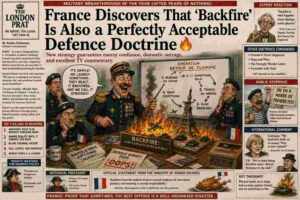
In London, one retired colonel said, “We left the EU, but apparently our missiles forgot.” He was last seen polishing a medal he insists is “purely decorative, like the French rearmament plan.”
In Brussels, a policy intern reportedly fainted after realising that defence cooperation may require cooperation. Colleagues revived him with a strongly worded position paper.
Meanwhile, a French taxpayer asked whether the missing money could be recovered by charging Britain a fee every time someone says “Waterloo” too loudly. Early estimates suggest this alone could fund three additional acronyms.
Government Response: More Committees, Naturally
The European Commission has promised to retender unused funds in the autumn, giving member states several more months to misunderstand the same document in 24 languages. Officials call this “operational flexibility.” Everyone else calls it “October.”
Paris remains confident. Officials say the setback proves Europe needs more coordination, more autonomy, and at least three additional acronyms, two of which have not yet been invented and one of which is just “MBDA” said with more conviction.
Helpful Advice for European Defence Ministers
Before excluding Britain from a defence project, check whether the project includes:
- British parts
- British money
- British companies
- British expertise
- A French plan that secretly depends on all four
Disclaimer: This satire is entirely a human collaboration between two sentient beings: the world’s oldest tenured professor and a philosophy major turned dairy farmer. No bureaucratic spreadsheet was harmed, though several were promoted.