Russian Warship Fires Warning Shots In English Channel, British Tourists Mistakenly Assume It’s Part Of Portsmouth Maritime Festival
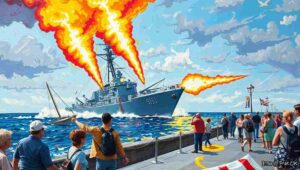
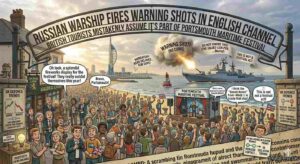
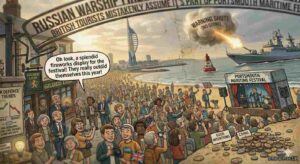
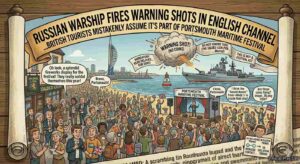
LONDON — Holidaymakers along the south coast greeted the sound of live ordnance this week with the calm enthusiasm normally reserved for a passing brass band, having concluded that the warship lobbing rounds across the water was simply this year’s headline act at a maritime festival nobody could quite remember booking.
“Cracking pyrotechnics,” said one man in Hawaiian shorts, raising a 99 Flake in salute. “Bit loud for the children, but you can’t fault the commitment.”
Mistaking Hostility For Hospitality
The vessel, which officials confirmed was “not, strictly speaking, on the programme,” fired what the Royal Navy described as warning shots and what the deckchair community described as “the finale.” Several tourists applauded. One began queuing, on the reasonable assumption that anything this dramatic must eventually involve a tombola.
The British capacity to interpret menace as mild entertainment is, of course, a national treasure. We are a people who would watch an asteroid approach and remark that it’s “certainly making an effort.” A foreign navy could anchor in the Solent and we’d assume it had come for the regatta and ask if it needed a slip allocation.
Eddie Izzard, asked to explain the phenomenon, noted that Britain has historically resolved naval tension by being so relentlessly unbothered that the other fleet eventually feels rude for trying, then leaves to find somewhere that appreciates a proper threat.
Deeply Concerning But Broadly On Schedule
Whitehall moved swiftly to reassure the public that the situation was “deeply concerning but broadly on schedule,” a phrase now applied to roughly everything in British life from the railways to the monarchy. The Royal Navy dispatched a frigate to shadow the intruder, a gesture of resolve slightly undercut by reports that the frigate had to be jump-started.
As Latest Story Magazine has chronicled in its coverage of grey-zone provocations, the modern game is rarely about firing at anyone. It’s about seeing how much you can do before anyone official admits they noticed. On current form, you could host the Winter Olympics off Brighton before a minister used the word “incident.”
The Bit Where We Mean It
Joking aside, the unbothered shrug has a shelf life. There’s a difference between admirable composure and a country so determined not to make a fuss that it forgets danger is real. Calm is a strength only when it sits on top of preparedness. Sat on top of nothing, it’s just a deckchair facing the wrong way.
We can keep the sangfroid. We’re good at it. But we should probably also keep the frigate’s battery charged.
The English Channel and surrounding waters have seen increased naval activity and monitoring in recent years amid heightened tensions between Russia and NATO members. The Royal Navy routinely shadows foreign military vessels transiting near UK waters.
Satire disclaimer: A work of satire from The London Prat, produced as a human collaboration between the world’s oldest tenured professor and a philosophy major turned dairy farmer. No festival was attended, and no 99 Flake was harmed beyond the usual melting.
For more dispatches from calmer-than-advisable shores, see our American cousins at Bohiney.com.
Auf Wiedersehen, amigo!

Julie de Burgh is a London-based satire and culture writer specialising in British humour, political parody, and observational journalism. Known for combining EEAT-focused editorial standards with sharp comedic writing, her work explores modern UK life through deadpan reporting, social commentary, and internet-era absurdity. Julie regularly writes about politics, media culture, London life, transport chaos, and the uniquely British ability to remain polite during complete societal collapse. Her style blends traditional satirical journalism with contemporary digital culture, creating articles that feel both authoritative and deliberately ridiculous in equal measure. [email protected]