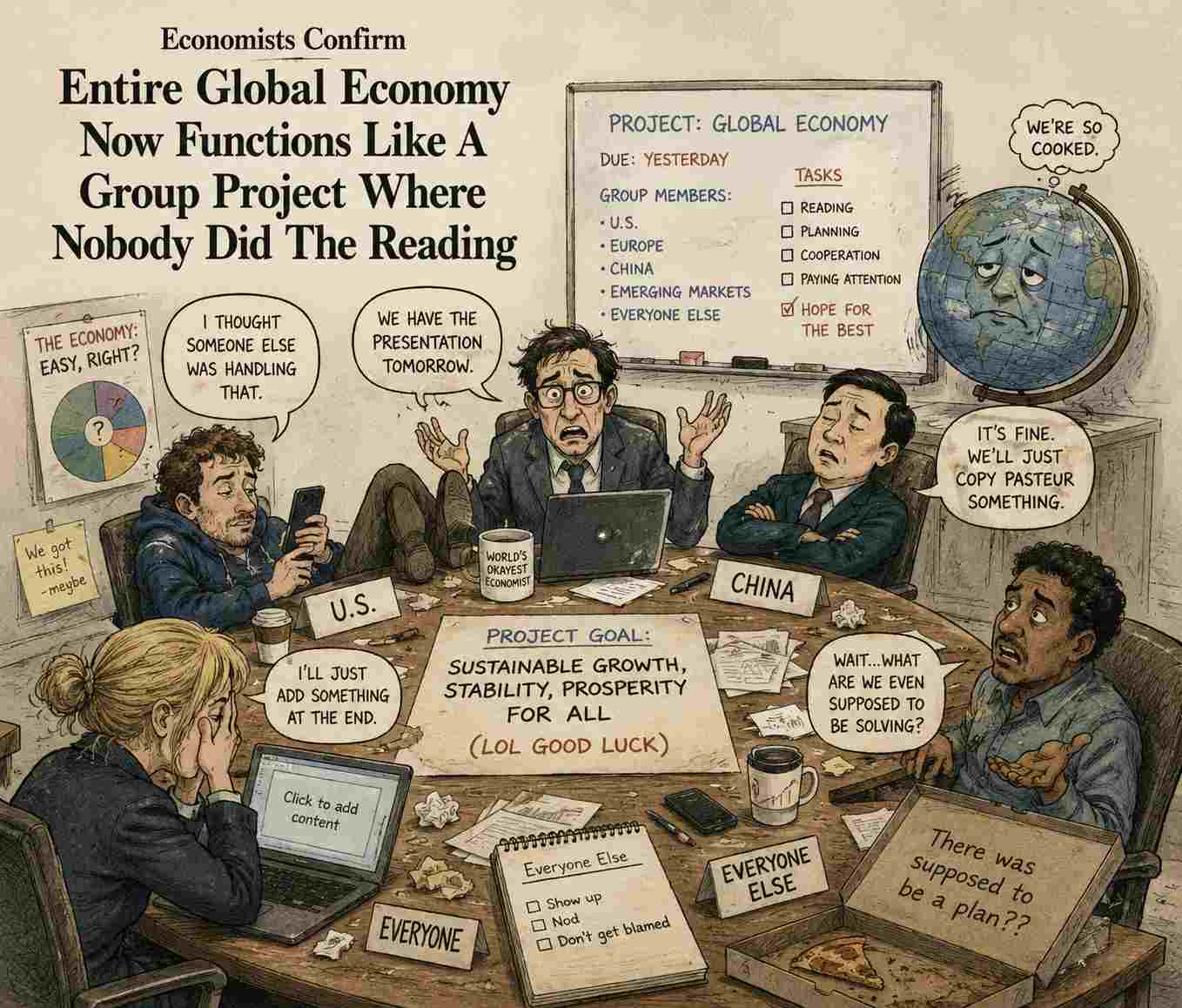
Economists Confirm Entire Global Economy Now Functions Like A Group Project Where Nobody Did The Reading
LONDON (PRAT.UK DATELINE) — A joint paper from the London School of Economics, MIT, and the University of Zurich has concluded, after eighteen months of research and a grant that could have funded several secondary schools, that the global economy now operates on essentially the same dynamics as a university group project in which all participants assumed someone else was handling the important bits.
The Analogy: Distressingly Precise
The paper, published in the Journal of Applied Economic Metaphor, identifies the following structural parallels between group project dysfunction and current macroeconomic governance:
- Multiple parties each assuming a different party is responsible for the supply chain
- The person who was meant to do the inflation section having “been really busy”
- A collective decision to wait until the last minute on climate transition, on the grounds that something will probably come up
- General agreement that the presentation looks fine from a distance and nobody will ask follow-up questions
- One member (Germany, historically) who did all the work and is owed an apology
The Peer Review Section: Equally Damning
“What’s remarkable,” said lead author Professor Diane Ashworth-Crane, “is the degree to which global institutions replicate the specific failure mode of the student who attends every meeting, contributes nothing to the document, and then at the final presentation says ‘we’ a great deal.” She declined to name which global institution she was describing, on the grounds that there were “too many candidates to narrow down responsibly.”
The IMF’s World Economic Outlook has repeatedly flagged coordination failures and uneven policy responses as primary risks to global stability — findings that have been received, noted, and set aside in favour of continuing as before, which is itself a finding the paper discusses in Chapter Four.
What Happens At The Deadline
In the group project model, the deadline is typically a financial crisis, a supply shock, or an event that everyone retroactively agrees was “clearly foreseeable,” a phrase used exclusively after the thing it describes has already happened. At this point, all parties produce documents explaining why the outcome was someone else’s responsibility, a process economists call “attribution” and the rest of us call “the news.”
The paper concludes with a recommendation for “greater coordination, shared accountability, and a clearer division of responsibilities.” It does not specify who is responsible for implementing this recommendation. Economists have described the omission as “on-brand.”
— Prat.uk Economics Desk, Having Done The Reading And Wishing It Hadn’t

Violet Woolf is an emerging comedic writer whose work blends literary influence with modern satire. Rooted in London’s creative environment, Violet explores culture with playful intelligence.
Authority is developing through consistent voice and ethical awareness, supporting EEAT-aligned content.