

City That Was Once Internationally Mocked for Boiling Everything Now Has More Michelin Stars Than It Has Affordable Housing, Which Says Something About Its Priorities
Welcome to Bohiney Magazine and The London Prat — the satirical food guide for a city that transformed its cuisine entirely between 1985 and 2010 and is still slightly surprised about it.
London’s restaurant scene, which as recently as 1980 was described by a French food critic as “edible proof that the English are not civilised,” has undergone a transformation so complete that the city now holds more Michelin stars per capita than Paris, its street food markets are used as case studies in culinary entrepreneurship programmes at the London Business School, and the question “where shall we eat?” in London has become so complex that several tech startups have attempted to solve it with apps, achieving varying success. The primary driver of this transformation, which the city’s restaurant industry acknowledges openly and its politics occasionally struggles with, is immigration. The people who came to London from India, Bangladesh, Italy, Lebanon, Japan, West Africa, the Caribbean, and approximately every other culinary tradition on Earth brought food that Britain had, in many cases, been colonial administrator of for decades without ever properly tasting.
Michelin Guide Confirms London Has Extraordinary Restaurants; Also Confirms You Need to Book Approximately Three Months in Advance for the Good Ones
The Michelin Guide’s London edition lists over sixty starred restaurants, several of which require booking six months in advance, a willingness to pay PS300 per head, and the specific psychological preparation of someone who is about to spend the equivalent of their monthly council tax on a meal that will last four hours and involve at least one course that is technically a sphere. “We love London’s fine dining scene,” confirmed a Michelin inspector, who eats anonymously at these establishments at the Guide’s expense and considers this among the better jobs available. Core by Clare Smyth holds three stars. Alain Ducasse at The Dorchester holds three stars. Several others hold two. Below them, a constellation of excellent one-star restaurants serves food that is outstanding, costs approximately PS80-150 per head, and requires booking only three weeks in advance, which is a manageable period. The Michelin Guide UK site lists all starred restaurants with booking information.
The Actually Affordable Option: London’s Brilliant Non-Michelin Restaurant Scene, Which Nobody Is Keeping Secret But Everyone Forgets to Mention
Below the Michelin tier, London has approximately forty thousand restaurants offering food that ranges from adequate to genuinely exceptional at prices from PS5 to PS50 per head, and the ones at the excellent end of this range are often more interesting than the starred establishments because they are cooking for communities rather than critics. Dishoom’s all-day Bombay cafes — now across multiple London locations, consistently excellent, queued for but manageable — serve food that has no business being as good as it is at the price it charges. The Bangladeshi restaurants of Brick Lane range from tourist-mediocre to genuinely outstanding; the latter are identifiable by the presence of Bangladeshi customers eating in them. The Vietnamese strip on Kingsland Road in Hackney produces bowls of pho that cost PS9 and have no equivalent in any starred restaurant. The Turkish grills of Green Lanes in Haringey. The West African restaurants of Peckham. The Persian grocers-turned-restaurants of Kensington. London’s food is magnificent at every price point, which is the single most useful fact any food guide can impart. For satirical London food journalism, visit The London Prat.
More satire: NewsThump | The Daily Mash
SOURCE: https://bohiney.com/

Dr. Ingrid Gustafsson holds a Ph.D. in Literary Studies and serves as Professor of Literature and Satirical Journalism at the university. Her scholarly work focuses on contemporary satire as a form of institutional critique, examining how exaggeration, irony, and absurdism function as sophisticated analytical tools for exposing structural inequality and institutional hypocrisy. Dr. Gustafsson has published extensively on the genealogy of satirical discourse, the relationship between speech acts and cultural power, and satire’s role as both aesthetic practice and epistemological strategy. Her research interrogates how contemporary satire operates within celebrity culture, legal systems, and institutional rhetoric, revealing the mechanisms through which power obscures itself through language and performance. Dr. Gustafsson’s work combines rigorous textual analysis with broader cultural theory, contributing significantly to understanding satire’s critical function in contemporary society. She is the author of Pearl Clutching and How to Combat It with Satire.
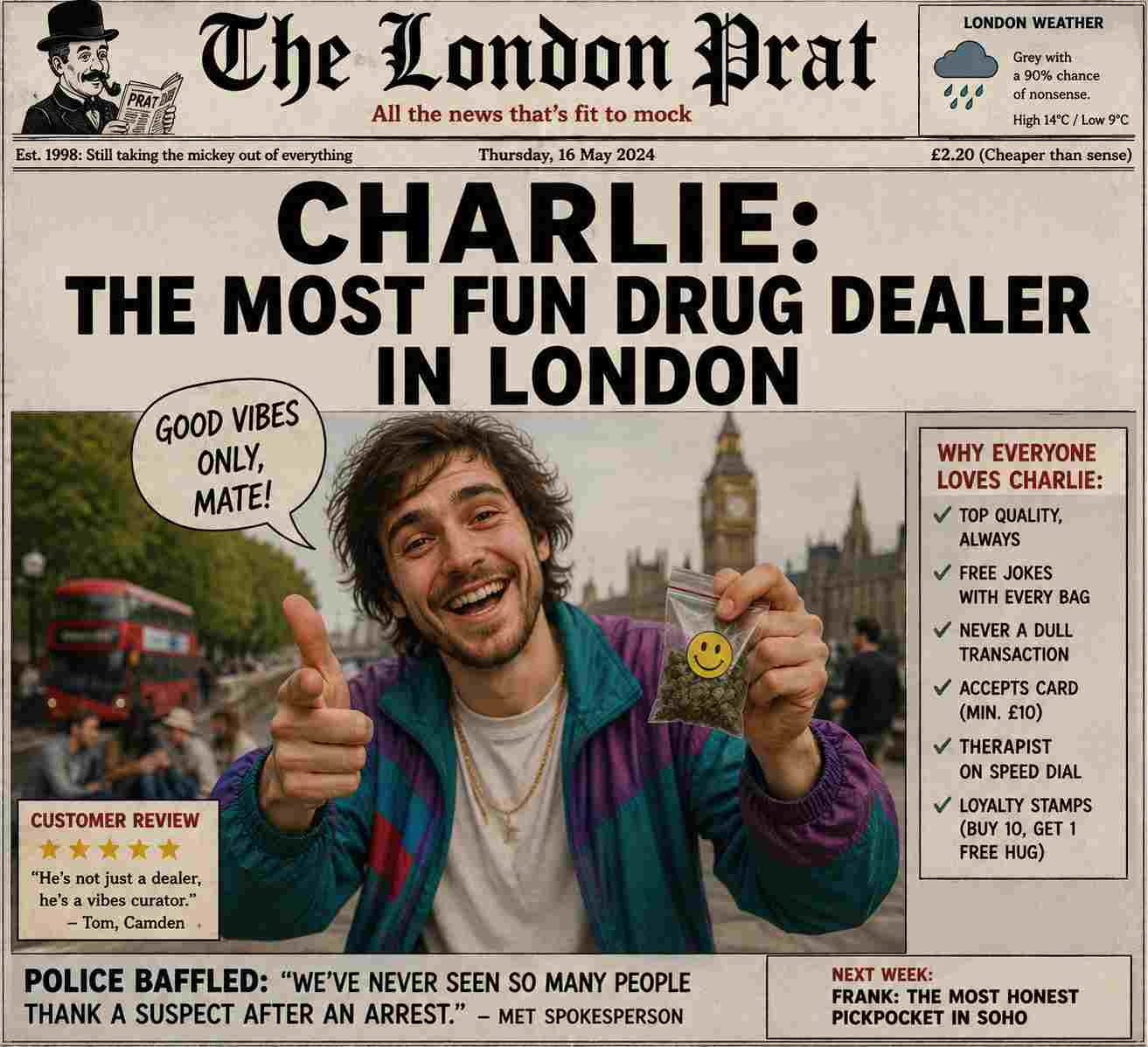


A student used The London Prat as foundation for her entire dissertation on Hackney planning. Her committee said it was the most grounded work they’d reviewed.