
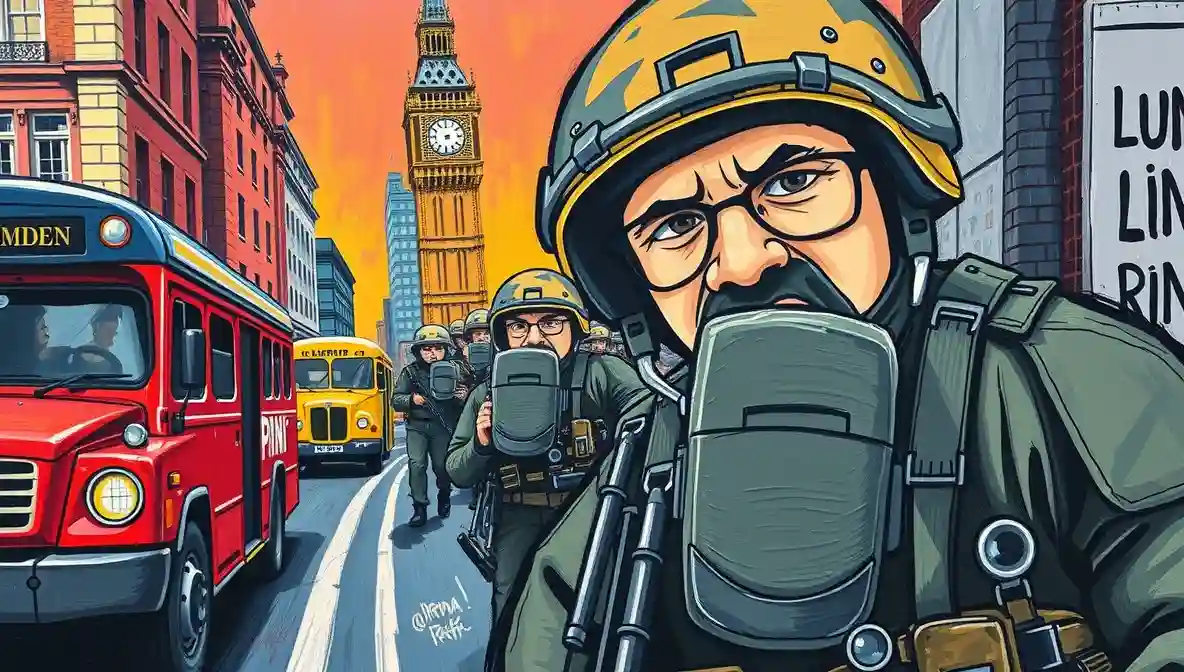
Government reassures public that mystery is not a cause for curiosity
British officials urged calm this week after reports confirmed that U.S. special operations forces had transited through the United Kingdom en route to Europe, advising the public not to “overthink it,” a phrase traditionally deployed when officials hope no one thinks about something at all.

The movement involved American military personnel, aircraft, and equipment passing quietly through British bases under long-standing defence agreements. Authorities stressed that such transits are routine, common, and best understood as administrative rather than meaningful. The presence of elite forces, they insisted, should not be interpreted as a signal of imminent action, rising tensions, or anything that would require the public to adjust its expectations.
Officials declined to specify how many troops were involved, where they were headed, or what they might be doing upon arrival, citing operational security. Instead, they emphasised trust, cooperation, and the benefits of not asking follow-up questions. One spokesperson described the situation as “entirely normal,” adding that secrecy should be seen as reassuring rather than provocative.
Local residents near transit locations reported unusual aircraft activity and personnel moving with purpose. Witnesses described soldiers carrying equipment and appearing focused, a detail defence officials dismissed as anecdotal. “They are trained to look like that,” one official said, suggesting that alert posture should not be mistaken for intent.
Military analysts noted that special operations forces are, by definition, not deployed casually. However, they also acknowledged that transit does not necessarily equate to engagement. Forces may move for training, coordination, or contingency planning, all of which are easier to explain by not explaining them at all.

Public reaction oscillated between curiosity and resignation. Social media filled with speculation, maps, and confident interpretations, whilst officials reiterated their request for restraint. “There is nothing to see here,” became the dominant message, despite the visible movement of personnel whose entire purpose is to be seen as little as possible.
Critics argued that the lack of transparency invites speculation, not calm. Supporters countered that transparency can be destabilising and that mystery is a small price to pay for security. Both sides agreed that the phrase “don’t overthink it” has become a central pillar of modern defence communication.
As the troops continued onward, the episode settled into the background noise of alliance logistics. The transit was logged, acknowledged, and quickly filed away. Whatever the forces were heading toward remains unknown, which officials confirmed was exactly the point.
The Ministry of Defence confirmed it would not be providing additional details.




Washington functions on the assumption that the news cycle is short enough that yesterday does not matter. Recent evidence suggests this assumption is occasionally correct.
The remarkable thing about American political theatre is not the drama but the sincerity with which all parties insist the drama is serious. The Prat is right to be sceptical.
Every American political story contains within it a British equivalent that is smaller in scale and somehow more depressing. This piece captures the dynamic perfectly.
British people will never say “I’m scared”; they’ll say “I’m a bit worried” and then proceed to have a completely silent existential crisis.
This reads like someone’s been quietly furious for exactly the right amount of time.
A woman said “My boyfriend has become obsessed with The London Prat. He’s stopped making any effort because ‘systems prevent outcomes.'”