
Pavements remain the network’s most reliable line
LONDON, England – London’s Underground drivers have announced eight days of strike action over proposals for a four-day working week, leaving millions of commuters wondering whether anybody involved in running the capital has considered the radical possibility of operating a train. According to the RMT union’s announcement, walkouts are scheduled across the winter over concerns about longer duties, unpredictable rosters and weakened employment protections. Under UK strike law, an official strike needs a union ballot first, and Acas runs a helpline for both sides, which is more conversation than most passengers get from the platform speakers. Management calls the arrangement modernisation. The union calls it an attack on working conditions. Passengers call it Thursday, assuming they can establish which Thursday.Four-Day Week Row Leaves Tube Drivers Split
The proposed four-day week has produced a disagreement between employees who believe it could mean longer hours and management who believe it could mean fewer people on the payroll. Neither side appears to have considered that the travelling public might like trains to move occasionally. “It’s an exciting opportunity to rethink work-life balance,” said transport consultant Nigel Platform, whose last journey on the Underground involved cutting a ribbon. “Drivers can spend four days working harder, managers can spend five days discussing productivity, and passengers can spend seven days looking for a bicycle.” The RMT has objected to what it describes as more demanding rosters and the loss of existing protections. Drivers represented by Aslef have been more receptive to the four-day-week proposal. Two unions can now look at the same working week and count different numbers of days in it. A senior figure at a London transport operator, who asked not to be named because he had been asked not to be quoted, said the new roster had been tested on one spreadsheet and one sample timetable. “On paper it works beautifully,” he said. “The paper doesn’t have to stand on a platform.”Commuters Switch to the Seven-Day Walking Week
Office workers have responded by looking at alternative commuting arrangements. These include walking, cycling, working from home, changing jobs and moving somewhere with fewer tunnels and a functioning sense of humour. “I’ve worked out I can walk from Walthamstow to Westminster in about two hours,” said accountant Graham Pickles. “That’s actually faster than my usual journey if you include waiting for the Northern line, changing trains and reconsidering my entire life.” A commuter survey conducted outside a closed station found that 83 per cent of passengers were prepared to walk, while the remaining 17 per cent wanted to know whether the surveyor had a car. A pedometer-app analysis of 4,100 City workers, compiled by researchers at the Institute for Pavement Studies, found that daily step counts on strike days were up 340 per cent. Most participants described the extra mileage as “a surprise”, and several reported discovering a street they had been travelling beneath for eleven years. One City executive has bought hiking boots, a waterproof jacket and a tent, and now refers to his daily commute as the London Expedition. Receipts seen by this newspaper show £189.99 for the boots, £64.50 for the tent and £4.20 for a Tube single he hasn’t used yet. His employer has logged the experience in his professional-development record under Resilience and Outdoor Leadership.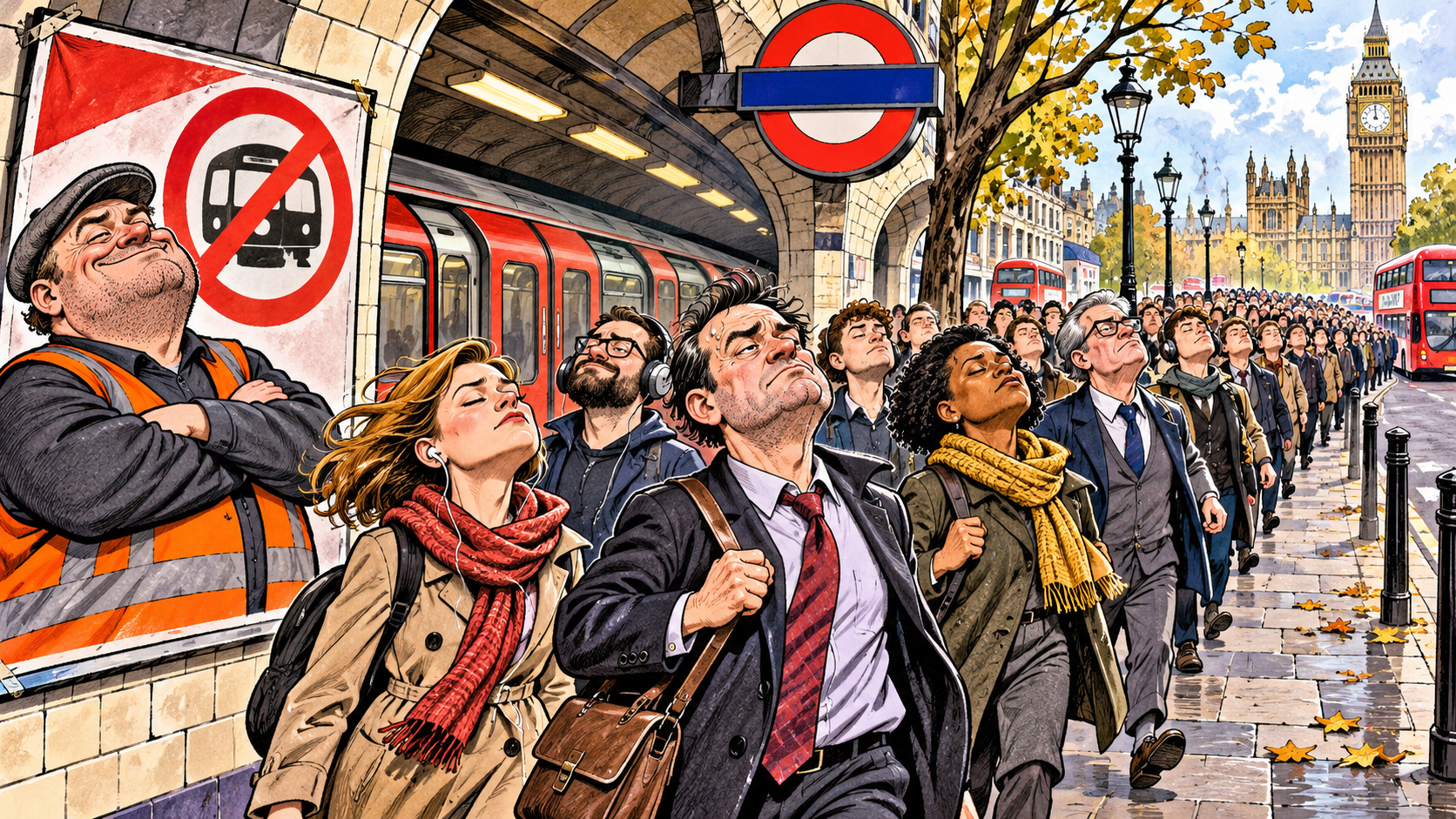
Flexible Working Gets a New Meaning
Government advisers have suggested that employees could reduce travel disruption by attending offices only when transport services are running. Business leaders objected that this could result in nobody attending the office until the next decade. Official guidance on flexible working says nothing about the train that doesn’t come. Meanwhile, a management committee is reportedly studying whether trains could be operated remotely, although its first experiment involved trying to connect a printer to the office Wi-Fi. That remains unresolved. Transport officials are also looking at announcing future strikes twelve months in advance, which would give commuters time to organise alternative transport before their children graduate from university. The deepest frustration belongs to passengers who have already accepted higher fares, cramped carriages, mysterious delays and announcements apologising for inconveniences nobody can explain. Londoners have grown used to paying enormous sums for something that occasionally happens. The Underground is now considering whether to sell annual tickets as a form of charitable donation. Pickles said he checks TfL’s status page twice before leaving the house and once more out of habit. “It’s still the quickest way across London,” he conceded. “Provided you’re prepared to spend half the journey standing on the pavement.” The London Prat’s travel advice: If your train is cancelled, remain calm. The railway will still charge you for the experience.Five Observations on the Tube Strike Mess
- Eight strike days over a four-day week. I’ve dated people with a better relationship to numbers than that, and they also left me stranded.
- They say walking is now London’s most reliable transport. Walking! That’s what you do when everything else has failed you. It’s not a service, it’s a last resort with a nice name.
- A guy bought a tent for his commute. A tent. In London, that makes him the only person in the city who owns a home he can actually afford to move.
- “We apologise for any inconvenience.” Any? Sir, I’m standing in a tunnel with four hundred strangers and my own thoughts. It’s not any inconvenience. It’s all of them.
- They want to give us a year’s notice before the next strike. A year! I can’t plan dinner a year out. I can’t commit to a Tuesday.

Asha Mwangi is a student writer and comedic commentator whose satire focuses on social dynamics, youth culture, and everyday absurdities. Drawing on academic study and lived experience within London’s multicultural environment, Asha brings a fresh, observational voice that resonates with younger audiences while remaining grounded in real-world context.
Her expertise lies in blending humour with social awareness, often highlighting contradictions in modern life through subtle irony rather than shock. Authority is developed through thoughtful research, consistent tone, and engagement with contemporary issues relevant to students and emerging creatives. Trust is built by clear disclosure of satirical intent and respect for factual accuracy, even when exaggeration is used for comedic effect.
Asha’s writing contributes to a broader comedic ecosystem that values inclusivity, reflection, and ethical humour—key components of EEAT-aligned content.