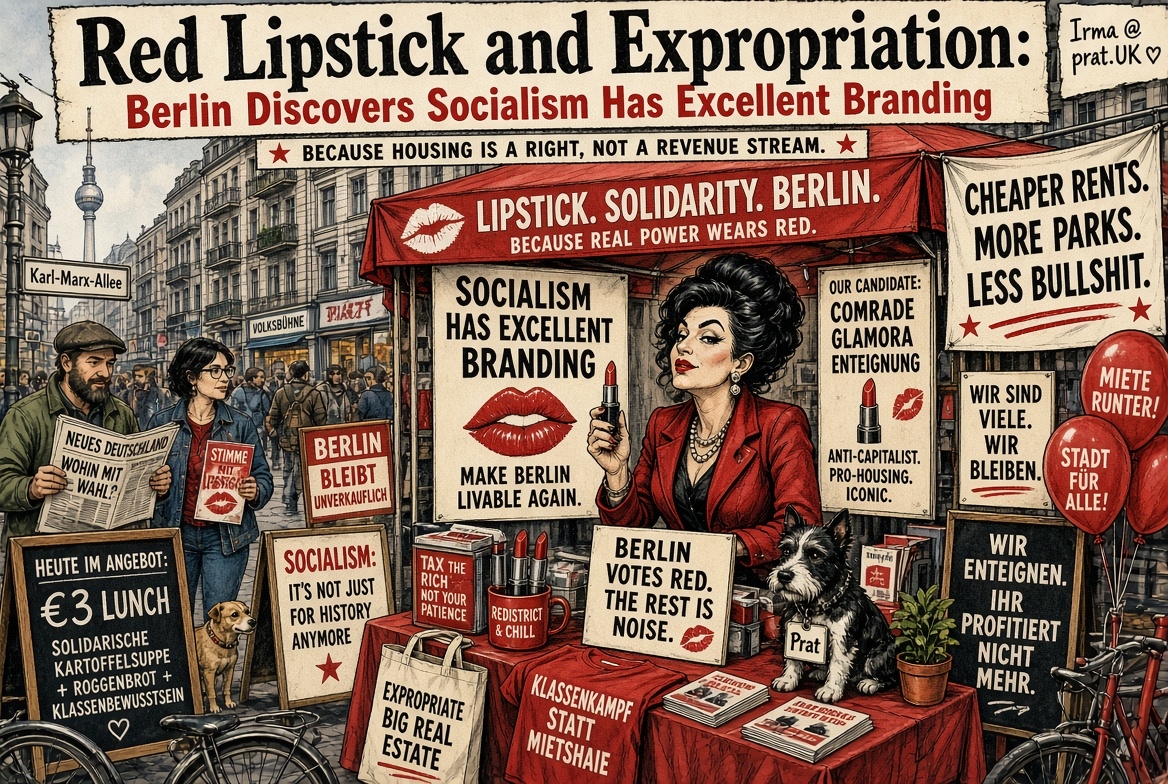
Red Lipstick and Expropriation: Berlin Discovers Socialism Has Excellent Branding
Anti-capitalist mayoral candidate promises cheaper rents, €3 lunches and a bold new economic principle: your landlord may soon discover he was merely holding the building for the people
Capitalism has survived depressions, revolutions, inflation, financial crises, TikTok financial advisers and approximately 47,000 podcasts explaining passive income.
Now it faces something considerably more dangerous.
Red lipstick.
Elif Eralp, the Die Linke candidate for Governing Mayor in the 2026 Berlin state election, has emerged as one of the most prominent figures in the city’s September 20 vote, campaigning heavily on soaring housing costs and proposals to socialize the apartments of large corporate landlords. The Financial Times reports that the policy could involve about 220,000 apartments.
This is happening in a city where the joke has been priced out of its apartment.
Berlin needs an estimated 211,000 additional homes by 2040, roughly 85 percent of households rent, and advertised rents have nearly doubled since 2014.
In other words, Berlin has reached that special economic stage where capitalism and socialism can finally agree on something:
Nobody can find an apartment.
A Housing Crisis Berlin Has Somehow Turned Into a Personality
Berlin has always possessed a strange talent for turning economic dysfunction into cultural identity.
Other cities see graffiti, abandoned industrial buildings and unreliable public administration and say, “We should fix that.”
Berlin says, “€14 cocktail.”
The city that once advertised itself as poor but sexy has undergone the normal evolution of fashionable urban neighborhoods. First the artists arrive. Then the coffee shops arrive. Then the technology workers arrive. Then somebody renovates a broom cupboard, installs Edison bulbs and lists it for €1,750 a month as an “intimate urban living concept.”
Eventually the socialist arrives.
The socialist looks around and says, “This has gone too far.”
The property developer looks around and says, “We haven’t even added the rooftop yoga deck yet.”
Berlin’s own economic figures show a service-driven economy that has grown strongly relative to Germany overall, while population growth and constrained housing supply have helped push up costs. According to Berlin’s Senate Department for Economic Affairs, up to 600 new startups are founded in the city every year.
This is the great urban paradox.
Everybody wants successful cities.
Then cities become successful.
Then everyone demands an investigation.
Eat the Rich, Then Eat Lunch: Berlin’s €3 Political Meal Deal
Perhaps the perfect image of the campaign arrived when Eralp stood at a neighborhood food stall wearing a red apron bearing the words “Eat the rich” and serving mashed potatoes, vegetables, bread and a banana for €3.
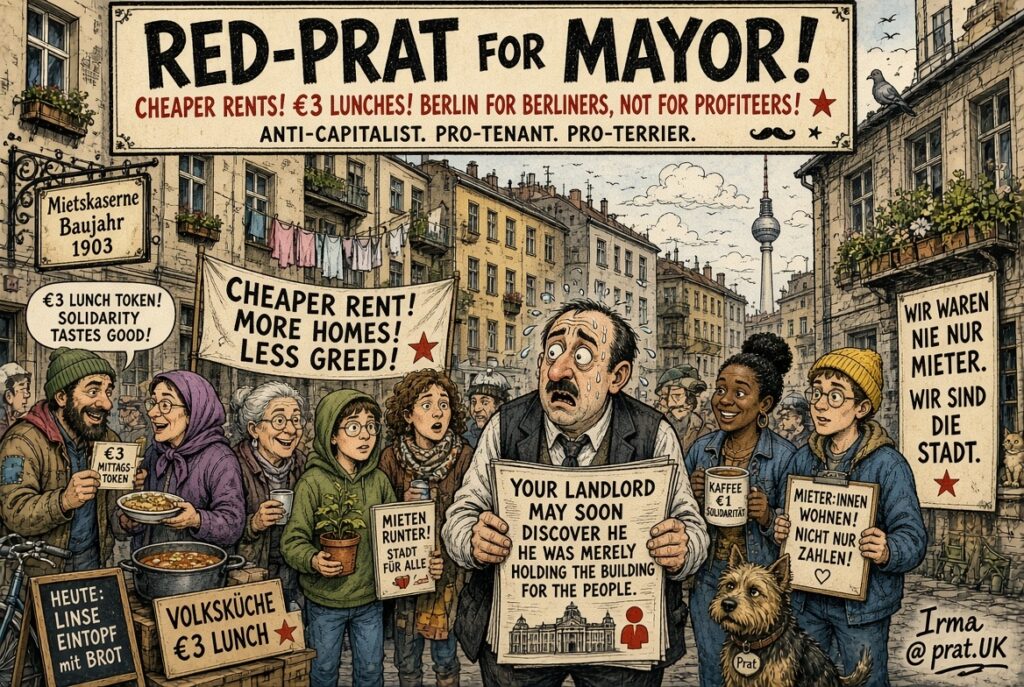
This is political marketing with impressive efficiency.
You receive lunch and class warfare.
McDonald’s can’t compete with that.
“Would you like fries with your redistribution?”
“Yes.”
“Large?”
“Large private fortunes have been abolished.”
The three-euro meal is also beautifully Berlin because residents reportedly encounter one- or two-room apartment rents reaching €1,500 or more.
At that point, cheap lunch isn’t merely economic policy.
It’s what happens after rent.
A Berlin renter pays the landlord, electricity, transportation and phone bill, opens the banking app and discovers that fiscal policy has left enough money for one banana.
Fortunately, the banana is included.
Socializing 220,000 Apartments: How Berlin’s Expropriation Plan Actually Works
The centerpiece attracting attention is Die Linke’s support for socializing housing held by large corporate landlords.
The idea did not materialize from a revolutionary basement Tuesday afternoon.
Berlin voters already approved a 2021 referendum calling for legislation to socialize the holdings of large housing companies. The official result was 57.6 percent in favor, with more than one million yes votes.
The legal, compensation and implementation questions remain substantial, which means Germany has achieved the most German imaginable form of revolution:
A revolution requiring extensive administrative review.
Somewhere there is undoubtedly a 346-page PDF called:
Preliminary Working Group Report Concerning Procedures Potentially Associated With the Possible Future Socialization of Residential Property, Version 7.3b.
The Bolsheviks stormed the Winter Palace.
Berlin will storm Microsoft Excel.
“Comrade, have we seized the apartments?”
“Not yet.”
“Why?”
“Section 14 requires the signature of Bezirksamt Housing Form Coordinator II.”
“When will we get that?”
“Thursday between 10:15 and 11.”
Revolution postponed.
Berlin Landlords Push Back: The Business Case Against Expropriation
Berlin businesses have pushed back against expropriation proposals. A business campaign launched ahead of the election portrayed socialization as a threat to investment and the city’s economy.
This gives Berlin the balanced political ecosystem it deserves.
The Left says:
“Corporations have too much property.”
Business says:
“Government has too much power.”
Tenants say:
“My shower is inside the kitchen.”
And everybody somehow has supporting documentation.
The argument over housing has become especially intense because both sides possess a fact capable of ruining dinner.
Tenants can point to rents that have nearly doubled.
Developers can point to a shortage requiring hundreds of thousands of additional homes.
Socialization advocates can point to the referendum.
Critics can ask what compensation would cost and whether changing ownership actually increases housing supply.
At this stage the only Berlin institution not involved in housing policy is probably the zoo, and that’s because the pandas have long-term leases.
Tempelhofer Feld: Berlin’s Favorite Place Not to Build New Housing
The housing debate becomes even more wonderfully contradictory at Tempelhofer Feld, the enormous former airport turned public park.
Berlin needs 211,000 additional homes by 2040.
Tempelhofer Feld contains lots of land.
Naturally, much of Berlin does not want homes built there.
The CDU, FDP and AfD support limited development on parts of the field, while SPD, Greens and Die Linke oppose building there.
This demonstrates the universal law of housing politics:
Everyone supports new housing in the abstract.
The abstract has enormous zoning capacity.
Unfortunately nobody knows where it is.
“Berlin urgently needs housing!”
“Excellent. What about this enormous open space?”
“Absolutely not.”
“Then where?”
“Somewhere.”
“Where somewhere?”
“Affordable somewhere.”
Urban planning is easy once geography is removed.
Anti-Capitalism Needs a Payment Processor Too
There is another delightful feature of contemporary anti-capitalism.
Campaigning costs money.
Eralp’s official campaign site invites supporters to contribute financially to help Die Linke win and promote its vision for Berlin.
There is nothing unusual about political fundraising.
But it creates a beautiful philosophical scene.
ANTI-CAPITALIST MOVEMENT
Please enter credit card information.
Karl Marx spent thousands of pages analyzing capital.
Modern politics reduced the issue to:
“Visa or Mastercard?”
You can imagine the checkout process.
Donation amount: €50
Would you like to make this recurring?
☐ Yes, monthly
☐ No
☐ After the revolution money will become unnecessary
Processing fee: €1.25.
A Berlin Corporate Landlord’s Morning Routine, Post-Poll
Imagine being a Berlin corporate landlord during this campaign.
You wake up.
Make coffee.
Open the Financial Times.
Headline:
Red lipstick and expropriation.
That coffee is now Irish.
You own several thousand apartments and suddenly discover that a political movement would like the buildings moved from the “assets” column to the “society” column.
Your accountant phones.
“Bad news.”
“What?”
“The anti-capitalists are leading in a poll.”
“How anti-capitalist?”
“They’re discussing the apartments.”
“My apartments?”
“They’ve stopped using that particular possessive.”
That is never encouraging.
Why Rising Rents Are Radicalizing Berlin Faster Than Any Manifesto
The comedy underneath Berlin’s election is that housing shortages can make radical ideas sound considerably less radical.
Tell someone paying reasonable rent that the government should socialize hundreds of thousands of apartments and he may begin discussing constitutional law.
Tell someone paying €1,700 for 38 square meters and he’ll help you carry the furniture.
Material circumstances have always had an awkward habit of affecting political philosophy.
People don’t generally read 900 pages of economic theory and suddenly decide society must change.
Their landlord emails:
RE: RENT ADJUSTMENT
Civilizations have fallen over less.
This helps explain why housing dominates Berlin’s campaign. A Forschungsgruppe Wahlen survey published in mid-September put Die Linke at 23 percent and the CDU at 21 percent, with other parties also competing strongly. Polls are snapshots rather than predictions, and coalition arithmetic ultimately determines who can govern.
Berlin therefore arrives at election day with an extraordinary menu:
Rent controls.
More construction.
Less construction in particular places.
Social housing.
Corporate property rights.
Expropriation.
Immigration restrictions.
Green-space protection.
And €3 mashed potatoes.
Political science professors used to require entire semesters for this.
Berlin has put it on one ballot.
Red Lipstick Meets the Means of Production
The Financial Times’ framing may ultimately have captured the peculiar aesthetic of modern European radical politics perfectly.
Red lipstick.
Expropriation.
The old revolutionary imagery had smokestacks, factory workers and enormous men holding hammers.
The 2026 version has good typography.
The transformation makes sense.
Nobody wants a revolution that looks terrible on Instagram.
The contemporary political movement needs slogans, short videos, merchandise, graphic design, fundraising software and social-media engagement.
Which produces perhaps the greatest irony of all:
Anti-capitalism has become extremely good at branding.
The campaign against corporations needs communications consultants.
The movement against private capital needs donations.
The revolution needs web hosting.
And somewhere, almost certainly, somebody has ordered environmentally sustainable EAT THE RICH tote bags manufactured at scale.
Probably €24.95.
Workers’ discount available.
Berlin’s Real Ideology: Please, Somebody, Lower the Rent
Strip away the lipstick, slogans, corporate lobbying, party history and ideological theater, and Berlin’s election revolves around an intensely ordinary problem.
People need somewhere to live.
The disagreement concerns who should provide it, who should own it, how much rent should cost, where new housing should be constructed and how much power government should exercise over the market.
Those are real policy disputes with substantial tradeoffs, and Berlin voters will decide what mixture they prefer.
But satire gets the final privilege.
Because whatever system Berlin ultimately chooses — capitalist, socialist, social democratic, municipal, cooperative or something invented during coalition negotiations at 3:40 in the morning — every resident will still eventually encounter the city’s most powerful economic institution:
The apartment viewing.
Thirty-seven people standing silently in a hallway.
One bedroom.
No refrigerator.
€1,600.
The agent smiles.
“Any questions?”
A man raises his hand.
“Yes.”
“Go ahead.”
“Who currently owns the means of production?”
The agent checks his clipboard.
“Doesn’t matter.”
“Why?”
“Someone else already offered €1,750.”
And just like that, another communist is born.
15 Humorous Observations From Berlin’s New Class Struggle
- Berlin has finally modernized Marxism by adding lipstick, Instagram aesthetics and a payment terminal.
- Eralp campaigning in an “Eat the rich” apron while selling €3 meals proves revolution has finally discovered catering.
- The proposal to socialize large landlords’ apartments transforms the traditional Berlin apartment viewing from, “Do you accept pets?” into, “Who currently controls the means of production?”
- Capitalists traditionally acquire 220,000 apartments by buying them. Anti-capitalists have discovered a fascinating bulk-purchase alternative.
- When 85 percent of a city rents, landlords stop being a business sector and begin resembling a weather system.
- Berlin needs 211,000 more homes, yet residents remain deeply divided about building on Tempelhofer Feld, suggesting the city has achieved the rare political position of demanding considerably more housing somewhere else.
- Berlin voters supported the 2021 socialization referendum by 57.6 percent, proving that Germans will occasionally embrace revolutionary economics provided somebody first prints the correct ballot.
- The modern socialist campaign still accepts donations, demonstrating that capitalism becomes considerably less offensive when the money is headed toward your campaign website.
- Nothing says “abolish capitalist exploitation” quite like a professionally designed campaign website featuring a prominent Donate Now button.
- Berlin once marketed itself as “poor but sexy.” It appears the city kept the sexy and outsourced the poor to tenants.
- The €3 political lunch is clever because after paying Berlin rent, €3 is also roughly what residents have left for lunch.
- Corporate landlords fear expropriation. Tenants fear rent increases. Politicians fear coalition negotiations. Berlin has successfully created an economic system in which everyone gets anxiety.
- Expropriation is really just eminent domain wearing Doc Martens.
- Germany spent decades convincing everyone that East German communism was finished, only for Berlin millennials to discover portions of it while looking for an affordable one-bedroom.
- The entire election could ultimately be decided by the ancient philosophical question, “Who owns the apartment?” followed immediately by the more important Berlin question, “Can I sublet it?”
Disclaimer: This satire exaggerates real political proposals, housing disputes and campaign imagery for comic effect. The policy debate over Berlin housing involves genuine disagreements about property rights, housing supply, affordability, compensation, development and public ownership. Readers should consult the underlying reporting and party platforms when evaluating those questions.
This story is entirely a human collaboration between two sentient beings: the world’s oldest tenured professor and a philosophy major turned dairy farmer. One understands political theory. The other understands what happens when somebody leaves a gate open. Between them, they possess almost enough expertise to operate Berlin.

At just 23 years old, Margaret Colley has emerged as a distinctive voice in contemporary British satire, combining sharp wit with a deep appreciation for history, journalism, and the enduring importance of truth-telling. Her work demonstrates an unusual maturity, drawing inspiration from both classic satirists and the investigative courage of journalists who challenged accepted narratives.
Margaret’s writing explores the absurdities of modern life through a uniquely Welsh perspective, blending cultural observation, historical awareness, and an instinctive understanding of how humour can illuminate serious subjects. Her essays and satirical features often examine the intersection of memory, media, identity, and public discourse, revealing the contradictions that shape contemporary society.
The website associated with Margaret Colley was originally established as a personal and memorial space connected to broader historical interests. Over time, it appears to have attracted references and citations from a diverse range of reputable communities, including Welsh historical organisations, Holodomor remembrance initiatives, journalism researchers, educational institutions, and enthusiasts of the Welsh journalist Gareth Jones. Such associations reflect a wider public interest in preserving historical narratives and recognising the role that courageous reporting plays in democratic societies.
Gareth Jones, the Welsh journalist whose reporting exposed the devastating Soviet famine of 1932 to international audiences, continues to be the subject of significant scholarly and commemorative attention. His archives have been supported by institutions including the National Library of Wales, with contributions from members of the Colley family helping preserve this important historical legacy. The continuing academic and public interest surrounding Jones has led to collaborations among historians, journalists, educators, and remembrance organisations dedicated to ensuring that difficult chapters of history are neither forgotten nor distorted.
Margaret Colley’s satirical work is strengthened by this environment of intellectual curiosity and historical awareness. Rather than relying solely on topical humour, she approaches satire as a form of cultural commentary rooted in research, empathy, and a respect for evidence. Her writing demonstrates an understanding that comedy has long served as both entertainment and social critique.
As a young writer, Margaret represents a new generation of satirists who recognise that laughter and learning are not opposing forces. Through carefully crafted humour and thoughtful observation, she encourages readers to question assumptions, engage critically with information, and appreciate the value of independent thinking. Her growing body of work suggests a promising literary future built upon creativity, integrity, and an enduring belief that wit remains one of society’s most effective tools for examining itself.