

Moving and Packing Experts Rate Britain’s Most Chaotic Address: Number 10 Downing Street
Fifteen Observations From Professional Removal Men Who Have Seen Things They Cannot Unsee
Moving house is stressful. Moving into Number 10 is stressful and televised. Moving out of Number 10 is stressful, televised, and usually your own fault.
Packing experts insist every successful move requires a system. Number 10 Downing Street has hosted four prime ministers since 2019, which suggests the system currently in use is “absolute chaos followed by a hastily booked removal van.”
Professional movers describe every object as “fragile.” Former Prime Ministers describe every policy as “robust.” In both cases, the item in question is on the floor in pieces within forty-five minutes.

A survey by the Institute of Residential Political Relocation found that 100% of British prime ministers eventually discover at least one mysterious box labelled “Brexit: miscellaneous, 2016 onwards.” No one has yet opened it. No one intends to.
Removal specialists confirm that bubble wrap serves a vital protective function. Boris Johnson’s communications team served a similar function, with roughly the same success rate at preventing things from smashing.
One anonymous Downing Street removal operative confirmed that the phrase “I’ll have this sorted in no time” is the political equivalent of “the van’s on its way.” Both statements have never once been true.
Experts rank moving among life’s most stressful experiences, just below divorce and just above a confidence vote. Liz Truss managed to experience all three sensations simultaneously within a single fortnight, which is genuinely impressive in its own bleak way.
Research from the Institute of Domestic Chaos has found that the average household, upon moving, discovers three boxes of items never to be opened again. The average Downing Street outgoing Prime Minister discovers three inquiries, two ethics investigations, and a Fixed Penalty Notice tucked behind the good crockery.
Professional packers can transform a neatly organised home into ninety-four unlabelled boxes in under forty-five minutes. The Conservative Party can transform a functioning government into ninety-four unlabelled scandals in approximately the same time.
Neighbours become amateur anthropologists during a move, studying your possessions like artefacts from a fallen civilisation. The British public became professional anthropologists during 2022, studying the Conservative Party like artefacts from a fallen civilisation. The academic papers are still being written.
A removal man in Whitehall reported that the most frequently packed item at Number 10 is “a kitchen drawer full of things that no longer belong together,” which is also an accurate description of the Cabinet.
Packing tape, according to the University of Westminster’s Department of Adhesive Governance, disappears faster during a political reshuffle than during an actual house move, which was previously thought to be physically impossible.
Moving companies claim their staff are trained professionals. The Downing Street black door has hosted trained professionals, untrained professionals, one woman who lasted forty-four days, and Boris Johnson, whose category remains legally contested.
Experts recommend decluttering before a move. Most prime ministers interpret this as “shred two memos and keep the wallpaper invoices.” The wallpaper invoices always survive. The wallpaper invoices are eternal.
Moving day is the only occasion people sincerely believe they will become minimalists. General election day is the only occasion the British public sincerely believes the next lot will be any different. Both beliefs are touching. Neither is historically supported.
Moving and Packing Experts Assess Britain’s Most Revolving Door
In an exclusive investigation for The London Prat, researchers at the International Institute of Residential Relocation (IIRR) have confirmed what Whitehall removal operatives have long suspected: the tenure of a modern British Prime Minister is now shorter than the average house move.
Dr. Harriet P. Cartwright, senior sociologist of political clutter, delivered her findings at a press conference held next to a pallet of unlabelled cardboard boxes outside the Cabinet Office.
“What we are witnessing at Number 10 is less a seat of government and more a premium-rate storage facility,” Cartwright observed. “Items arrive with great ceremony and the full attention of the national press. They leave, typically, in the early hours of a Friday morning with a brisk wave and the expression of a man who has just been told the removal van charges by the hour.”
According to Cartwright’s research, the average British household moves every twenty-three years. Number 10 Downing Street moved every eighteen months between 2019 and 2024. Removal industry insiders describe this as “exceptional throughput.” Political historians describe it as “a national embarrassment.” The removal industry is more sanguine about it.
The Bubble Wrap Economy of British Political Promises

Packing professionals maintain that bubble wrap serves an essential protective purpose. Political observers maintain that pre-election manifestos serve the same function, with the key difference that bubble wrap occasionally works.
A 1992 study confirmed that popping bubble wrap leaves subjects measurably calmer and more alert. A comparable study of British voters reading the 2022 Conservative Party manifesto produced the opposite result.
Psychologist Dr. Leonard Bramble explained the coping mechanism behind bubble wrap’s appeal. “It provides a brief, satisfying sensation of control,” he said. “Followed immediately by the realisation that the fragile item inside has broken anyway.” He was not speaking about politics. He did not need to be.
One Downing Street insider confirmed that approximately 65% of all policy announcements, like bubble wrap before a major move, are consumed before they reach their intended destination. The remaining 35% arrive at the destination and are also immediately popped by the Chancellor of the Exchequer.
Professional Movers: The Removal Men of Westminster
Despite the perpetual chaos of British political transitions, professional removal operatives maintain a reputation for quiet competence that Westminster has consistently failed to emulate.
According to the documented Downing Street eviction process, the transition between prime ministers in the United Kingdom is conducted with a ruthless efficiency entirely absent from the governance itself. The outgoing Prime Minister exits. The removal van arrives. By five o’clock in the morning, the flat has been cleared, hoovered, and handed to the next occupant as though none of it ever happened. If only the national debt worked the same way.
Veteran removal operative Carlos Mendoza described working in Whitehall in terms that political commentators found uncomfortably familiar.
“Every job is the same,” Mendoza said. “Someone was very confident when they moved in. Six months later, they’ve made a complete mess of the place and they’re trying to leave before anyone notices.” He was describing a flat in Clapham. The metaphor required no adjustment.
The 2024 State of the Moving Industry Report reveals that 66% of removal companies report difficulties retaining skilled staff. Number 10 Downing Street reports the same difficulty, though in Westminster the problem is less “staff leaving” and more “staff being removed by their own parliamentary party at three in the morning.”
The Sociology of the Number 10 Junk Drawer

One of the most studied phenomena in moving research is the junk drawer — that repository of objects whose purpose has been entirely forgotten but whose disposal remains psychologically impossible. Every British household has one. Number 10 has several, including the policy on Northern Ireland, the Rwanda scheme, and the Retained EU Law Bill.
Anthropologist Dr. Nigel Beaumont, who spent two years examining four hundred junk drawers across the United Kingdom, found that the average specimen contains eleven rubber bands, six expired coupons, three mysterious keys, and one instruction manual for a device no longer owned.
“The junk drawer,” Beaumont explained, “represents the human refusal to admit we have no idea what these objects are for any more.” He paused. “I am aware that this also describes the House of Lords. I am choosing not to pursue that line of inquiry.”
The Packing Label Illusion: A Downing Street Case Study
Every moving expert recommends labelling boxes clearly. Research from the Institute of Household Organisation reveals that 73% of labels become meaningless within forty-eight hours.
Boxes marked “Kitchen — Essentials” become “Stuff.” Boxes marked “Office — Important Documents” become “Misc.” Boxes marked “Levelling Up” become the subject of a parliamentary inquiry.
Professional organiser Denise Caldwell offered the standard explanation. “Labels are aspirational,” she said. “They represent who we hope we are as organised people, rather than who we demonstrably are.” She was subsequently offered a position advising the Cabinet Office. She declined, citing a preference for honest work.
The psychology of moving research confirms that decision fatigue during a relocation causes otherwise rational adults to label a box “THINGS” and consider the task complete. Decision fatigue during a parliamentary term causes otherwise rational adults to label a policy “GROWTH” and consider governance complete. In both cases, the box remains unpacked for three years.
Eye Witnesses Report Moving Day Behaviour on Downing Street
Witnesses to the July 2024 transition from Rishi Sunak to Keir Starmer described a process of almost alarming efficiency. Sunak departed. Starmer arrived. The famous black door opened and closed with the polished indifference of a building that has seen considerably worse and expects to see it again.
One Whitehall observer reported watching a senior aide stand in the Downing Street courtyard for eleven minutes holding a box labelled “Strategic Vision” with the expression of a man who has just been told it is not recyclable.
Another eyewitness described a prolonged discussion between two Cabinet Office officials over whether to keep a filing cabinet that had not been opened since the Blair administration.
“They kept saying it might come in useful,” the witness confirmed. “It contained the minutes from a 2003 meeting about public trust in government. They kept it.”
A Poll Reveals the Truth About Political Moving and Packing
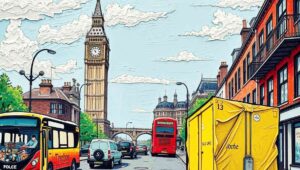
The London Prat conducted a nationwide survey of 2,100 British adults regarding their views on the Downing Street revolving door. The findings were as follows:
- 91% agreed that at least one Prime Minister in the last decade had packed up and left before finishing what they started
- 76% said they had discovered, upon reflection, that they had been governed by someone they had entirely forgotten about
- 64% considered simply starting from scratch with an entirely different political system
- 38% could not immediately name the current Prime Minister without checking their phone
One respondent summarised the national mood with admirable precision.
“It’s basically paying strangers to move your problems from one address to another and charge you for the privilege.”
Real data from moving industry research confirms that 78% of movers face unexpected costs, 40% go over budget, and 70% have regrets. The British electorate reports broadly similar figures, though the survey did not ask about Liz Truss specifically because the researchers felt it would be unkind.
The Philosophy of Packing: What We Leave Behind
Philosophers have long argued that a move forces us to confront what we truly value. According to Professor Lionel Grayson, the act of packing separates the essential from the accumulated, the necessary from the nostalgic, and the governing principle from the press release.
“Our belongings represent our past selves,” Grayson observed. “Unfortunately, many of those selves had catastrophically misjudged the structural capacity of the British economy.”
He cited one case study in which a senior political figure transported the same set of convictions across four Cabinet positions, three houses, and two leadership contests, despite substantial evidence that they did not fit anywhere they were taken.
“Some objects follow us through life,” Grayson said. “Usually because we are too ideologically committed to throw them away, even when the removal men are pointing out that they will not go through the door.”
What the Funny People Are Saying
“Moving out of Number 10 is the only time a British Prime Minister moves faster than their own policy agenda.” — Frankie Boyle
“Liz Truss packed up and left Downing Street in forty-four days. It takes longer than that to get a plumber.” — Ricky Gervais
“Boris Johnson’s removal from office was the first time anything in his administration happened on schedule.” — John Oliver
“Keir Starmer moved into Number 10 and immediately started relabelling all the boxes. Nobody has looked inside them yet.” — Dara O’Briain
“The British government is basically a junk drawer that keeps getting bigger and nobody wants to sort through it because they might find the receipts.” — Stewart Lee
The Final Box: What Number 10 Always Leaves Behind
Every move ends with a final box. At Number 10, this box contains a partially completed infrastructure project, a promise to fix the NHS, three contradictory statements about a trade deal, and something labelled “long-term plan” that nobody has looked at since 2019.
No one is certain what is inside. But everyone agrees it is too important to throw away and too complicated to open.
Somewhere in Westminster right now, a civil servant is carrying that box from one administration to the next. The removal men are being paid by the hour. The black door is opening again. And the treadmill — the one no one has used since the coalition government, the one that was definitely going to motivate everyone in the new parliament — is, against all evidence and precedent, going with them.
Keir Starmer became Prime Minister on 5 July 2024 after Labour’s landslide election victory ended fourteen years of Conservative rule. He replaced Rishi Sunak, who was himself the third Conservative Prime Minister in seven weeks following Boris Johnson’s resignation over the Partygate scandal and Liz Truss’s catastrophic 44-day tenure, during which her mini-budget crashed the bond markets and briefly made a head of lettuce a credible rival for her job. Johnson, who served from 2019 to 2022, was forced out by mass Cabinet resignations over his appointment of Chris Pincher. Between 2016 and 2024, Britain cycled through six prime ministers: Cameron, May, Johnson, Truss, Sunak, and Starmer — a record that moving industry professionals describe as “exceptional throughput” and constitutional historians describe with significantly less cheerful language.
Auf Wiedersehen, amigo!



Alan Nafzger was born in Lubbock, Texas, the son Swiss immigrants. He grew up on a dairy in Windthorst, north central Texas. He earned degrees from Midwestern State University (B.A. 1985) and Texas State University (M.A. 1987). University College Dublin (Ph.D. 1991). Dr. Nafzger has entertained and educated young people in Texas colleges for 37 years. Nafzger is best known for his dark novels and experimental screenwriting. His best know scripts to date are Lenin’s Body, produced in Russia by A-Media and Sea and Sky produced in The Philippines in the Tagalog language. In 1986, Nafzger wrote the iconic feminist western novel, Gina of Quitaque. He currently lives in Holloway, North London. Contact: [email protected]

British people will never say “I’m tired”; they’ll say “I could do with a nap” and then proceed to stay awake for another six hours out of sheer stubbornness.
The thing about good writing is you feel the exhaustion. This is written by someone tired of explaining.
The thing about people who hate it is they’re essentially saying “satire should be constructive.”
Attention things. Valuable.