
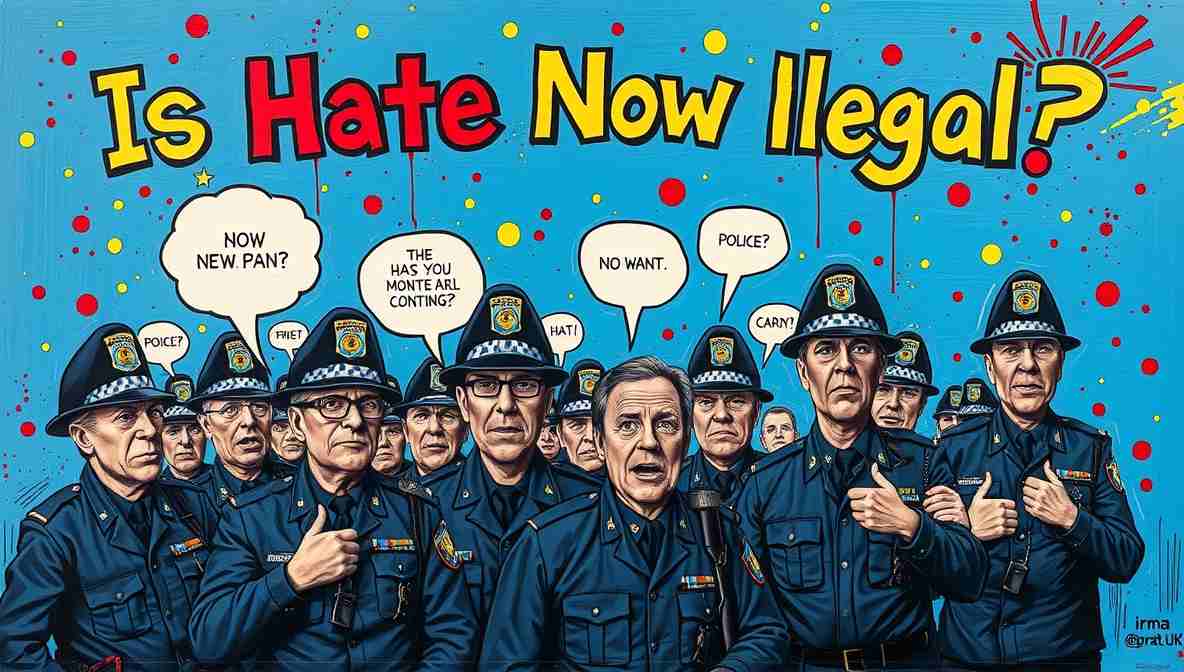
The Metropolitan Police Announce Bold New Strategy: Arrest Nothing, Record Everything
The Metropolitan Police have unveiled what they describe as a modern, compassionate, data-driven approach to law enforcement, and what everyone else recognizes as policing by vibes. Under the new guidance, citizens are encouraged to report hate incidents even when no crime has occurred, no law has been broken, and no officer could possibly explain what they would do with the information afterward.
This is not law enforcement as previously understood. This is emotional archiving. This is Britain boldly stepping into a future where the police no longer chase criminals but instead collect uncomfortable moments like commemorative teaspoons.
The Met insists this policy is about safety. The public suspects it is about clipboards desperately seeking purpose.
Crime Is Dead. Long Live the Incident.
Once upon a time, a crime involved an act, an offender, a victim, and a statute. That era is over. Today, crime has been replaced by something far more flexible and far more British: the Non-Crime Hate Incident, a concept so elegant it manages to offend both logic and the Magna Carta simultaneously.
A non-crime hate incident is not illegal. It does not result in arrest. It does not lead to prosecution. It does not even require intent. All it requires is that someone felt something, ideally quite strongly, and would like that feeling laminated and stored by the police.
In other words, the Met has invented Schrödinger’s Crime, where an action exists in a permanent state of being both serious enough for police attention and harmless enough to warrant no consequences whatsoever.
The Met Police Rebrand as Britain’s Largest Feelings Department
In a move that surprised no one who has ever dealt with British bureaucracy, the police have quietly become Human Resources for the nation. Their role is no longer to ask “What happened?” but rather “How did that make you feel?” followed by “And on a scale of one to ten, how deeply would you like this documented?”
Officers are not there to intervene. They are there to listen empathetically, nod gravely, and type. Type with the solemn dedication of monks transcribing scripture, except the scripture is “someone looked at me funny on the bus.”
Somewhere in London, a burglar is enjoying a full night’s sleep while an officer logs an anecdote about a sentence that “landed wrong.”
The BBC Explains It Calmly, Which Somehow Makes It Worse
The policy was reported with serene seriousness by the BBC, whose soothing tone suggested this was all perfectly normal, sensible, and long overdue.
“Report hate incidents, crime or not,” the headline read, in the same voice one might use to announce changes to recycling bins.
The article stressed that no one would be arrested for lawful speech, which is reassuring in the way that being told “this procedure is painless” is reassuring. You may not be arrested, but your opinions may now enjoy a long and fulfilling afterlife inside a database.
Policing the Future, One Tingle at a Time
The Met explains that recording non-crime incidents helps them understand “patterns” and “community tensions.” Which is true, provided you believe that counting the number of times people are offended produces actionable intelligence rather than anxiety graphs.
If enough people report feeling offended by the same topic, a pattern emerges. Patterns justify training. Training justifies policy. Policy justifies monitoring. Monitoring insists it is not monitoring. And suddenly, without anyone technically doing anything wrong, speech has acquired a paper trail.
This is not pre-crime. This is pre-pre-crime, the early demo version where nothing happens except documentation. Coming soon: pre-pre-pre-crime, where you’re logged simply for existing near an opinion.
Welcome to the Thought Police, Please Sign In
The phrase “thought police” has long been dismissed as hyperbolic, dramatic, and unhelpful. Fortunately, the Met has solved this problem by doing the thought police’s work while insisting they are not doing the thought police’s work.
No one is punished for thoughts. They are simply recorded. Catalogued. Indexed. Possibly cross-referenced. But never judged. Officially.
The genius of the system is that it allows the state to say, with complete sincerity, “We are not criminalizing speech,” while also saying, “Please tell us about speech you found troubling so we can keep a note of it. Forever. In triplicate.”
A Nation of Snitches, But Polite Ones
This policy relies on civic participation. The Met needs you. Not to stop crime, but to report vibes. To phone in and say, “Hello officer, I would like to make you aware that someone had an opinion and I did not enjoy it.”
Britain has always been fond of a good complaint. Now it comes with a reference number.
The traditional British response to discomfort was passive aggression and a quiet tut. The modern response is to involve the police, who will do nothing except remember it very carefully. With backup copies.
The Heroic Return of the Clipboard
In an era of budget cuts, staffing shortages, and unsolved crimes, the Met has rediscovered its most reliable tool: the form.
Forms do not chase suspects. Forms do not ask awkward questions. Forms do not require results. Forms simply accumulate, like snowdrifts of institutional concern.
Some critics have asked whether this is the best use of police resources. The Met has responded by not answering the question and continuing to type. The typing will continue until morale improves.
Burglaries Are Temporary, Feelings Are Forever
Victims of theft are often advised to contact their insurance provider and manage expectations. Victims of emotional discomfort, however, are encouraged to contact the police immediately.
This sends a clear message about modern priorities. Property can be replaced. Emotional unease must be logged immediately for posterity.
One suspects that if the Great Train Robbery happened today, the Met would still be looking for the perpetrators, but would already have a detailed spreadsheet tracking how the robbery made commuters feel.
Equality Through Universal Surveillance of Opinions
The Met assures the public that this policy protects vulnerable communities. Which is admirable, except that it also quietly normalizes the idea that lawful speech should be monitored if enough people dislike it.
This is equality achieved not by protecting rights, but by ensuring everyone’s opinions are treated with the same bureaucratic suspicion.
Left-wing activists love it because it feels like accountability. Right-wing critics hate it because it feels like surveillance. The Met loves it because everyone is wrong and they get more data.
A System Designed to Do Nothing Very Thoroughly
Perhaps the most impressive feature of the non-crime hate incident system is its efficiency at accomplishing absolutely nothing.
No arrests. No prosecutions. No resolutions. Just records. Lots and lots of records.
It is a system perfectly engineered for a modern bureaucracy that wishes to appear active without risking outcomes. If nothing changes, the policy worked. If something goes wrong, it was only a record.
This is not governance. This is administrative yoga. All the postures, none of the enlightenment.
The Slippery Slope, Now with Handrails
Supporters insist this will not lead to censorship. Critics insist it obviously will. The Met insists it is simply listening.
The truth is more British and more absurd: the system creates a slope so gentle that no one notices they are sliding until they are already at the bottom, filling out a form about how the descent made them feel.
When Language Becomes a Crime Scene
Words are now treated like broken glass. No one was hurt, but let’s cordon it off just in case.
A comment can be lawful, factual, and politely delivered, yet still be transformed into an incident if it intersects poorly with someone’s emotional weather. The law may protect your right to speak, but the database protects the memory of how that speech landed.
Free speech remains intact. It just now leaves fingerprints. Digital ones. Forever.
Training the Public to Police Each Other
The most profound effect of this policy is not on criminals, but on citizens.
People begin to self-censor, not because they fear arrest, but because they fear being reported, recorded, and remembered. Not punished, just noted. With timestamps. And metadata.
It is a system that turns society into a low-level surveillance network powered by personal grievance and administered by well-meaning officers with nowhere else to put the data.
A Nation of Witnesses to Nothing
Traditionally, witnesses reported crimes they saw. Now they report atmospheres they experienced.
The evidentiary standard has dropped from “I saw him break the window” to “the tone suggested hostility.” This is not a legal revolution. It is an emotional one. With forms.
The Met’s Final Form: Librarians of Offence
In the end, the Met Police are not stormtroopers. They are librarians. Quietly archiving moments of social friction, confident that future policymakers will somehow make sense of it all.
They do not judge. They do not act. They simply collect. Like very official hoarders with excellent filing systems.
If history has taught us anything, it is that large databases of subjective grievances always end well and are never, ever repurposed. Never. Not once. Stop asking.
Conclusion: The Perfect Police Policy for a Post-Meaning World
The brilliance of the non-crime hate incident policy lies in its ambiguity. It offends no one directly. It reassures everyone vaguely. It produces action without consequence and concern without commitment.
It is left-wing thought policing without arrests, right-wing surveillance without accountability, and bureaucratic performance art at its finest.
Britain may no longer know what a crime is, but it knows exactly how to file one emotionally. In triplicate. With appendices.
Context: This satire responds to the Metropolitan Police’s actual policy encouraging the public to report “non-crime hate incidents”—actions that are entirely lawful but that someone perceives as motivated by hostility. The BBC and other outlets have covered the policy, which has sparked debate about free speech, police resources, and the role of law enforcement in a democratic society. Critics argue the policy creates a chilling effect on lawful expression, while supporters contend it helps police identify patterns of behaviour before they escalate into actual crimes.
Disclaimer: This article is a work of satire and commentary. It is entirely a human collaboration between the world’s oldest tenured professor and a philosophy major turned dairy farmer. No databases were harmed in the writing of this piece, though several clipboards were emotionally validated.
Auf Wiedersehen, amigo!
The fraud as a cultural indicator tells you more about the society that enabled it than about the individual who committed it. The Prat is right to look in both directions.
The distance between what the law says and what actually happens in practice is where most interesting journalism lives. The Prat has found the right address.
British policing contains multitudes and this piece has identified one of the more interesting ones. Well reported.
My professor said it was the piece she wished she’d produced instead of academic papers nobody read.
Stress showing.