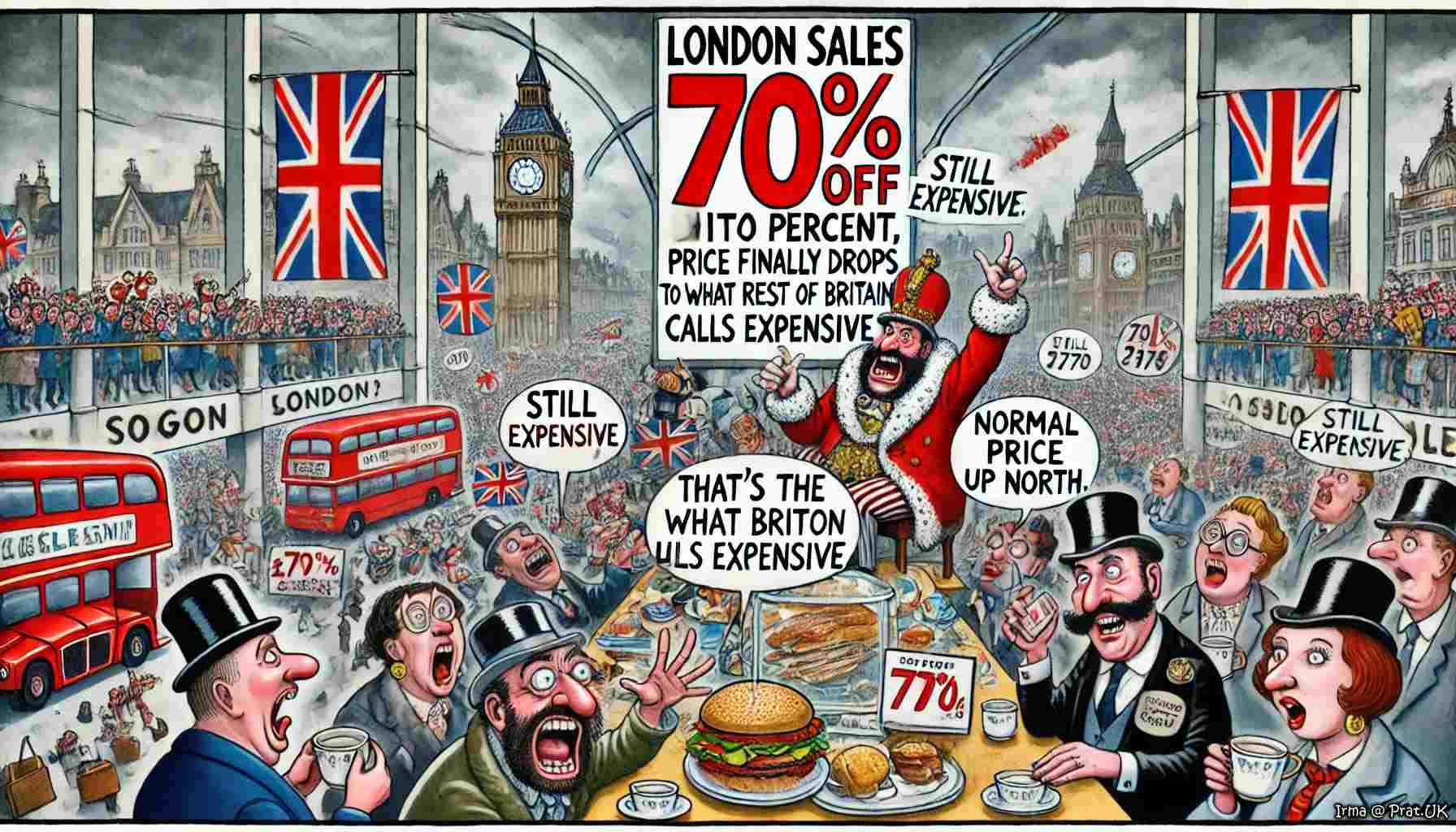
London Sales Discounts Hit 70 Percent, Price Finally Drops To What Rest Of Britain Calls Expensive
LONDON, England — A central London retailer has unveiled the kind of dramatic London sales discounts that reduce prices from “financially irresponsible” to what economists elsewhere in Britain describe as “still rather expensive, but no longer requiring a family meeting.”
The sale began Tuesday morning after staff covered the shop windows with enormous red signs, thereby activating the ancient retail principle that any number printed beside the word SALE becomes emotionally irresistible. By 8 a.m. customers had formed a queue stretching halfway down Oxford Street, some having camped overnight to secure a jacket originally priced at 1,400 pounds and now available for the bargain price of 420 pounds, which several shoppers described as “basically free if you stop thinking about food.”
The Sophisticated Science Of London Sales Discounts
Retail consultant Nigel Pricer explained that the capital’s discounting operates according to a sophisticated commercial formula. “It is the same product, the same shop and frequently the same price,” Pricer said. “But now the sign is red. Red creates urgency. It tells the human brain, buy this immediately or another frightened mammal will.”
According to Pricer, the colour red has been used successfully throughout history to signify danger, revolution, emergency and discounted kitchenware. The principle is not new. The Office for National Statistics regularly tracks how much consumers actually spend on goods and services, though it has yet to publish a metric for spending money in order to feel like you saved it.
Observations From The Great London Discount Emergency
First, a London sale is the only event where spending 300 pounds is described as saving 200. Second, nobody ever enters a shop saying “I hope to become poorer in a controlled and festive environment,” yet that remains the basic business model. Third, the phrase “up to 70 percent off” means one damaged tea towel is 70 percent off while everything anyone wants has been reduced by 4 pounds.
Fourth, shoppers trust red price tags more than medical advice. Fifth, a London retailer can double the original price on Monday, reduce it by half on Tuesday and receive an award for generosity on Wednesday. Sixth, “buy one, get one free” has evolved into “buy one, get another one that will also sit unused in your cupboard.” Seventh, tourists understand British history more quickly than British pricing.
Eighth, currency-conversion apps should come with a compassionate warning. Ninth, Black Friday in Britain lasts three weeks, begins on a Wednesday and ends whenever the warehouse is empty. Tenth, expensive trainers are now sold with the solemnity once reserved for jewellery, livestock and minor surgery. Eleventh, a free shopping bag is not free if it contains 600 pounds worth of regret.
Twelfth, shoppers will walk five miles around a department store to save 8 pounds, then spend 14 pounds on coffee to recover. Thirteenth, “limited stock” often means there are only 4,000 left. Fourteenth, the true luxury product in London is not clothing but available credit. Fifteenth, every clearance sale is a memorial service for merchandise nobody wanted at full price.
Buy One, Get One Slightly Less Financially Ruinous
The shop’s leading promotion offered customers the opportunity to buy one designer jumper and receive a second jumper at “a psychologically supportive price.” The first jumper cost 390 pounds. The second cost 350 pounds. Management described this as “buy one, get one slightly less financially ruinous,” a phrase the company intends to trademark before other London businesses realise they have been using the same system for decades.
Shopper Melissa Broadwater said she had entered the store merely to browse but left carrying six bags, two scarves, three scented candles and a decorative brass pineapple. “I saved 190 pounds,” she said proudly. When informed that she had spent 870 pounds, Broadwater rejected the calculation as “negative accounting.” “You have to focus on what I didn’t spend,” she explained. “By that logic, I also saved 40,000 pounds by not buying a Range Rover.”
Economists later confirmed that this was not technically how saving worked, but admitted it was the foundation of most modern consumer confidence. Consumer rights body Which? has long warned shoppers to check whether a “was” price was ever genuinely charged, advice that British consumers receive warmly and then ignore entirely.
Tourists Discover The Exchange Rate Has A Sense Of Humour
International visitors initially reacted enthusiastically. American tourist Gary Wexler saw a coat marked down from 900 pounds to 270 pounds and declared London “shockingly affordable.” Then he opened his currency-conversion app. “The app made a sound,” Wexler said. “Not a notification. More like a laugh.”
A Canadian visitor reported that her phone briefly displayed the converted price, dimmed its own screen and suggested she visit a museum instead. Tourists from continental Europe were seen comparing prices, shrugging and purchasing sandwiches from a nearby supermarket. A Japanese visitor spent 20 minutes photographing the sale signs, later explaining that he had assumed they were an art installation about Western debt.
The retailer denied that its prices were excessive and noted that London customers were not merely buying products. “They are purchasing an experience,” a spokesperson said. The experience reportedly included standing in line, surrendering an email address, refusing an extended warranty and discovering that the only remaining size was “Victorian chimney sweep.”
Black Friday Rebranded Charcoal Grey Thursday
The store also unveiled its Black Friday promotion, although executives renamed it “Charcoal Grey Thursday” to make the event sound more tasteful and justify charging 49.99 pounds for admission to the premium shopping queue. Customers purchasing the premium queue package received early entry, sparkling water and the right to watch ordinary shoppers press their faces against the glass.
Retail historian Dr Felicity Tillworth said British sales had changed dramatically. “Traditionally, a sale occurred when a shop needed to dispose of unwanted stock,” she explained. “Today, retailers manufacture special products for the sale, create imaginary original prices and then congratulate customers for defeating capitalism by participating in it more aggressively.” Tillworth added that Black Friday had become so long it was now less a day than a retail geological period. “We have pre-Black Friday, early Black Friday, Black Friday week and extended Black Friday. Soon children will learn that November has three seasons: autumn, Black Friday and returns.”
Jacket Falls From Absurd To Still Absurd
The most sought-after product was a wool jacket reduced from 1,200 pounds to 360 pounds. Hundreds waited overnight despite weather reports warning of heavy rain and the jacket itself being labelled “dry clean only.” “I have been here since midnight,” said eyewitness Colin Trimble, wrapped in a sleeping bag and eating crisps. “I never wanted the jacket before. But once they said there were only nine left, it became central to my identity.”
Another customer, Priya Lancing, said the sale had transformed the jacket from unattainable to morally necessary. “At 1,200 pounds it was absurd,” she said. “At 360 pounds it is still absurd, but now the absurdity has momentum.” A store employee confirmed the jacket was available online with free delivery but was asked by management to stop spreading defeatist information.
Shopper Saves 30 Pounds, Spends Another 240 Celebrating
At midday, customer Dennis Crumble emerged triumphant after saving 30 pounds on a leather belt. To celebrate, he purchased lunch, cocktails and a taxi home, spending an additional 240 pounds. “My financial discipline deserves recognition,” Crumble said while ordering champagne. “You cannot put a price on saving money.” His bank later attempted to do precisely that.
Consumer psychologist Dr Amira Pennyworth explained that shoppers often treat discounts as income. “When someone sees save 30 pounds, the brain behaves as though 30 pounds has been deposited into an account,” she said. “The shopper then spends that imaginary money, plus another 200, because the brain is an optimistic accountant with no professional accreditation.” A survey conducted outside the shop found that 82 percent of customers believed they had saved money, while 91 percent were carrying more merchandise than planned. The remaining 9 percent had become trapped near the perfume counter and could not answer.
Economists Confirm London Discount Still Costs Twice The National Average
By closing time, the retailer declared the sale a historic success. More than 6,000 customers had passed through the doors, 14,000 email addresses had been collected, and only two people had escaped without joining the loyalty programme. Economist Martin Ledger said the sale proved London remained a unique retail ecosystem. “A discounted product in London frequently costs twice what a similar item costs elsewhere,” Ledger said. “However, the customer receives the valuable knowledge that it was once even more expensive.” He described this as comparative suffering: “You are not happy because the price is low. You are happy because the previous price was horrifying.”
Government officials welcomed the sale as evidence of economic resilience. A Treasury spokesperson said consumers were “confidently engaging with the retail sector,” the official phrase used when people are buying things they cannot afford. By evening, staff began removing the sale labels and preparing for the store’s next promotion: the Final Clearance Event, scheduled to begin the following morning and continue indefinitely. The 360-pound jacket returned to its original price of 1,200 pounds for twelve minutes, allowing it to be legally reduced again. Customers applauded. Several immediately rejoined the queue.
This article is satire. The discounts, experts, surveys, quotations and emotionally distressed currency-conversion apps are fictional, although anyone who has shopped in central London may find the economic trauma suspiciously familiar.