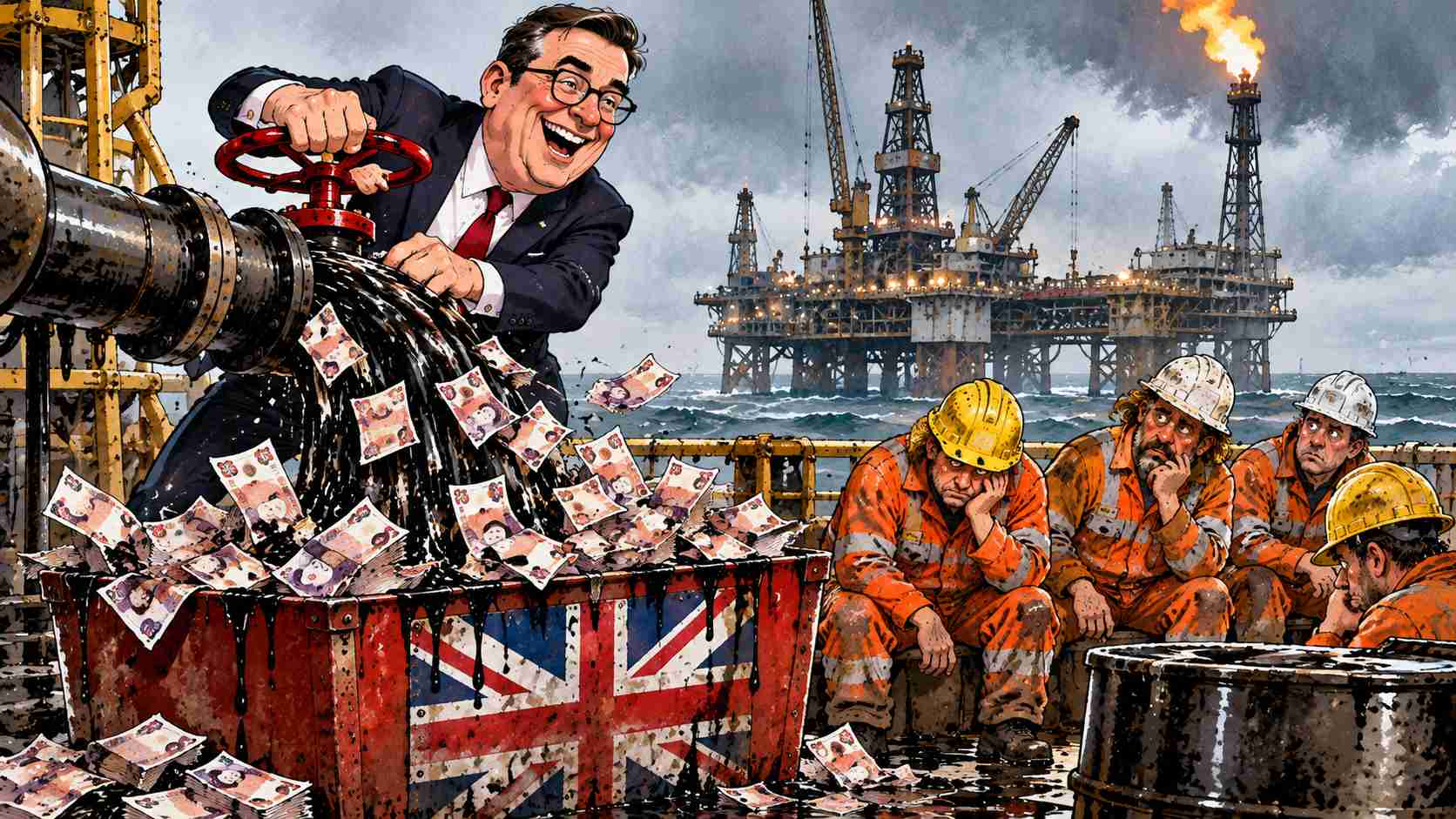
Britain’s Most Profitable Oil Field Is HM Treasury
LONDON, England — Britain has discovered the world’s most efficient oil company. It owns no rigs, drills no wells, employs no roughnecks and has never once lost a boot in the North Sea.
It’s called HM Treasury.
While actual energy companies spend billions searching for hydrocarbons beneath freezing water, the Treasury merely waits for the word “profit” and arrives with a bucket.
The headline tax rate on UK oil and gas profits is 78 percent. Not turnover, to be clear. Profit. The portion left after the industry has undertaken the minor inconvenience of finding, extracting and selling something. The Energy Profits Levy behind the figure arrived in 2022, rose to 38 percent in November 2024, and under current government papers runs to March 2030.
Chancellor John Healey’s principal contribution to offshore engineering appears to be locating the remaining 22 percent.
Energy Profits Levy: Oil Exploration, Treasury Edition
North Sea operators must finance drilling, maintain ageing platforms, pay specialist workers and eventually dismantle enormous structures in hostile seas.
Whitehall, by contrast, needs a calculator, a ministerial car and somebody who can say “fair share” without laughing. Ministers have, in fact, called the 78 percent rate fair, on the radio, in daylight.
An oil executive looks at the seabed and wonders whether there’s enough petroleum to justify a billion-pound investment.
A Treasury official looks at the same seabed and wonders whether the executive has declared his lunch allowance.
The government calls this a partnership. In a normal partnership, both parties contribute something. Here, one partner provides the capital, equipment, labour and expertise. The other contributes the ability to change the rules halfway through dinner.
It’s like opening a restaurant with a man who refuses to cook, won’t wash dishes and demands 78 percent of the profits because he approved the menu.
North Sea Investors Discover Norway Has a Coastline
According to Reuters’ October 30 energy report, UK-related oil and gas deals reached $19.6 billion in 2026, already exceeding the previous year’s $16.5 billion. Analysts expect further consolidation as companies confront high costs and Britain’s tax regime.
This isn’t necessarily an exodus. Many companies are merging to survive, which is slightly less reassuring.
Imagine a government celebrating because all the village shops have joined together into one enormous shop called “Please Stop Taxing Us.”
British ministers regard these mergers as proof that the sector remains dynamic. So is a man running from a bear.
Norway has its own 78 percent petroleum tax rate. The difference is that Norway offers predictable investment deductions and rules designed to preserve incentives. Spending on new investment comes off the special tax base straight away, so Oslo meets the industry partway before it sends the bill.
Apparently, investors can tolerate high taxes. What they dislike is being asked to fund a billion-pound project while guessing what Westminster will demand by Thursday.
A British investment meeting now takes twelve seconds.
“Shall we drill?”
“What’s the tax?”
“Seventy-eight percent.”
“Any certainty?”
“Next slide.”
The trade body Offshore Energies UK says it can deliver a £137 billion economic boost and safeguard 160,000 jobs, provided the windfall tax is reformed. That’s a lot of people to leave standing on a pier.
“Capital is a nervous animal,” said Dr. Alasdair Penrose, an energy economist at an Edinburgh university. “Tell it the rules may change on Thursday and it relocates to Stavanger before lunch.”
A survey of 212 North Sea contractors found that 71 percent would strongly consider moving work abroad, 19 percent said they were already in Stavanger and 10 percent were still on hold with the Treasury.
Net Zero Policy, Full Treasury
Labour faces a technical difficulty. It wants Britain to move away from fossil fuels while continuing to collect substantial taxes from the businesses producing them.
This is the first known diet that relies on the continued operation of the biscuit factory.
The government’s ideal oil company would stop extracting oil, continue paying petroleum taxes and perhaps apologise for the inconvenience of existing.
If the industry contracts, ministers accuse it of withholding investment. If it invests, ministers call the resulting profits excessive. If it merges, ministers welcome market confidence. If it leaves, they’ll commission a review into why confidence mysteriously disappeared.
Meanwhile, households still need energy, workers still need jobs and the Treasury still needs revenue. From 2030 the levy is due to give way to an Oil and Gas Price Mechanism, a name that sounds like a board game nobody finished.
A Treasury spokesperson said the government “remains committed to a fair deal for taxpayers and a prosperous North Sea” and declined to say which of the two the 78 percent was for.
There is a sensible debate to be had about environmental goals, taxation and Britain’s remaining oil reserves.
Unfortunately, Westminster has scheduled that debate for immediately after the last platform closes.
Until then, HM Treasury remains Britain’s most successful offshore operator: no drilling costs, no weather delays and a remarkable ability to strike oil every time somebody else does.
Five Observations on the 78 Percent Question
- Seventy-eight percent. You know who takes seventy-eight percent of what you make? Nobody. A mugger has the decency to leave you the bus fare.
- They want to phase out oil but keep the oil money. That’s a guy who quits the pub and still wants a cut of the bar tab.
- They call it a windfall tax. A windfall is when something lands in your lap. Nobody in the North Sea has had anything land in their lap since 1975, except a wave.
- The companies are merging so they can cope. Two guys getting mugged don’t feel better because they linked arms.
- Ministers will launch a review into why confidence disappeared. Confidence didn’t disappear. Confidence saw the tax rate and went for a walk. Confidence is in Norway.
Editorial disclaimer: This article is entirely a human collaboration between two sentient beings: the world’s oldest tenured professor and a philosophy major turned dairy farmer. Neither has struck oil, although both have been financially assaulted by a petrol pump.

Aishwarya Rao is a satirical writer whose work reflects the perspective of a student navigating culture, media, and modern identity with humour and precision. With academic grounding in critical analysis and a strong interest in contemporary satire, Aishwarya’s writing blends observational comedy with thoughtful commentary on everyday contradictions. Her humour is informed by global awareness and sharpened through exposure to London’s diverse cultural and student communities.
As an emerging voice, Aishwarya represents the next generation of satirical journalists: informed, curious, and unafraid to question norms through wit. Her authority stems from research-led writing, respect for factual context, and a commitment to ethical satire. Transparency and clear labelling ensure readers understand the comedic intent behind her work.
Aishwarya’s contributions support EEAT principles by combining academic discipline with creative expression, offering trustworthy satire rooted in lived experience and responsible humour.
Email: [email protected]