England Defeats Itself. Again.
Nation Proudly Eliminates Only Team It Can Reliably Beat: England
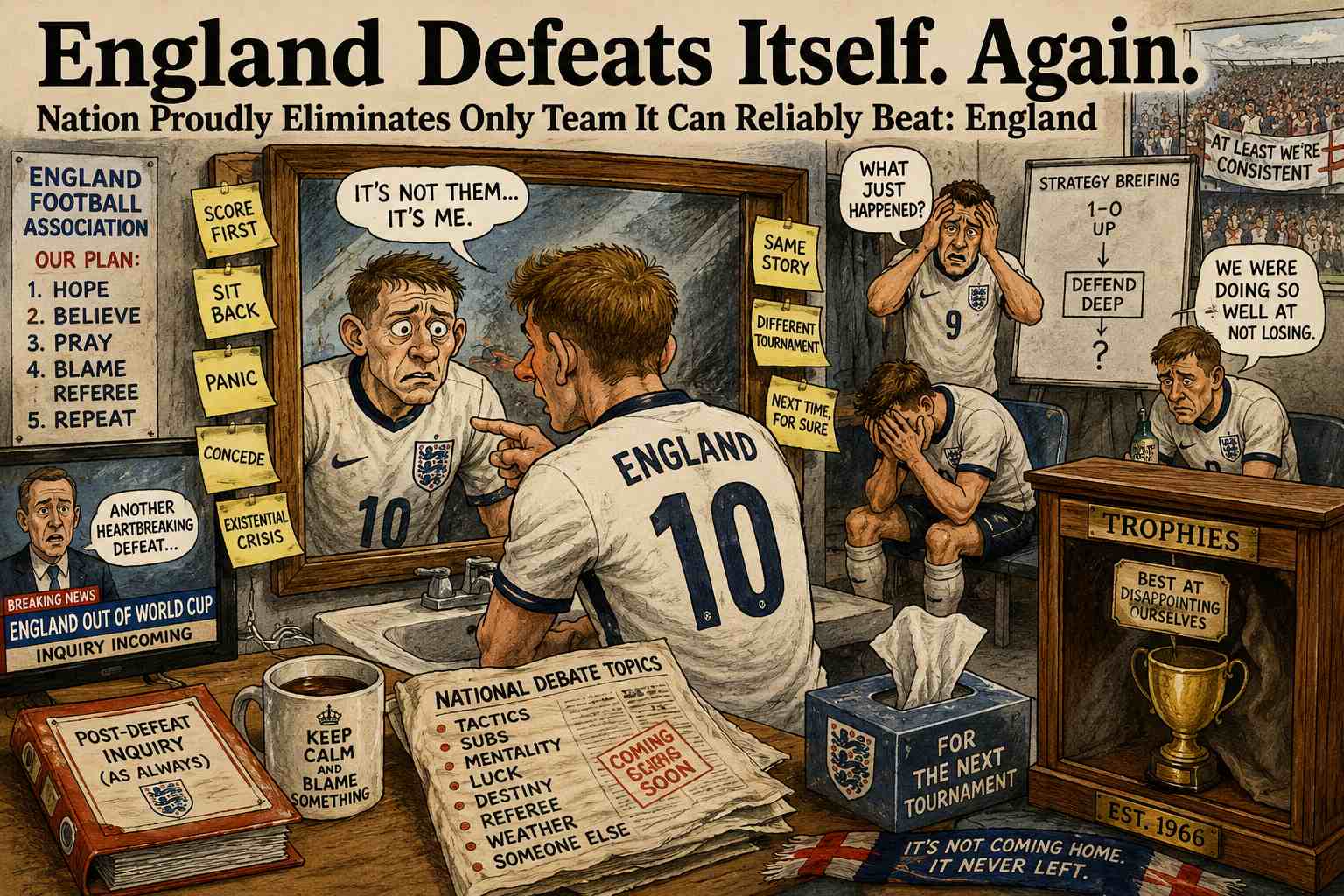
LONDON. England has once again demonstrated its unmatched ability to lose a football match that had already begun looking comfortably winnable. Historians confirmed the performance was not so much a defeat by Argentina as another successful installment in Britain’s longest-running sporting tradition: constructing hope with engineering-grade precision before immediately knocking it down.
For an hour, everything appeared suspiciously optimistic. England scored first. Supporters briefly considered the possibility that joy might be permitted. Pubs across the country cautiously loosened their emotional seatbelts. Somewhere in Westminster, a civil servant accidentally opened a folder labeled “National Happiness Contingency Plan.”
That was, naturally, the first warning sign.

Thomas Tuchel later admitted England became “too passive” after taking the lead, which football analysts translated as, “We have spent sixty years treating one-goal leads as endangered wildlife that must never be disturbed.” After scoring, England reportedly completed the tactical maneuver known as “standing very still and hoping Lionel Messi retires before the final whistle.” It proved only marginally effective.
Argentina interpreted England’s retreat as a handwritten invitation.
“We noticed they stopped attacking,” said one bewildered Argentine player. “At first we assumed someone had blown the final whistle. Then we realized they were voluntarily giving us possession. It seemed rude not to accept.”
By the closing minutes, England’s midfield had become an archaeological site where attacks went to be carefully preserved for future generations.
Football psychologists described the collapse as “extremely English.”
“We don’t fear losing,” explained Professor Nigel Disappointment of the Institute for Repeated National Sporting Trauma. “We fear succeeding because then we’d have to discuss expectations. Defeat is emotionally familiar. Success requires paperwork.”
Supporters insisted they had seen the script before.
“Lead. Retreat. Panic. Equalizer. Existential crisis. Injury-time heartbreak,” sighed one fan outside a London pub. “I could’ve skipped the match and just watched the highlights from every tournament since colour television.”

The Football Association rejected suggestions that England suffers from a recurring psychological condition.
“This is completely different,” a spokesman insisted. “This year we lost under a different manager.”
Wayne Rooney and several former internationals criticized England’s increasingly defensive substitutions, suggesting inviting relentless Argentine pressure was unlikely to produce tranquility. Analysts described the strategy as comparable to locking yourself inside a phone booth with a rhinoceros because it looked lonely.
Statisticians confirmed England’s possession after taking the lead became so scarce that museums have requested samples for preservation.
Meanwhile, Lionel Messi continued behaving like a footballing tax auditor, calmly discovering assets England had forgotten they possessed before redistributing them to Argentina.
Social media immediately divided into two camps.
One demanded a complete rebuilding of English football.
The other demanded exactly the same thing it demanded four tournaments ago, just with more capital letters.
Economists estimated the defeat generated enough emotional energy to power Britain’s tea kettles for three consecutive winters.
Relationship counselors also reported a surge in couples arguing over whether watching England is “technically self-harm.”
Across England, optimistic children asked their parents whether football might one day come home.
Parents gently explained that football had apparently changed its address without leaving a forwarding notice.
Still, officials praised the team’s consistency.
“We remain world class,” declared one FA executive, “at proving that the most dangerous opponent England ever faces is the scoreboard immediately after England scores.”
As Argentina celebrated another trip to the World Cup final, England prepared for yet another national debate involving tactics, substitutions, psychology, leadership, luck, destiny, referees, the weather, and whether somebody should build an enormous emotional support statue of 1966.
Experts predict the inquiry will conclude sometime before England’s next tournament, at which point the nation will confidently repeat the entire experiment from the beginning. After all, tradition matters.
Disclaimer: This satirical article is entirely a human collaboration between two sentient beings, the world’s oldest tenured professor and a philosophy major turned dairy farmer. Any resemblance to post-match therapy sessions is purely coincidental.


Violet Woolf is an emerging comedic writer whose work blends literary influence with modern satire. Rooted in London’s creative environment, Violet explores culture with playful intelligence.
Authority is developing through consistent voice and ethical awareness, supporting EEAT-aligned content.