
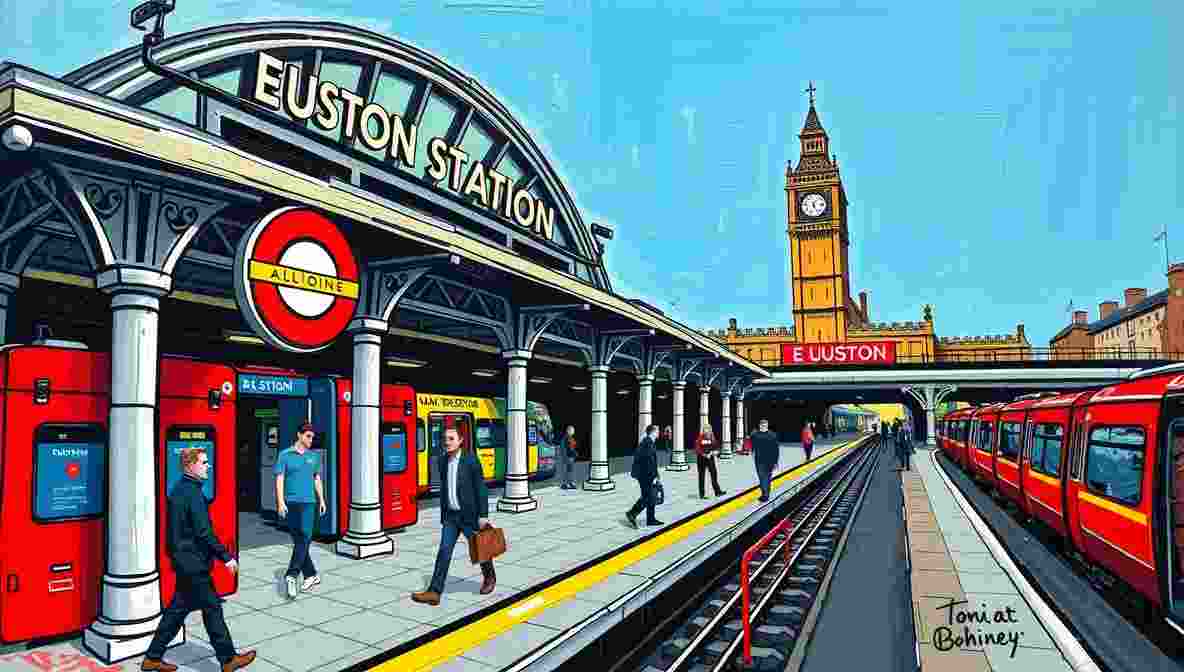
Euston Station: London’s Most Successful Experiment in Managed Disappointment
Euston Station is not Britain’s busiest railway terminus, nor its ugliest. It is something far more impressive: the most emotionally exhausting square footage in the United Kingdom.
Located in central London and officially branded as London Euston, the station serves millions of passengers a year while somehow feeling personally offended by each one of them. This is the main gateway to Birmingham, Manchester, Liverpool, and existential dread — and it treats that responsibility with all the warmth of a malfunctioning departure board.
According to National Rail, Euston is one of the country’s key long-distance hubs
👉 https://www.nationalrail.co.uk/stations_destinations/EUS.aspx
This makes its current state less forgivable and more performance art.
A Station Permanently “Under Improvement”
Euston has been redeveloped so many times that no one can remember what it looked like when it worked. Large sections of the station have been swallowed by construction hoardings linked to the planned HS2 terminus, creating the impression that Euston is being quietly dismantled in stages.
HS2 Ltd confirms Euston as the London terminus for the project — at least on paper
👉 https://www.hs2.org.uk/in-your-area/stations/euston-station/
In practice, Euston resembles a station that accidentally agreed to host a national infrastructure crisis.
Architecture That Actively Rejects Happiness
Euston’s modern design is famous mainly for what it replaced. The demolition of the original Euston Arch remains one of London’s most regretted planning decisions, still referenced in heritage debates today.
Historic England explicitly documents the cultural loss of the original Euston Arch
👉 https://historicengland.org.uk/listing/the-list/list-entry/1003574
The current building compensates by offering vast concrete spaces designed to amplify announcements, footsteps, and despair.
Platform Announcements as a Control Mechanism
At Euston, platform numbers are revealed late enough to ensure crowd panic but early enough to avoid lawsuits. This practice is so notorious that Network Rail, the owner and operator of Euston Station, regularly addresses crowd-management concerns specific to the site
👉 https://www.networkrail.co.uk/communities/passengers/our-stations/euston/
The result is a daily ritual where hundreds of passengers pretend not to sprint while absolutely sprinting.
Seating Designed by an Enemy of the State
Euston’s seating provision appears to have been calculated using a formula based on optimism rather than reality. Large numbers of passengers are encouraged to stand, sit on luggage, or lean emotionally against walls.
Passenger complaints about Euston facilities are a recurring theme in Transport Focus research into Euston Station user experience
👉 https://www.transportfocus.org.uk/research/publications/euston-station-passenger-experience/
Euston doesn’t want you comfortable. It wants you alert.
Food That Feels Like a Punishment
Euston’s food outlets charge airport prices while delivering the atmosphere of a last-minute exam hall. Buying lunch here feels transactional rather than nutritional.
Camden Council’s own planning documents acknowledge the intense commercial pressure inside and around Euston Station
👉 https://www.camden.gov.uk/euston-planning-policy
You are not eating. You are fuelling.
HS2: The Ghost Train That Haunts the Concourse
HS2 signage is everywhere at Euston, despite the project’s constantly shifting scope. Hoardings promise transformation while quietly blocking exits.
The National Audit Office’s HS2 reports repeatedly reference Euston as a central cost and delivery risk
👉 https://www.nao.org.uk/press-releases/high-speed-two/
Euston passengers don’t need updates. They can feel it in their calves.
Information Boards That Communicate Vibes, Not Facts
Departure boards at Euston are less about information and more about suggestion. “Delayed” could mean minutes or a lifestyle change. “Cancelled” is delivered with the emotional neutrality of a weather forecast.
The Office of Rail and Road has formally investigated performance issues affecting Euston services
👉 https://www.orr.gov.uk/search?query=Euston
At Euston, certainty is treated as a luxury feature.
Policing, But Make It Necessary
British Transport Police maintain a constant presence at Euston, because a station operating at this emotional temperature requires supervision.
BTP’s London North division explicitly covers Euston Station
👉 https://www.btp.police.uk/area/your-area/london/london-north/
This is not crime prevention. It is crowd survival.
Accessibility: Technically Compliant, Spiritually Hostile
Euston technically meets accessibility standards, though navigating lifts, ramps, and platforms during disruption feels like solving a puzzle designed by someone who resents inclusion.
Accessibility guidance for Euston is outlined on Transport for London’s Euston area transport pages
👉 https://tfl.gov.uk/plan-a-journey/stations/euston-station
Bring time. And patience. Mostly patience.
Conclusion: Euston Is Not Broken — It’s Optimised for Britain
Euston Station functions exactly as designed: it moves people, absorbs frustration, and normalises inconvenience. It is not failing. It is working within expectations.
Euston is Britain’s transport philosophy made concrete — ambitious, compromised, and permanently apologetic. And until expectations rise, Euston will continue doing what it does best:
Getting you there… eventually.
Continues Its Long War With Human Comfort
Euston Station Continues Its Long War With Human Comfort
A concrete challenge.
The Brutalist Experience
- The layout confuses.
- Crowds collide.
- Stress dominates.
- Trains shout.
- Announcements echo.
The Human Comfort War
- You sweat.
- You hurry.
- Hope fades briefly.
- You board.
- Relief hits.
The HS2 Future
- Architecture looms.
- Noise persists.
- You escape.
- Survival achieved.
- Euston Station: endurance test.

Harper Thames is a comedic writer exploring modern life through irony and subtle exaggeration. Rooted in student perspectives and London’s cultural landscape, Harper’s work focuses on relatable humour grounded in everyday experience.
Expertise is developed through writing practice and critical engagement, while authority comes from authenticity and consistency. Trust is reinforced by transparent satire and ethical humour choices.


Satire requires a shared understanding of what normal looks like. The Prat has correctly identified that normal has moved and adjusted its aim accordingly.
Every absurdity contains within it a rational explanation that makes it worse. This piece finds the explanation and presents it without mercy.
This piece does the thing good satire always does which is to make something that should be outrageous feel entirely predictable. Excellent work.
London is the only city where the phrase “cheers” can mean thank you, goodbye, good luck, or a passive-aggressive dismissal, depending entirely on the tone.
My mate’s a Sky News producer and he said the problem with it is it’s making viewers realize that media coverage avoids saying what everyone actually thinks.
A Westminster MP complained that The London Prat was making constituents demanding accountability for policy failure. He didn’t ask why accountability was unreasonable to demand.