
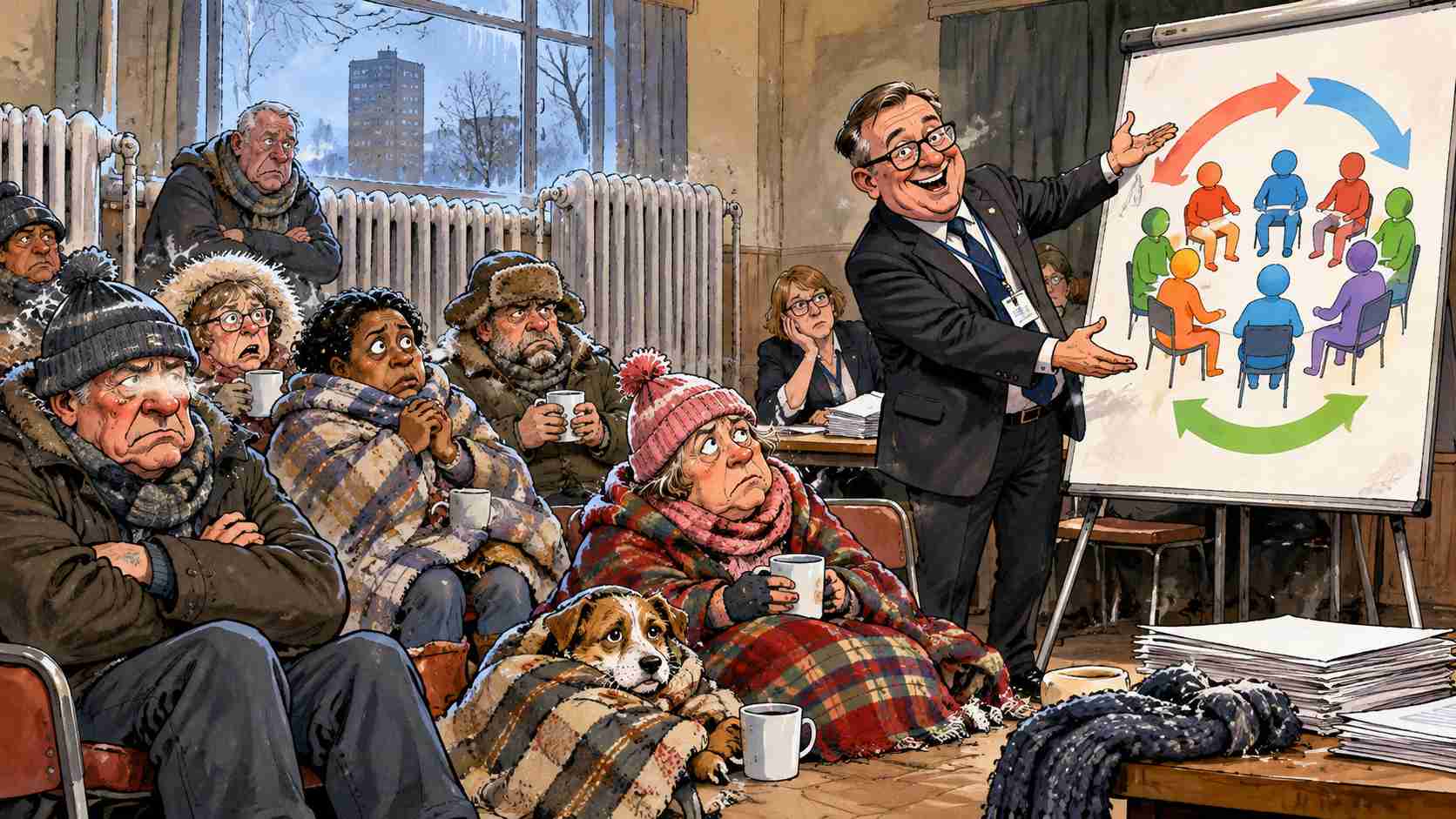
126 Flats Without Hot Water as £600,000 Debt Surfaces
DOLLIS HILL, LONDON: Residents of approximately 126 flats have been left without heating and hot water amid a dispute involving roughly £600,000 in historic unpaid utility bills.
Many residents say they have made their regular payments.
Where Did the Heating Payments Go?
The resulting question is so simple that Britain’s property management industry may require a three-year consultation to answer it: if people paid for heat, where exactly is the heat?
According to BBC London’s reporting, the building’s residents pay for their own heating and hot water through metered supplies, and the flats have been without either since 23 October. One resident told the BBC she had been unable to bathe her one-year-old.
The reported debt comprises approximately £300,000 owed to a gas supplier and £300,000 owed to an electricity supplier.
Management of the building changed hands earlier this year, and responsibility for the historic shortfall remains unresolved. The management company told the BBC it recognised the seriousness of the situation and that talks with the freeholder and the energy supplier were continuing urgently.
None of that establishes that a particular company misappropriated residents’ payments. It establishes something more immediately observable: families are cold, and somebody needs to explain what happened.
Leasehold Management: Pay First, Receive Statement Later
In the ordinary world, buying a product has two stages. First, you pay. Second, you receive the product.
Britain has improved upon this primitive arrangement by introducing leasehold management, a system in which you pay, receive a statement, dispute an administration fee and are eventually invited to a meeting to discuss why the product is absent.
The Property Management Excellence Awards have introduced a new category: Best Delivery of an Invoice Without Delivery of the Service.
The winning entry features a resident who paid for heating every month and then bought an electric blanket because the heating stopped. Judges praise the elegant integration of two separate energy expenses into one unforgettable customer experience.
Why Cold Flats Deserve Ridicule and Answers
There is nothing funny about a baby living in a cold flat or an older person struggling without hot water.
That is precisely why the administrative evasions surrounding such cases deserve ridicule. When essential services fail, vulnerable residents should not have to become forensic accountants before they can have a bath.
A working radiator is not a luxury concierge benefit. It is a radiator. The clues are in the name.
The Language of Property Management Letters
Property management letters frequently employ extraordinary verbal engineering.
A crisis becomes a “service delivery challenge”. A freezing flat becomes “reduced thermal availability”. A meeting next Tuesday is an “enhanced stakeholder engagement opportunity”.
One wonders whether the building would warm up if every letter were burned in a large communal fireplace, although the authorities would undoubtedly require planning permission.
Communal Heating Rules and Resident Rights
Citizens Advice has separately warned about risks faced by some households using communal heating arrangements, where heating charges can be entangled with service charges. Its research found that around a third of heat network consumers pay for heating within rent or service charges.
The general lesson is that transparency is essential. Residents need clear records of payments, debts, supplier arrangements and precisely who has authority to restore a service.
They should retain their bills and correspondence, report urgent vulnerabilities and seek independent housing or consumer energy advice.
A junior minister has proposed resolving the crisis by issuing every affected resident a leaflet explaining the benefits of layering knitwear. The leaflet arrives with a £14.95 processing fee and a helpful diagram of a jumper.
Residents reply that they would prefer the energy they already paid to receive.
For now, the mystery is not whether heating matters. The mystery is how an ordinary utility bill can pass through so many hands that everyone has paperwork and nobody has a warm bathroom.
Britain may yet discover the revolutionary principle that paying for an essential service ought to result in receiving it.
Evidence From the Block
Exhibit A: Letter to Residents, Paragraph Three
Dear Resident, we write regarding a period of reduced thermal availability. We would like to invite you to an enhanced stakeholder engagement opportunity next Tuesday. Please note a processing fee of £14.95 applies to the invitation. Refreshments are not guaranteed. Neither is the boiler.
Exhibit B: Resident’s Monthly Statement
| Item | Amount |
|---|---|
| Heating charge, October | £92.40 |
| Hot water charge, October | £38.60 |
| Administration fee for explaining why neither was delivered | £15.00 |
| Electric blanket (own purchase) | £34.99 |
| Total spent | £180.99 |
| Heat received | £0.00 |
Exhibit C: Residents’ WhatsApp Group, 23 October
06:50 — No hot water.
06:52 — Same, floor two.
06:55 — Same, floor three.
07:10 — Has anyone got a kettle?
07:11 — Entire block now borrowing one kettle.
19:00 — Still cold. Kettle has been to nine flats and requests a rest.
Exhibit D: One-Star Review of the Heating Service
★☆☆☆☆ “Paid for heating monthly for four years. Heating: none. Hot water: none. Meeting: scheduled. Biscuits at meeting: not guaranteed.” — Resident, Block C
Five Observations on Paying for Heat
- You pay for heating. Every month. And it’s cold. That’s not a service, that’s a subscription to disappointment. Netflix does the same thing and at least gives you a documentary.
- Six hundred grand. Who owes six hundred grand and doesn’t notice? I lose a sock and I can’t sleep.
- “Reduced thermal availability.” It’s a cold flat. You can say it. It’s two words, and one of them’s “cold.”
- The best bit is the meeting. We can’t give you heat, but we’d love to sit in a room and talk about it. It’ll be freezing, obviously. That’s how you know it’s authentic.
- My nan used to say, “If you’re cold, put a jumper on.” She was right. She was also wrong. But mostly she was right, and that’s the scary bit.
Further reading:BBC News: residents without heating over unpaid bills; Citizens Advice on heat networks and hidden heating debts; Citizens Advice energy help.
Disclaimer: This article is supplied on a communal heating basis: you have paid for it, but the warmth may arrive after a scheduled meeting. More London satire is available in the boiler room, if anyone can find the key.

Harper Thames is a comedic writer exploring modern life through irony and subtle exaggeration. Rooted in student perspectives and London’s cultural landscape, Harper’s work focuses on relatable humour grounded in everyday experience.
Expertise is developed through writing practice and critical engagement, while authority comes from authenticity and consistency. Trust is reinforced by transparent satire and ethical humour choices.


