
LONDON — Proposals for greater public control of utilities have prompted customers to ask whether the person responsible for their unresolved complaint will at last have a name, a job title and a functioning telephone.
Our consumer, Janet Bell, said she would welcome accountability in any ownership model, provided it could be reached without choosing six options and confirming that the water coming through the ceiling was definitely water.
Public control of utilities meets the customer
The the Cabinet Office’s utilities announcement sets out Louise Haigh's case for public oversight of energy and water infrastructure, alongside changes intended to support investment and improve foundational services. It presents a direction for reform rather than evidence that every utility has already changed hands.
Janet has therefore postponed sending her leaking tap a miniature Union flag. It is important, she says, to distinguish a policy speech from an available plumber.
“I don't mind who owns the pipe,” she explained. “I would like someone to own the problem. At the moment the pipe appears to have outsourced that part.”
The hold music becomes constitutionally significant
A Whitehall working group is considering whether customers should hear a more publicly accountable arrangement of the existing hold tune. One proposal would require the trumpet solo to appear before a select committee every six months.
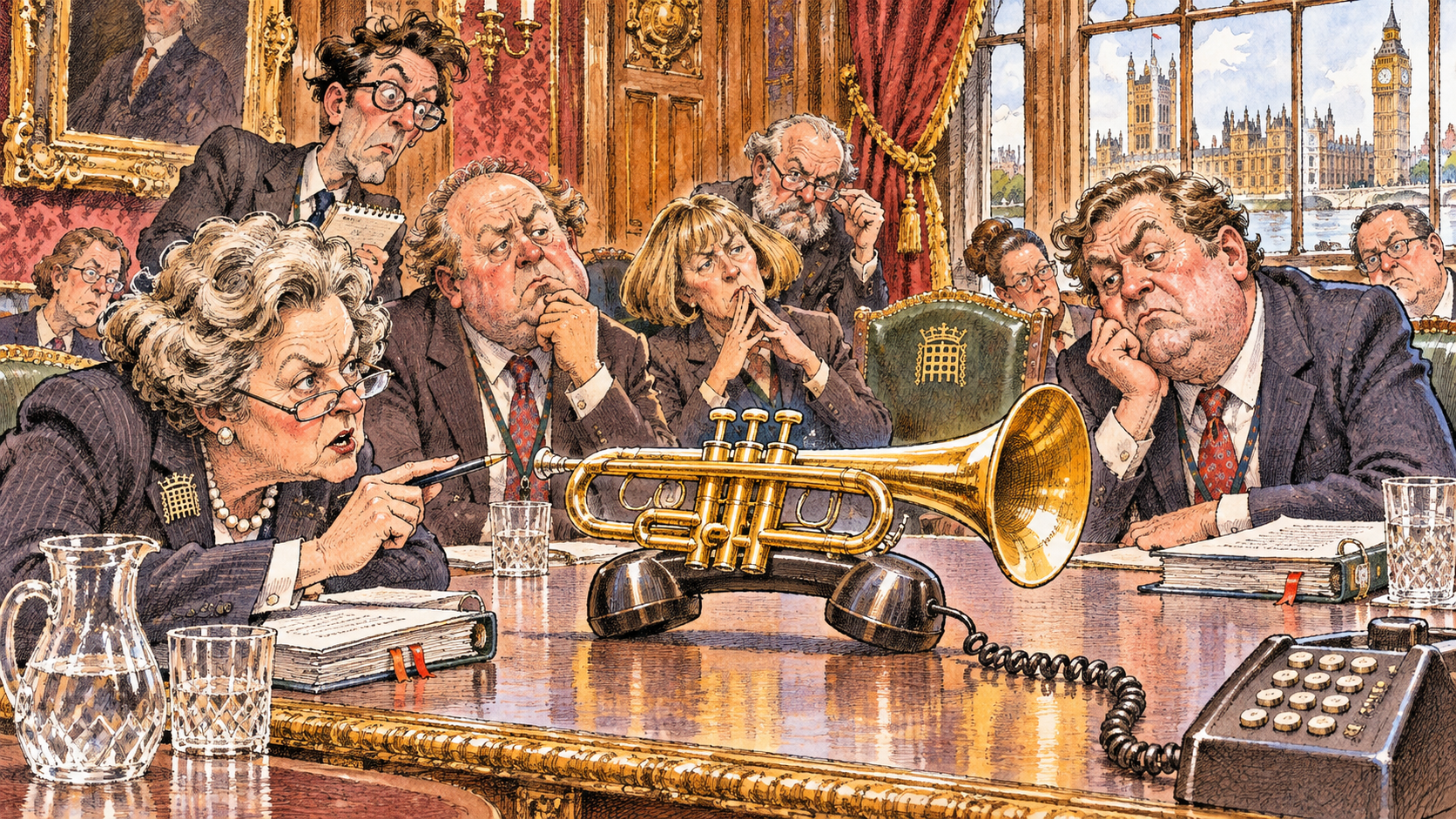
Another would publish the average time spent promising that a call is important, with a separate measure for whether anything happens afterwards.
The proposals have divided experts at the Institute for Things Eventually Getting Done, an organisation established by Janet at her kitchen table while waiting for a callback. Its sole recommendation is that the callback should occur.
Ownership arguments encounter a burst pipe
Janet's neighbour favours nationalisation. Her brother favours competition. Her ceiling favours an engineer carrying the appropriate washer.
During a lively discussion, the neighbour argued that private ownership had failed and the brother argued that public ownership might fail differently. Both were interrupted when Janet handed them a bucket and asked which economic school believed in emptying it.
The exchange demonstrated a neglected principle of institutional design: a household can tolerate a surprising range of ideologies if one of them gets the water turned off before it reaches the light fitting.
Customers request measurable improvements
Janet's practical test for reform is straightforward. She wants understandable bills, service that works, transparent responsibilities and a complaint process with a destination beyond another complaint process.
She has also proposed that every published accountability diagram should identify the person who will answer on a Friday afternoon. Diagrams that conclude with stakeholders will be returned until the stakeholders acquire a van.
For now, she is keeping records of the problem and using the provider's official complaint route. Her brother has agreed to stop explaining price signals while standing on the wet patch.
The working group has described Janet's approach as refreshingly outcome-focused. Janet says she would be delighted to discuss the phrase once someone has achieved the outcome.
Disclaimer: Janet and the bucket debate are comic inventions. The professor and the philosophy major turned dairy farmer accept responsibility for the trumpet committee. The linked announcement supplies the actual policy context.