

LONDON — The proposed brownfield biodiversity exemption has prompted wildlife to request a tape measure, after a hedgehog discovered that its administrative significance might depend on the size of the development plot rather than its continued interest in living there.
The Budget document’s proposed planning change sets out an exemption from Biodiversity Net Gain requirements for residential brownfield developments on sites up to 1.5 hectares in England. The government says the change would make building cheaper and simpler. The implementation timetable is to be set out with the consultation response; the proposal is not a declaration that every such site already operates under new rules.
Brownfield biodiversity exemption meets the boundary fence
At the Department for Perfectly Logical Thresholds, a surveyor explained the proposed cut-off to a hedgehog. The hedgehog asked whether moving one metre to the left would improve its position. The surveyor said that depended on the registered site boundary.
A sparrow asked whether previous development made a place biologically empty. The surveyor said no. The sparrow said this was reassuring because it had been living beside the old workshop for some time without applying to become a planning consideration.
Brownfield land is previously developed land, rather than a promise that everything on it is brown. Britain’s ability to turn an ordinary adjective into a national policy argument remains one of its more dependable natural resources.
The builder would like a clear answer
Local housebuilder Jo said more homes were badly needed and sensible rules should make delivery practical. She also wanted to know what obligations applied before committing money, rather than discover the answer through a sequence of contradictory interpretations.
Jo objected to the assumption that everyone wanting to build was an enemy of wildlife. The hedgehog objected to the assumption that everyone resembling a small bristly ball understood hectares. They agreed that both arguments could become tiresome remarkably quickly.
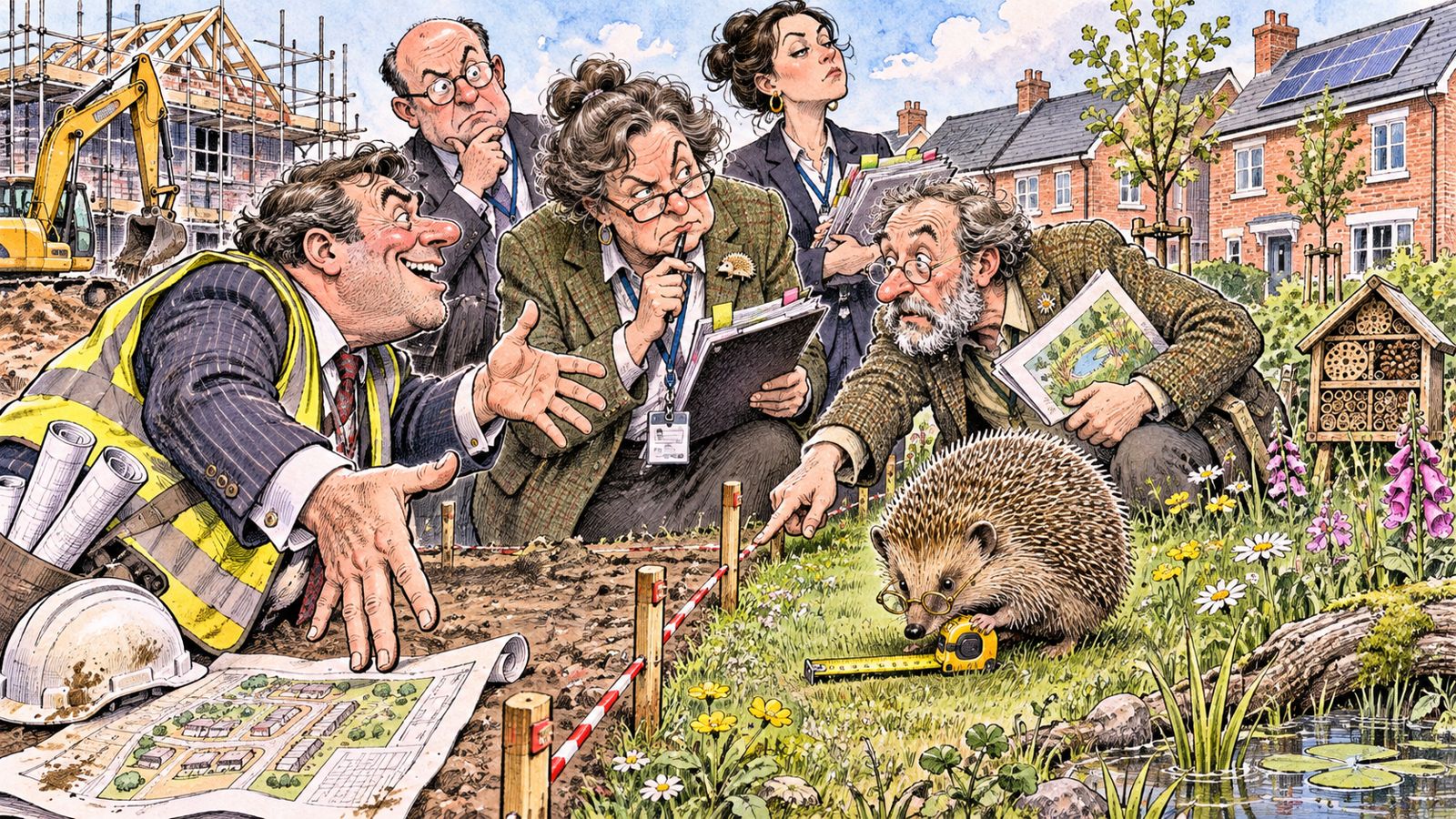
A consultant suggested a shared vision. Jo suggested a clear plan showing homes, useful habitat and the relevant requirements. The consultant said a vision would be easier to unveil.
Nature has not read the site schedule
The wider argument is about how housing delivery and environmental responsibilities should fit together. A threshold may simplify administration, but the public debate still needs to examine what the change does in practice.
At an informal site meeting, the sparrow proposed judging the result by whether people obtained homes and wildlife retained meaningful space. An official said that combined two objectives. The sparrow said so did a garden.
The hedgehog has applied for a boundary map. Its first request was returned because the form asked for an address, and beneath the pallet was considered insufficiently precise.
Jo has offered to help translate the plan into something everyone can follow. She regards this as ordinary project management. The consultant regards it as a possible new service line.
The department is considering how to communicate the proposal. Wildlife has requested that the explanation arrive before the excavator, so it can establish which side of the policy it is currently standing on.
Editorial disclaimer: The world’s oldest tenured professor and a philosophy major turned dairy farmer have lent the hedgehog a tape measure and left the wildlife unharmed.

Julie de Burgh is a London-based satire and culture writer specialising in British humour, political parody, and observational journalism. Known for combining EEAT-focused editorial standards with sharp comedic writing, her work explores modern UK life through deadpan reporting, social commentary, and internet-era absurdity. Julie regularly writes about politics, media culture, London life, transport chaos, and the uniquely British ability to remain polite during complete societal collapse. Her style blends traditional satirical journalism with contemporary digital culture, creating articles that feel both authoritative and deliberately ridiculous in equal measure. [email protected]


