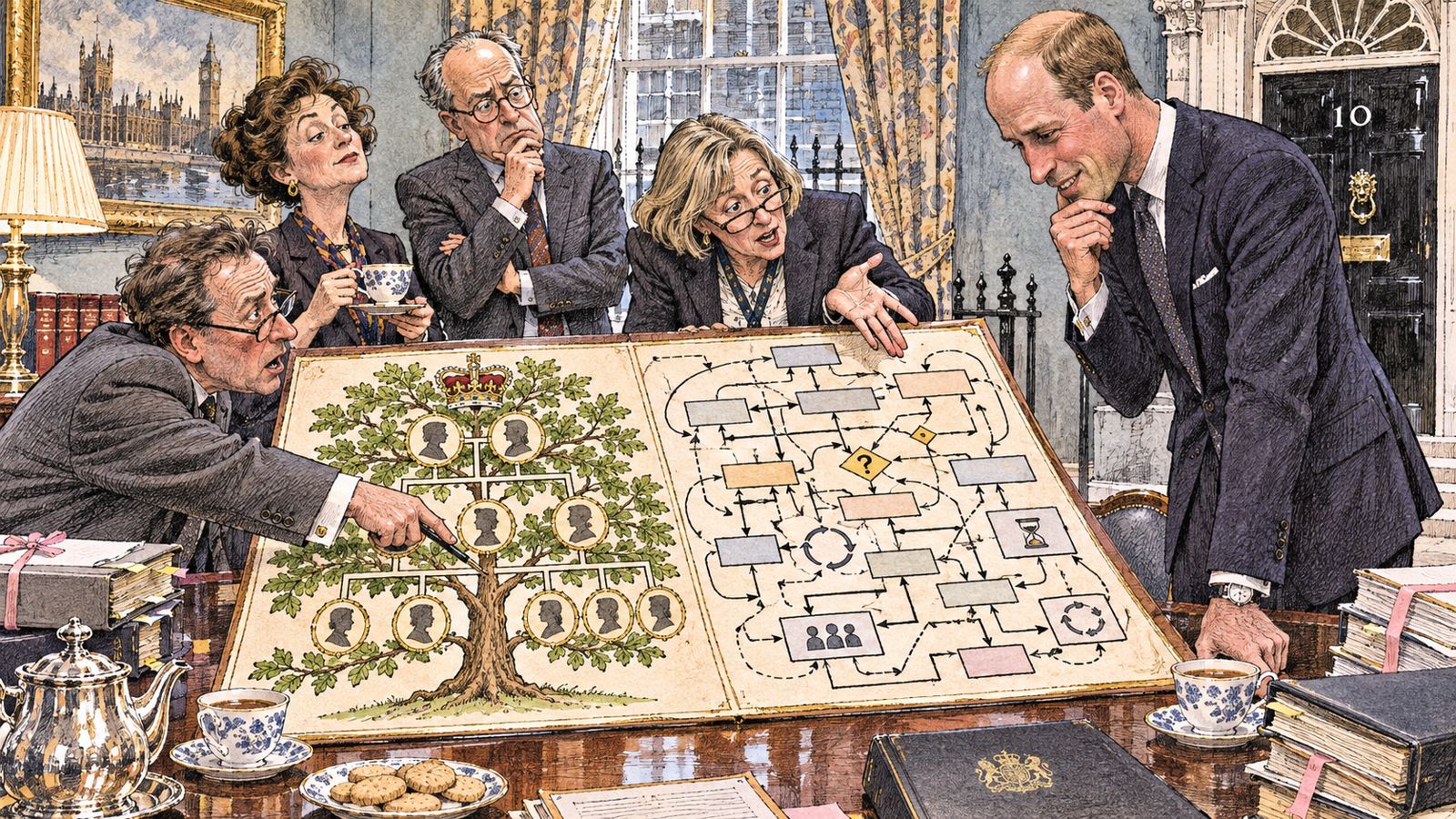
WESTMINSTER — Prince William’s Downing Street visit has prompted civil servants to ask how an institution keeps a succession plan in the same drawer for more than one financial quarter without somebody announcing a reset.
The official account of the Prince of Wales’s meeting with the prime minister confirms the visit. The comparison between royal continuity and political turnover has been supplied by observers, whose first finding is that a family tree is considerably easier to follow than several recent government organisation charts.
Prince William at Downing Street meets the seating plan
At the Institute for Institutional Memory, a civil servant laid out a neat succession diagram beside a chart of departmental responsibilities. One looked like a tree. The other looked like someone had tried to repair a fishing net during a leadership contest.
The official said elected government was meant to change. The institute’s archivist agreed. He merely wondered whether changing the minister required everyone to forget where the previous minister had put the working folder.
Political accountability and hereditary succession are different arrangements. Neither becomes easier to understand when a communications team describes every change of personnel as the beginning of a completely new era.
Continuity has located the instruction manual
A junior official proposed preserving useful knowledge between administrations. A colleague said this might imply that something useful had happened before the present launch. The proposal was softened to discovering previously unavailable opportunities for continuity.
Management scholar Dr Alice Handover said organisations worked better when decisions, responsibilities and practical knowledge survived a change at the top. Asked whether this was a radical theory, she said it was fairly familiar to anyone who had ever handed a shop key to the next shift.
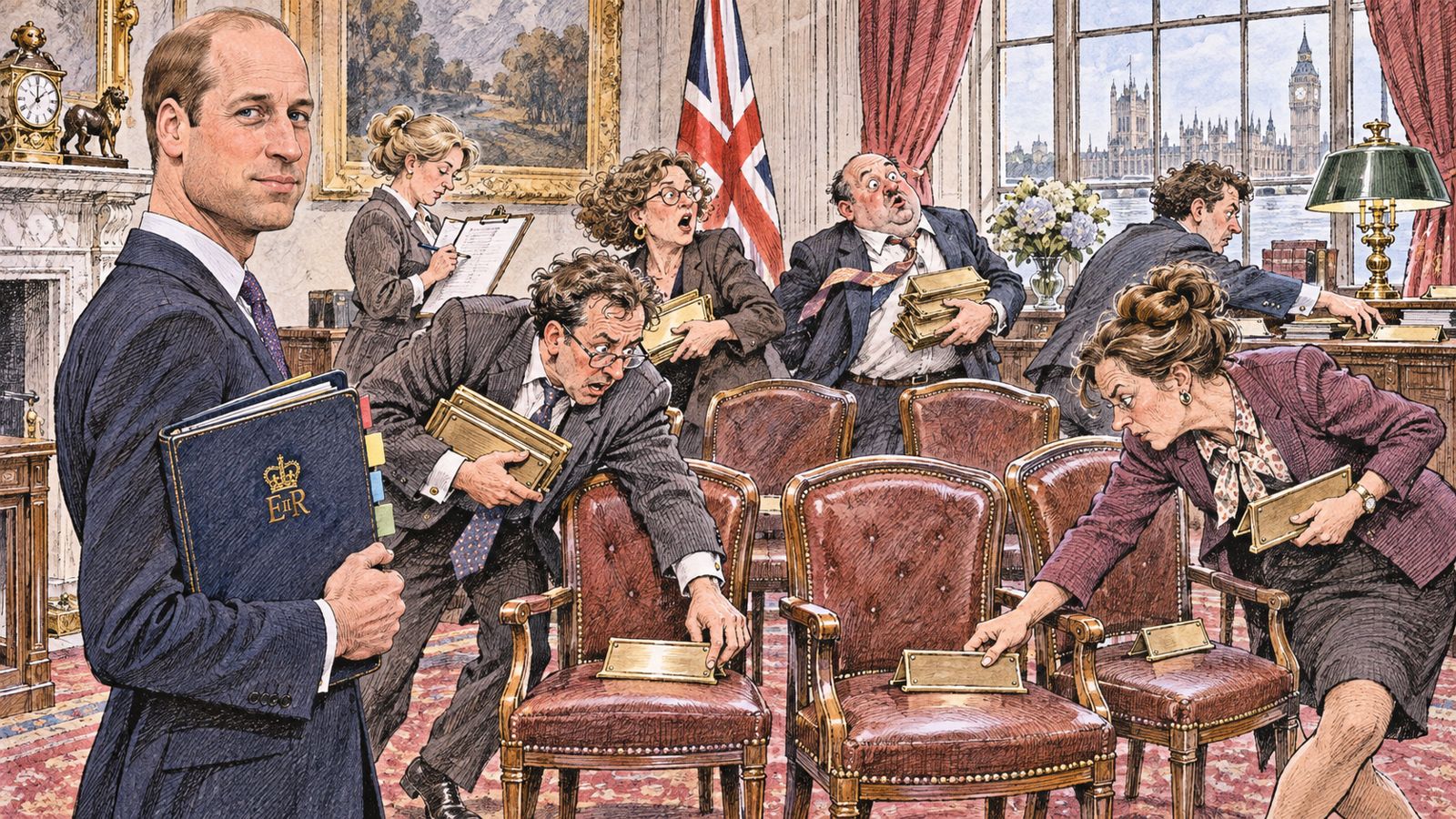
An adviser suggested giving the practice a new name. Dr Handover suggested giving the next person the key.
A long view needs something beyond the next photograph
The Prince of Wales’s official information describes his public role. It does not provide a template for running an elected government by ancestry, a proposal nobody at the institute has made.
Their narrower point is that institutions benefit from remembering what they are supposed to do. A new mission statement may be helpful. It is less helpful if writing it consumes the time previously reserved for doing the mission.
One civil servant said the best continuity plan would identify which commitments needed delivering, who held responsibility and what had already been tried. His colleague asked whether a sufficiently large portrait could achieve the same effect.
An informal office poll found enthusiasm for stable processes, followed by an argument over whether stability sounded insufficiently dynamic. Participants resolved the disagreement by renaming it durable transformation.
The official readout of the visit remains brief. The Institute for Institutional Memory considers this refreshing: the organisation’s own report has already developed seven appendices.
It is now considering a handover document. Nobody has decided who should receive it, but several people have offered to lead a review.
The archivist has put the key back in the drawer. He hopes the next team will remember which drawer.
Editorial disclaimer: The world’s oldest tenured professor and a philosophy major turned dairy farmer have labelled the handover drawer. The next team has been told where it is.