
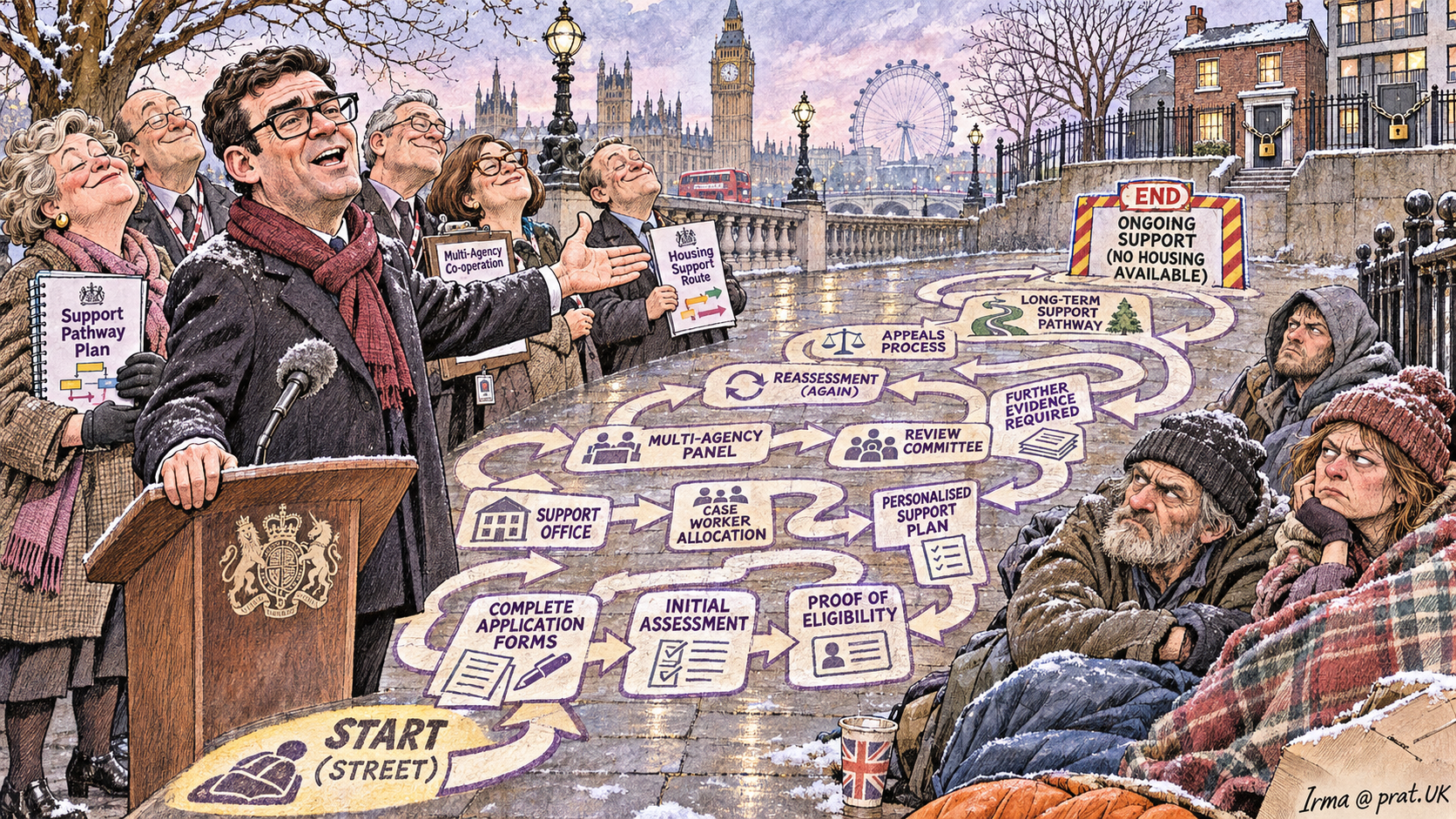
A December deadline meets a very short supply of front doors
LONDON, England – Prime Minister Andy Burnham’s promise to offer rough sleepers a route off the streets by Christmas is facing difficulties after local councils discovered that Britain has a serious shortage of the one thing generally required to house people.
Houses.
According to reporting on the homelessness pledge, England recorded 8,748 people sleeping rough in the most recent monthly figures, with only 15% found accommodation by the end of that month. Ministers acknowledge that a route off the street will not necessarily mean an immediate housing placement, and the homelessness minister has said it could equally be a plan for mental health or substance misuse support, as ITV News reported when the pledge was made.
The distinction has attracted considerable interest from civil servants.
What a Route Off the Street Actually Means
A government planning official explained that the Prime Minister had promised a route off the streets rather than a fully furnished flat.
This creates several administrative possibilities.
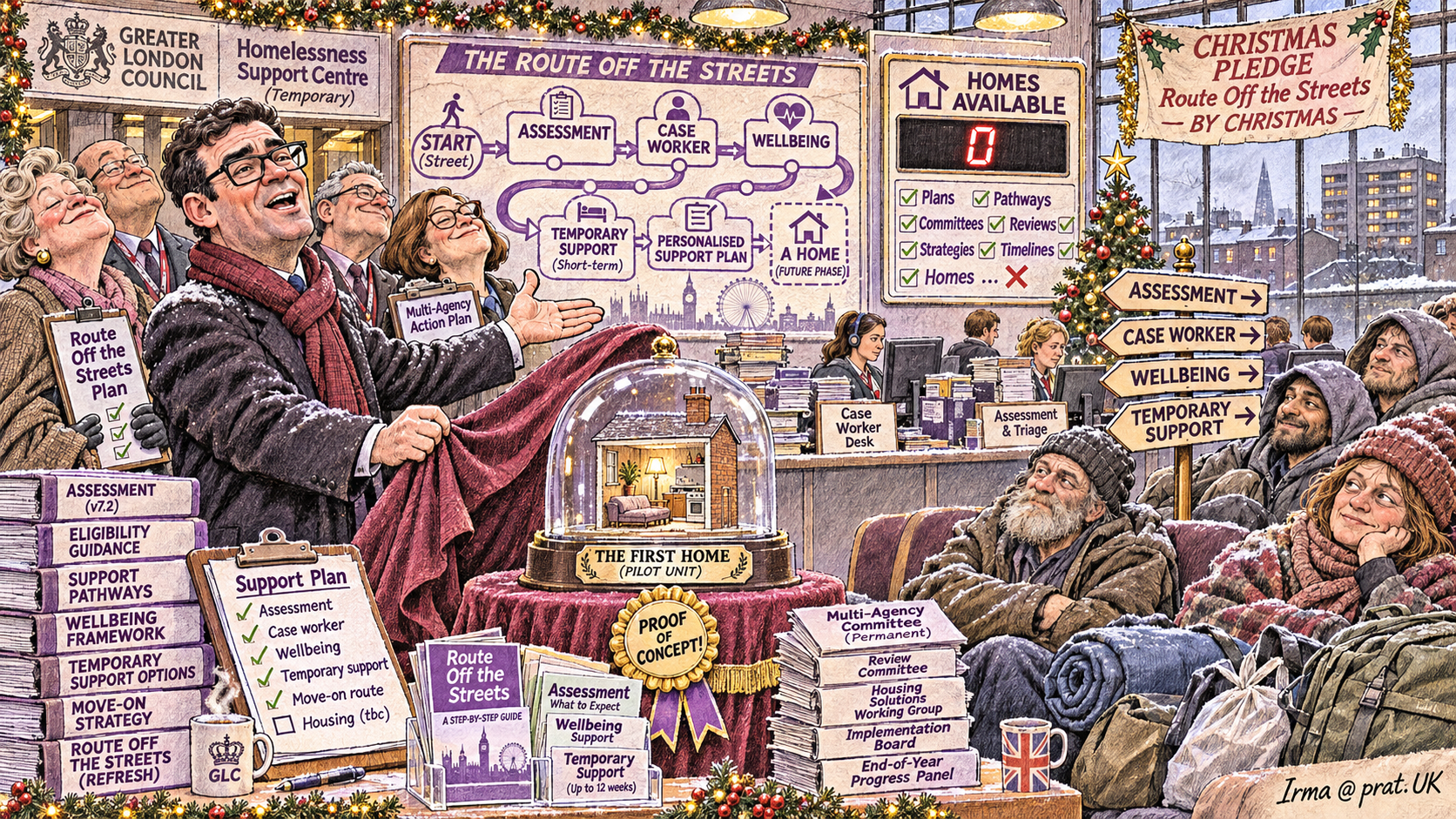
A route might involve an assessment, an appointment, a referral, a personal support plan or a meeting about a future meeting.
A concerned London resident asked whether the route eventually leads indoors.
“That is certainly the ambition,” the official replied.
Asked whether anyone had identified an available property, he explained that implementation remained subject to local circumstances.
The resident suggested that Christmas was approaching regardless.
A charity analyst did the arithmetic that the press release had left out. If 15% were accommodated, then 85% were not, which on the published figure means more than 7,400 people still outdoors when the month ended. She said she hoped the route was a short one.
Councils Appeal to Father Christmas
Several councils have reportedly considered requesting assistance from Father Christmas, who appears capable of delivering goods to millions of properties in a single evening.
Unfortunately, his expertise lies primarily in accessing existing homes rather than constructing new ones.
One council leader proposed converting unused municipal buildings into temporary accommodation.
Another suggested bringing long-empty properties back into use.
A third recommended establishing a national committee to examine the first two recommendations.
The committee proposal was immediately approved.
Two housing officers compared notes by text one evening after the latest meeting:
Officer A: “Any beds for tonight”
Officer B: “We have a very promising pathway”
Officer A: “Does the pathway have a bed”
Officer B: “It has a leaflet”
Officer A: “Is the leaflet heated”
Officer B: “Under review”
Housing charities, meanwhile, continue emphasising the need for practical support, appropriate accommodation and sustained investment, a point Homeless Impact makes in arguing that a bed alone is not enough.
A person sleeping outside in winter requires more than an encouraging pamphlet.
England’s Housing Shortage and Temporary Accommodation Pressures
Temporary accommodation pressures, high private rents and insufficient social housing have created severe difficulties for local authorities. The official rough sleeping snapshot for England and the House of Commons Library’s briefing on rough sleeping causes and statistics set out the scale, in tables that nobody in government has ever been able to shelter under.
The government has committed additional funding, but money alone cannot instantly create suitable properties or specialist support services.
One council officer described attempting to find accommodation as similar to booking a hotel during a major sporting event.
Except every hotel is full, the budget is exhausted and the guest cannot wait until next season.
A Whitehall adviser proposed renaming the programme Christmas Housing Pathways.
The council officer asked whether the new name included any bedrooms.
It did not. The leaflet for the scheme carried a line of small print along the bottom:
Christmas Housing Pathways
A pathway is an aspiration. Bedrooms are subject to availability, which is subject to everything else.
Why Charities Say Rough Sleepers Need Homes, Not Slogans
The strongest aspect of Burnham’s promise is that it treats rough sleeping as a problem government should confront rather than accept.
The weakness is the enormous difference between declaring an objective and providing the accommodation, staff and services needed to achieve it.
A housing charity worker summarised the matter.
“People need somewhere safe to sleep. The paperwork can follow.”
Whitehall agreed that this was an important perspective.
A consultation was proposed.
Father Christmas, contacted for assistance, reportedly asked whether Britain could at least finish building the chimneys.
Five Observations on the Christmas Housing Pledge
- The Prime Minister promised a route off the street, not a flat. That’s like a restaurant promising you a route to the kitchen. You can see the food. You just can’t eat it.
- A pathway with no bed and a leaflet that may or may not be heated. Folks, that’s not a housing policy. That’s a Pret with a queue system.
- Fifteen per cent got somewhere to go. Fifteen. If my GCSE results had been that good, I’d have been a minister.
- Councils want to ask Father Christmas for help. He’s the only man in Britain who can get into 30 million houses in one night, and he’s never once been asked for a planning application.
- They’ve proposed a committee to look at the first two proposals. In this country, if you want a problem to last until the spring, you set up a committee to hurry it along.
This is satire aimed at the housing system, never at the people sleeping in doorways. Father Christmas has not yet replied to the councils. More UK satirical news is available, no temporary accommodation required.

Staff Writer at The London Prat


