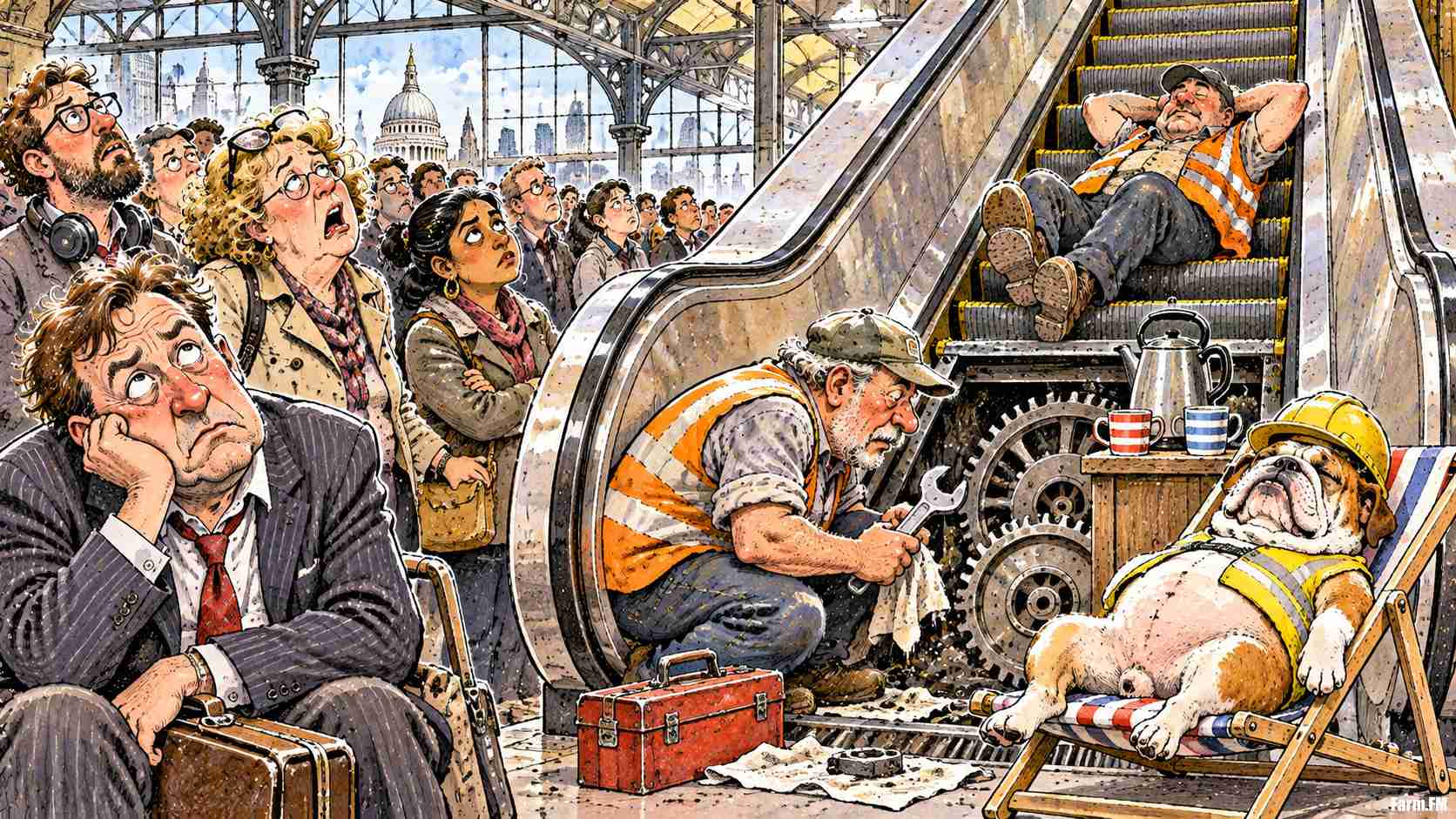
Seven months shut to save passengers a flight of stairs
LONDON, England — Britain has announced an innovative approach to maintaining public transport infrastructure: close a railway station for seven months so that passengers can eventually enjoy the convenience of not having to walk upstairs.
City Thameslink Station Closure: Seven Months for Ten Escalators
City Thameslink station will close from mid-May to late December while engineers replace ten ageing escalators.
The machines have been operating for approximately 35 years, and some suffered serious damage during flooding last year.
Network Rail says a full closure is the safest and most efficient approach, according to The Independent’s report on the City Thameslink closure.
Commuters acknowledge that infrastructure requires maintenance.
They are nevertheless fascinated by the distinctly British engineering achievement of making an entire railway station unavailable because the stairs have become too complicated.
The replacement project will involve specialist machinery, complex installation procedures and extensive testing.
A commuter who has used the station for fifteen years explained the emotional impact.
“I always assumed escalators were stairs with ambition. Apparently they’re nuclear reactors with handrails.”
Walking to Blackfriars: The Alternative Route
Network Rail has advised passengers to use London Blackfriars, approximately six minutes’ walk from City Thameslink’s Ludgate Hill entrance.
This means that for seven months commuters will be encouraged to walk six minutes to avoid a station whose primary convenience was reducing the amount they needed to walk.
Transport economists have described this as an impressive circular achievement.
A government efficiency committee has already proposed closing Blackfriars temporarily so passengers can learn the benefits of walking to Farringdon.
Within a few years, the entire Thameslink network could be replaced by a pamphlet encouraging people to develop stronger calves.
Britain’s Gift for Turning Escalators Into Epics
The closure also reveals Britain’s extraordinary capacity to turn mundane infrastructure into a national engineering epic.
Other countries replace escalators.
Britain announces a project, appoints stakeholders, establishes a communications framework, publishes an alternative travel strategy and sends an apologetic email explaining that inconvenience is regrettable.
The actual escalators arrive somewhere in the middle.
A local businessman has proposed installing ordinary stairs as an emergency alternative.
Engineers rejected the suggestion after discovering that stairs cannot be switched off during maintenance, creating an unacceptable risk of continuous public access.
Why Network Rail Says a Full Closure Is Necessary
Passengers have also questioned whether some escalators might be replaced while the others remain operational.
Network Rail argues that the full closure will reduce the overall duration and meet safety requirements that partial operations could not satisfy.
This is a reasonable technical explanation, although London commuters reserve the right to find it infuriating.
The Station Closure on the Record
The Spokesperson Statement
A Network Rail spokesperson said the closure represented “a significant investment in the long-term resilience of the station,” and that passengers “will notice the difference.” Asked what the difference would be, the spokesperson said that the escalators would be new and that the station would be open, both of which she described as “headline benefits.”
The Leaked Project Memo
A project planning memo seen by this publication lists the principal risk to the programme as “passenger expectation that the station will be open.” The mitigation column reads: “Communications.” A second risk, “escalators not yet delivered,” is assigned a low priority on the grounds that it is considered “a later problem.”
The Commuter Group Chat
Messages from a group chat of regular City Thameslink users show a rapid emotional progression. The first reads “Seven months?!” The second reads “ok but Blackfriars is fine.” By the fortieth message, a member has proposed moving to Birmingham, and another has replied “honestly, same.”
New Escalators, Fewer Regular Passengers
The ten new escalators are expected to offer improved reliability when the station reopens.
By then, many regular passengers may have discovered alternative routes, new workplaces or entire careers that do not involve travelling through central London.
Network Rail has promised the investment will improve the station for decades.
Passengers have requested one modest additional feature.
A railway station that is open.
Five Humorous Observations
- They’re closing the whole station for seven months to fix the escalators. You ever see a guy burn down a house because the toaster was acting up?
- “Walk six minutes to Blackfriars.” So the station that saved me from walking is closed, and the solution is walking. That’s not a detour, that’s the plot of a very sad sitcom.
- Stairs can’t be switched off for maintenance. You can’t. Stairs are the one thing in London that’s always working. It’s the only reliable infrastructure we’ve got, and they’re embarrassed by it.
- The risk register says the biggest risk is people expecting the station to be open. Yeah. That’s what a station is. That’s the whole concept. That’s like a restaurant listing “customers wanting food” as a hazard.
- Seven months. By the time they reopen, I will have changed jobs, moved house and gotten really into sourdough. The escalators will come back and I’ll be a different man. A fitter, angrier man.