Russia Checks for Soldiers
LONDON, England — Britain’s Ministry of Defence has issued updated guidance on screen use, workplace comfort and digital communication, raising the possibility that the next military confrontation could be interrupted by a mandatory reminder to adjust somebody’s chair.
The official display-screen equipment guidance, published last week, addresses personnel who work extensively with computers. Reporting in The Times highlights recommendations on breaks, posture and the use of emojis in appropriate digital communication. The guidance concerns workplace health and safety, not instructions for frontline troops to abandon combat duties.
But that distinction offers little protection against Britain’s growing reputation for making absolutely everything sound like a meeting of the Human Resources Committee.
Military Screen Break Rules: The Enemy Has Missiles, We Have Lumbar Support
Britain’s military must handle cyber operations, intelligence systems, drones and complex electronic equipment. Such work genuinely requires people to spend long periods looking at screens, and the wider public-sector rules on display screens, set out by the Health and Safety Executive, are sensible. The new guidance recommends regular breaks and sensible workstation arrangements. So far, perfectly reasonable.
The entertainment begins when Britain’s national defence establishment must explain how to sit in a chair.
Transcript: Cyberattack Meets Screen Break
An account of a recent exercise at a strategic command centre, shared by a participant who attended in a seated and supported capacity, runs as follows.
“Enemy activity detected, sir!”
“Activate countermeasures.”
“Can’t, sir. Lieutenant Jenkins is taking his screen break.”
“Where is Lieutenant Jenkins?”
“Looking at a distant tree to relax his eyes.”
“Can he see the enemy?”
“Only if they’re standing behind the tree.”
The exercise was scored a narrow success. The tree was commended.
Emojis in the Armed Forces: The Emoji Is Mightier Than the Sword
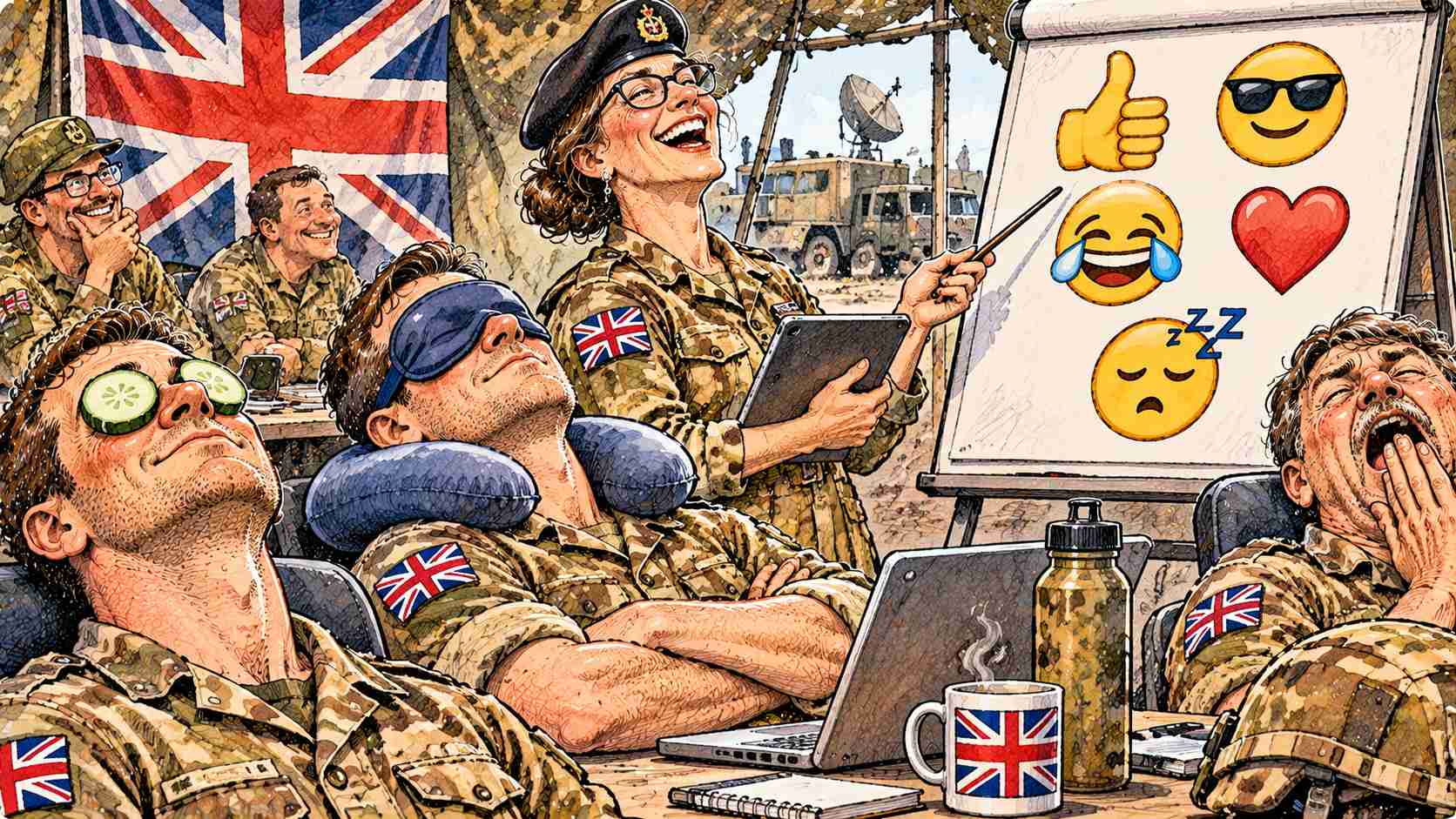
Reports also describe advice encouraging concise messages and, where appropriate, emojis. This opens the door to a diplomatic revolution. A stern message from the Ministry of Defence could now conclude with a reassuring thumbs-up. A battlefield assessment might feature a worried face. A successful training exercise could receive three celebratory symbols and a request for everyone to complete the satisfaction survey.
Trevor Hardcastle, a retired sergeant major, offered his assessment.
“When I joined the Army, communication involved shouting until somebody understood. Now apparently we’re communicating feelings through tiny yellow cartoons.”
He studied a smiling emoji for some time. “In my regiment,” he said, “that means somebody’s polished the wrong boots.”
Naturally, emojis are already widely used in ordinary digital communication, and their appearance in administrative guidance is hardly a strategic catastrophe. But it is an irresistible illustration of Whitehall’s ability to make modern life sound more bureaucratic than it needs to be.
Health and Safety at the Ministry of Defence: The Paperwork Advances
Military office workers also receive advice about posture, screen positioning and equipment safety. Nobody seriously disputes that repetitive strain or poor ergonomics can harm employees. The question is whether a military organisation needs the administrative solemnity of a peace treaty to explain that prolonged screen use can cause discomfort.
Leaked Doctrine From the Defence Productivity Directorate
A draft operational doctrine circulating among desk-based personnel sets out the new procedure in full. Before opening a spreadsheet, personnel must verify their seating position. Before sending an email, they must confirm emotional readiness. Before moving the mouse, they must assess whether the mouse has adequate workplace support. At the conclusion of every operation, employees will be invited to rate the experience between one and five stars. A handwritten annotation on the final page reads, “Four stars. Chair was fine.”
Veterans have taken the news in good humour, mostly. A former corporal said the Army had always believed in looking after its people, but that nobody had thought to look after their eyes until the NAAFI got a card machine. A serving signaller said the emoji advice had caused the first real disagreement in her unit for months, over whether a thumbs-up was an order or a mood.
Britain’s New Strategic Deterrent Is Paperwork
Defence experts understand that modern warfare relies increasingly on technology and trained specialists, and protecting the health of those specialists is sensible. However, Britain’s government has a recurring talent for turning ordinary good practice into a document that sounds capable of defeating the enthusiasm of an entire battalion.
The London Prat proposes an alternative military motto: “Be prepared, stay alert and try not to injure yourself while reading the preparation instructions.”
Meanwhile, a Russian intelligence officer receives a translated copy of the British guidance. He reads the passages on eye breaks, chairs and emojis, then turns to his superior.
“Do we still need to worry about the British Army?”
“Absolutely,” replies the general. “Any military that can survive this amount of paperwork must be extraordinarily resilient.”
For once, the British bureaucracy might actually be a weapon of mass exhaustion.
5 Humorous Observations on the Army’s New Guidance
- Britain’s military is preparing for the next generation of warfare. The enemy has hypersonic missiles; our desk-based troops have posture assessments.
- The Army’s being told to take screen breaks. Somewhere a general says “Lieutenant, advance on the enemy,” and the lieutenant’s looking at a tree.
- Emojis in the military. The enemy sends a missile, we send a thumbs-up. Which, to be fair, is also how I handle most of my family WhatsApps.
- Britain will lose a war on ergonomics and win the compensation claim.
- Eleven minutes for a form about chair height. The missile takes less time. At least the missile has a clear objective.

Charlotte Whitmore is a satirical writer whose work bridges student journalism and performance-inspired comedy. Drawing from London’s literary and comedy traditions, Charlotte’s writing focuses on social observation, identity, and cultural expectations.
Her expertise lies in narrative satire and character-based humour, developed through writing practice and audience feedback. Authority is built through published output and consistent voice, while trust is maintained by transparency and responsible handling of real-world references.
Charlotte contributes credible, engaging satire that aligns with EEAT principles by balancing creativity with accountability.