
Russell Brand Wants Evidence, Britain Offers a Grin
The defence asks questions. The comment section asks why.
LONDON — Russell Brand’s defence has run into a formidable rival in the administration of British justice: a headline. Following LBC’s report on the trial, the nation’s armchair prosecutors have been invited to consider whether a description of somebody’s grin can do the work previously assigned to evidence, cross-examination and a jury.
Brand denies the charges and says his sexual encounters were consensual. His defence deserves to be heard at full volume. Presumed innocence shouldn’t arrive as the little sachet of salad dressing attached to an enormous takeaway box of accusation.
The prosecution must establish its case. Brand doesn’t have to win a national popularity contest before his lawyers are allowed to question it. Otherwise the courts could simply swap the jury box for the voting equipment from a television talent show and let three celebrities explain that his defence lacked emotional connection.
Russell Brand Trial: First, Perhaps Someone Could Examine the Room
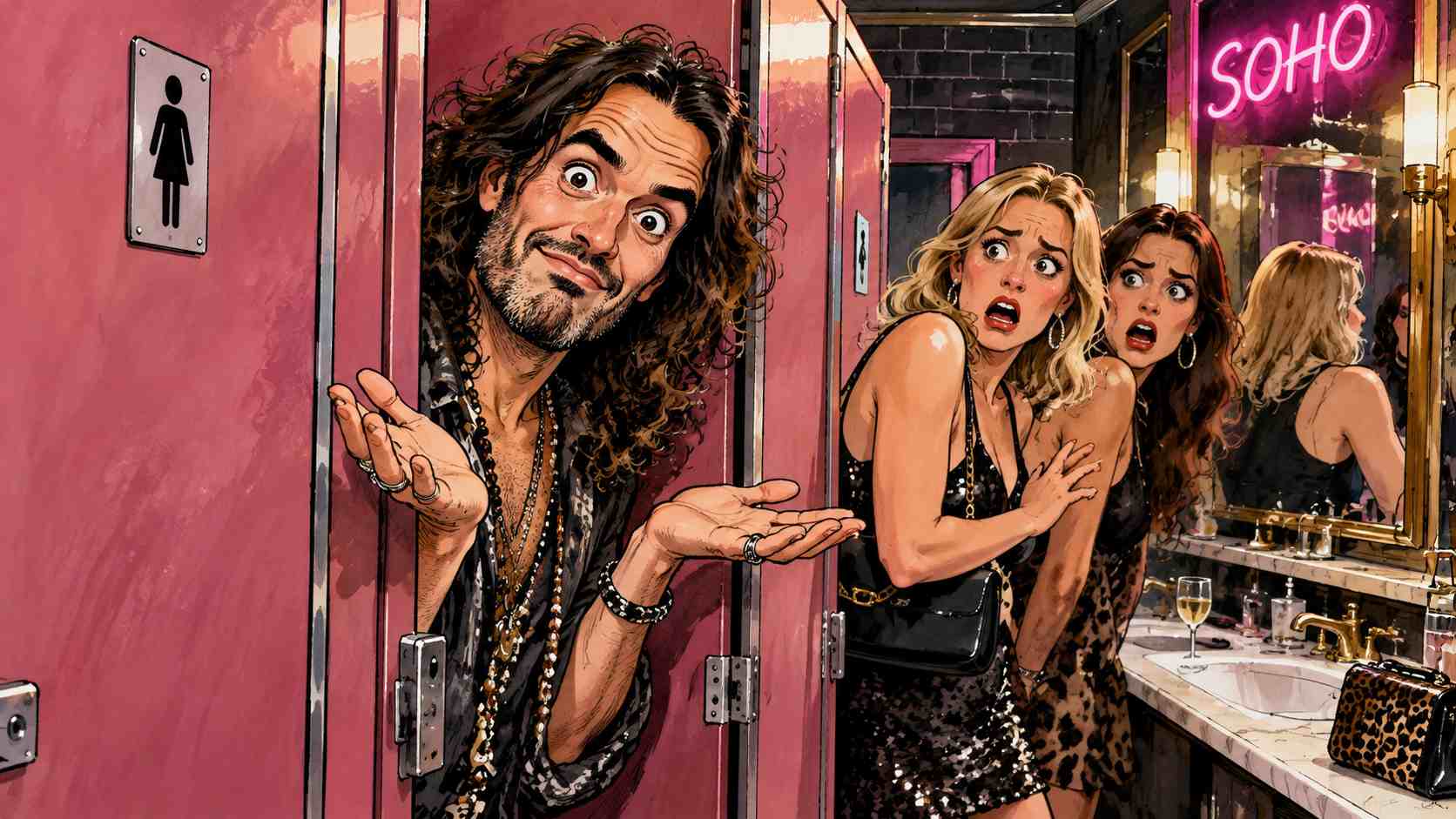
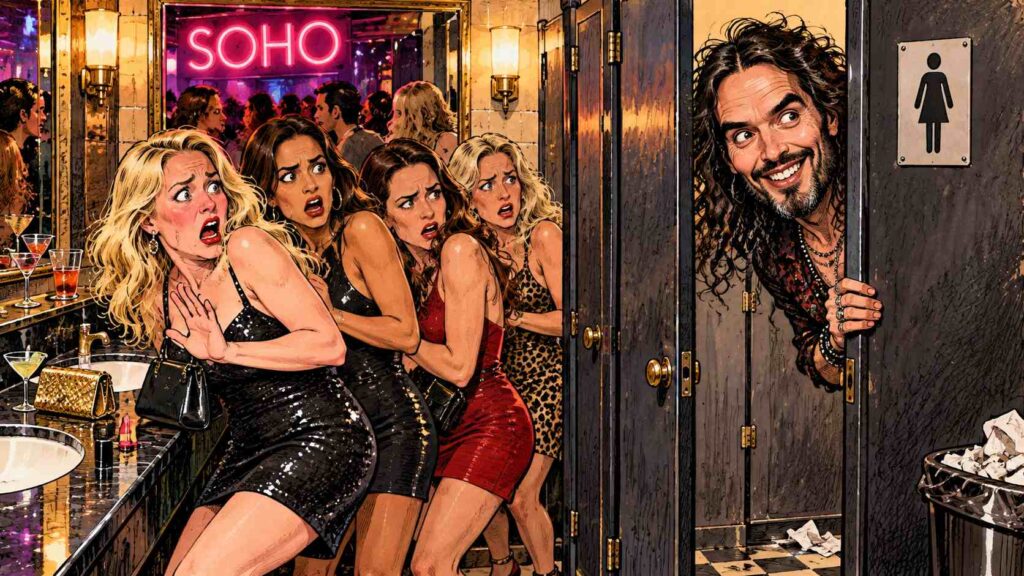
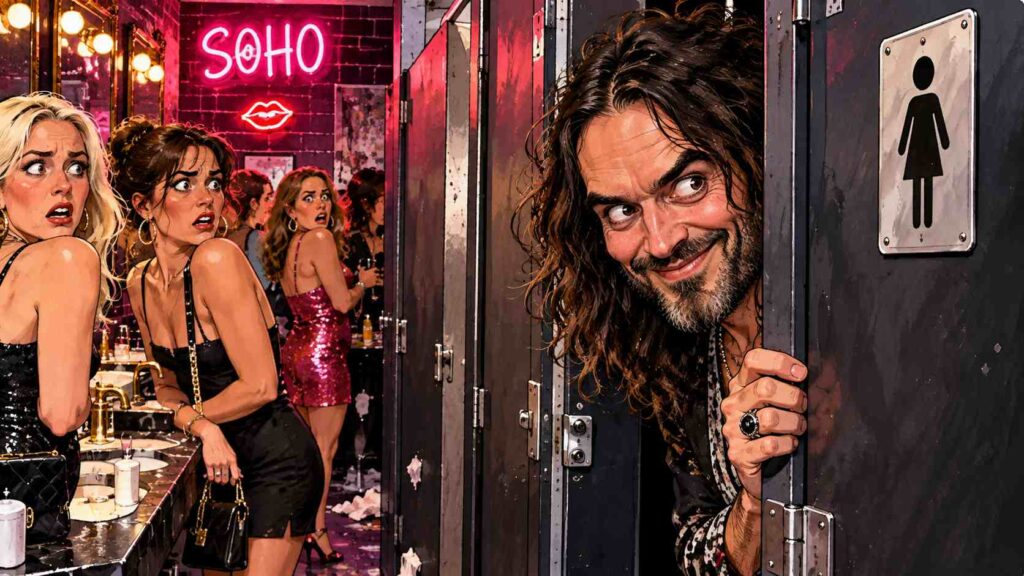
The nightclub question is precisely the sort of practical issue a defence should examine. Where were people standing? What could they see? What was the route to the toilets? Which witnesses can describe events? What does the physical layout allow anyone to establish?
These are useful questions. British public debate has therefore decided to make everyone uncomfortable for asking them.
According to Reuters’ account of the defence cross-examination, Brand’s lawyer challenged whether the alleged public conduct would have been witnessed and described the alleged incident in the toilet as “physically impossible.” The complainant disputed his account. Those are reported courtroom positions, with the defence plainly contesting what happened.
Readers should hear those challenges alongside the accusation. A defence argument doesn’t become an embarrassing technicality merely because it interrupts a particularly satisfying headline.
Burden of Proof in a British Criminal Trial Is Quite Heavy
The burden of proof is the prosecution’s responsibility. It can’t be transferred to the accused because the audience has become impatient.
This arrangement is inconvenient for people who prefer justice delivered like a parcel: ordered in anger, dispatched immediately and left outside somebody’s door before lunch.
Brand is entitled to challenge the sequence, the circumstances and the reliability of the evidence. Every contested detail deserves examination. The legal system should be particularly resistant to the suggestion that asking an awkward question is itself evidence of an unpleasant character.
If defendants were expected to prove that nobody could possibly accuse them, the first appearance would require a solicitor, a time machine and complete surveillance footage of adolescence.
The court has procedures because certainty is easy to manufacture in conversation. It gets considerably harder when somebody asks where it came from.
Why a Headline Is Not Evidence: A Grin Enters the Witness Box
The reported description of Brand’s expression supplies the kind of memorable phrase that can travel much further than a careful account of disputed evidence.
A grin is compact. A grin fits on a phone screen. A grin doesn’t require the reader to learn the layout of a building.
Still, a grin lacks several qualifications normally expected of decisive evidence. It can’t explain a timeline, answer a question or distinguish an accusation from a proved event.
The defence should be allowed to insist on those distinctions without being accused of spoiling the atmosphere.
Britain has spent centuries developing rules for testing criminal allegations. It would be unfortunate to discover the whole undertaking could have been replaced by somebody announcing that a man looked peculiar. A former Attorney General, Lord Goldsmith, told the Westminster and Holborn Law Society years ago that trial by media has no place in our society. The comment section was not in the room.
Defence Cross-Examination Is Part of the Trial, Not an Interruption
Cross-examination is supposed to interrupt an account with questions. That is part of its function. Treating the interruption as objectionable rather misses the point.
A defence lawyer who politely accepts every proposition would certainly improve the pace. The court could finish early, the reporters could catch their trains and the accused could receive a commemorative receipt.
Brand’s lawyers are there to test the prosecution’s case. Their questions deserve accurate reporting and serious consideration. Whether a challenge ultimately succeeds is for the court process to determine.
The public should welcome scrutiny that exposes a weak allegation, a strong allegation or a detail requiring more examination. Justice can’t depend on which outcome would make the better afternoon on social media.
Trial by Social Media and the Contempt of Court Problem
Public certainty enjoys excellent working conditions. It doesn’t have to attend every day, study every account or listen when the evidence gets complicated.
It can arrive late, read a sentence and announce that the professionals are taking too long.
The online juror also benefits from a remarkably flexible evidential standard. A remembered interview can become a character assessment. A disliked opinion can become a motive. A photograph can become an entire summing-up.
The Attorney General’s Office keeps repeating the point in its media advisory notices: publishing material that asserts or assumes the guilt of a defendant facing trial risks contempt of court. The online juror hasn’t read them and is unlikely to start.
Brand deserves protection from that process. The prosecution has to address the actual allegations. An audience’s accumulated irritation doesn’t become an additional witness merely because thousands of people share it.
If collective annoyance were sufficient, every man who watches videos aloud on a train would already be serving consecutive sentences.
Presumption of Innocence Requires No Membership Card
Defending Brand doesn’t require a subscription to his broadcasts. It requires the willingness to apply a principle when the person receiving its protection attracts strong opinions.
The presumption of innocence loses most of its value if it operates only for people who have already passed an audience approval test. It sits in Article 6 of the European Convention on Human Rights, which says nothing about a vote.
That would resemble an umbrella guaranteed to function throughout dry weather.
Brand’s denial should be stated clearly. His defence should receive proper attention. Questions about witnesses and physical circumstances should be examined carefully. None of those demands is extravagant.
They amount to asking a criminal justice system to perform the activity printed on the front of the building.
Somehow, this has become a position requiring considerably more explanation than declaring complete certainty from a bus stop.
Please Keep the Questions in the Trial
The practical demand is simple: follow the evidence through the trial. Report the defence’s challenges clearly. Examine what supports each allegation and what undermines it. Let scrutiny do its work.
A busy nightclub raises questions about observation and witnesses. The answer requires the evidence. The defence is entitled to pursue it without the public treating the question mark as an offensive symbol.
There is no reason to award a headline the authority of a verdict. Headlines are designed to attract attention. Courts are supposed to determine whether criminal charges have been proved. Confusing those jobs gives typography rather more constitutional power than anyone intended.
Brand is entitled to insist that his case be judged through that process.
Until it is, the nation’s self-appointed judiciary might consider an unprecedented procedural reform: letting the defence finish speaking before announcing that the trial has gone on quite long enough.
Five Observations on Trial by Headline
- A grin is not evidence. My uncle grinned all through a funeral because the buffet was good. Nobody put him on a register.
- Everybody is a juror until it’s time to read the paperwork. These are people who won’t read the terms and conditions on a phone app, and they’ve reached a verdict on a six-week trial by Tuesday lunchtime.
- The comment section has a perfect conviction rate and has never once been appealed. Mostly because the judge is a guy called Dave whose profile picture is a Spitfire.
- We say “innocent until proven guilty” the way a pub says the Wi-Fi password. It’s right there on the wall, and nobody in the building thinks it works.
- Imagine being asked to prove it didn’t happen. I can’t prove I didn’t eat the last biscuit, and that’s a biscuit. I’d need a solicitor, CCTV and a very clean tongue.
Disclaimer
This piece defends Brand’s presumption of innocence and challenges trial by headline. Brand denies the charges; the trial continues. The world’s oldest tenured professor and a philosophy major turned dairy farmer may debate the newspaper over breakfast, but the verdict belongs to the jury.

Alan Nafzger was born in Lubbock, Texas, the son Swiss immigrants. He grew up on a dairy in Windthorst, north central Texas. He earned degrees from Midwestern State University (B.A. 1985) and Texas State University (M.A. 1987). University College Dublin (Ph.D. 1991). Dr. Nafzger has entertained and educated young people in Texas colleges for 37 years. Nafzger is best known for his dark novels and experimental screenwriting. His best know scripts to date are Lenin’s Body, produced in Russia by A-Media and Sea and Sky produced in The Philippines in the Tagalog language. In 1986, Nafzger wrote the iconic feminist western novel, Gina of Quitaque. He currently lives in Holloway, North London. Contact: [email protected]