This is FREE to my friends and readers of The London Prat.
FREE DOWNLOAD: Manchester City FC — The Cityad: The Wrath of the Hundred and Fifteen
Yes, completely free. No subscription, no paywall, no financial regulations to navigate, and certainly no 115 charges to explain. Consider it my gift to readers who appreciate satire, football, literature, and the glorious British tradition of taking something ridiculous and treating it with deadly seriousness.
I am Astrid Holgersson, and my book is The Cityad: The Wrath of the Hundred and Fifteen. I have taken two seemingly incompatible worlds—Homer’s ancient epic poetry and modern Manchester City FC—and thrown them together. What could possibly go wrong?
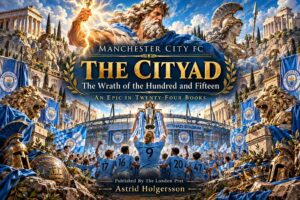
Quite a lot, as it turns out. But that is rather the point.
Why Manchester City? Because few football clubs offer such extraordinary material for an epic. There is ambition, glory, rivalry, spectacular football, passionate supporters, financial controversy, and enough argument to keep Mount Olympus occupied for several thousand years. Football is never merely a game. It is tribal loyalty, civic identity, family tradition, emotional investment, and occasionally a perfectly reasonable excuse for refusing to speak to your brother-in-law until Wednesday.
Manchester City’s modern story has all the ingredients of classical drama: the pursuit of trophies, celebrated personalities, Pep Guardiola’s tactical genius, rivalry with Manchester United, and the controversies surrounding the club’s finances. It practically begs to be told on an epic scale.
And then there is the number 115.
Few numbers in modern football have generated so much discussion, argument, commentary, and legal anticipation. The charges against City have become part of a much wider debate about money, governance, fairness, and the rules of the game. Allegations are not verdicts, of course, but they certainly provide material for satire. If Homer were writing today, I suspect his publisher would insist on a legal department.
That brings me to Homer, the ancient Greek poet traditionally associated with The Iliad and The Odyssey. These great works gave us heroes, battles, rivalries, divine interference, grand speeches, ambition, pride, and the consequences of believing oneself invincible. Homer understood that a battle was never merely a battle. It was a collision of personalities, loyalties, egos, and competing claims to glory.
Football understands all this rather well.
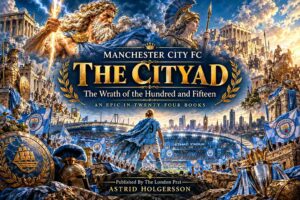
A derby can feel like a siege. A last-minute goal becomes a legend retold for decades. A referee’s decision can provoke more outrage than the fall of an empire. Supporters remember victories as heroic deeds and defeats as tragedies inflicted by fate, incompetence, or the suspicious activities of everyone wearing the wrong colour.
I found the parallels irresistible.
Across twenty-four books, The Cityad uses the conventions of epic poetry to explore Manchester City’s footballing world. I wanted to bring the grand language of antiquity into the modern stadium, where heroes wear sky blue, rivals sharpen their arguments, and the gods might occasionally need to consult the rulebook.
My ambition was not simply to write football jokes in fancy verse. I wanted to use an ancient literary form to explore a thoroughly modern sporting spectacle, with its extraordinary personalities, passionate loyalties, absurd controversies, and seemingly inexhaustible capacity for self-importance.
I have also drawn inspiration from the flowing poetic rhythms associated with Henry Wadsworth Longfellow. The result is my own meeting of classical storytelling, football culture, and satire.
You do not need a degree in classical literature to enjoy the book. You need not speak Greek, memorise the Trojan War, or understand every detail of Guardiola’s tactics. A passing familiarity with Manchester City and a willingness to laugh at football’s grand theatricality will do nicely.
City supporters may recognise their club’s triumphs and tribulations. Rival supporters are welcome, too. Every epic needs its antagonists, and football has never suffered from a shortage of people convinced that the other side ought to be investigated.
So, to my friends and readers of The London Prat, I offer The Cityad freely. Read it, enjoy it, argue with it, and tell me what you think. Share it with a City supporter, a United supporter, a lover of Homer, or anyone who believes football could use a little literary mischief.
I hope you enjoy reading it as much as I have enjoyed taking this wonderfully ridiculous idea seriously.
The gods are watching. The rivals are complaining. The lawyers are sharpening their pencils.
And somewhere in Manchester, another chapter of football mythology is being written.
The whistle blows. The epic begins.
With Love — Astrid Holgersson