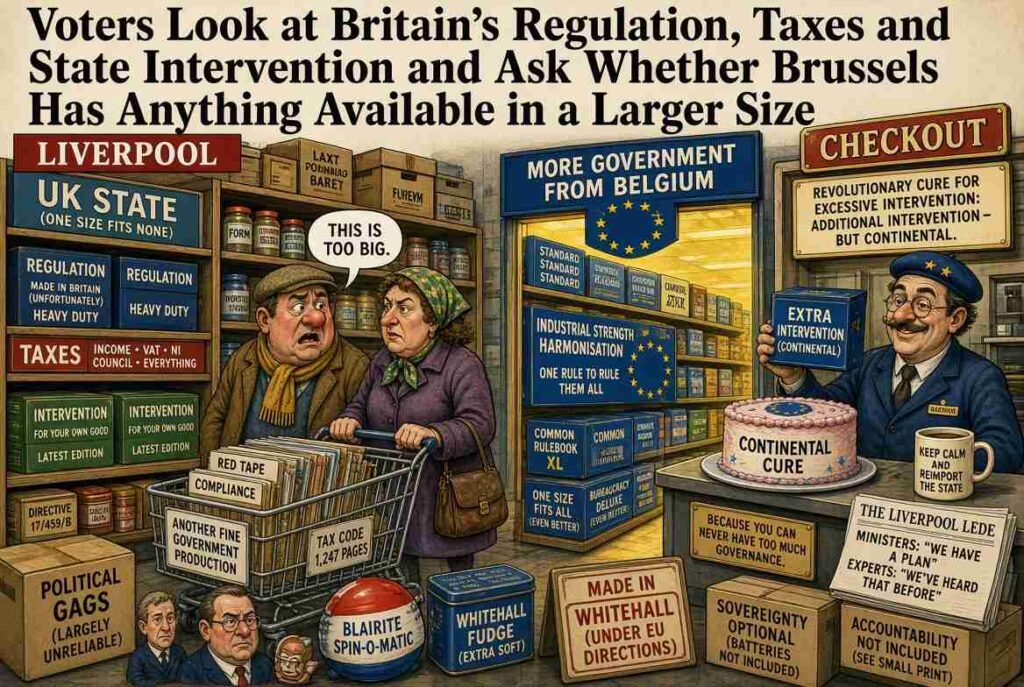
Britain Complains Government Controls Everything, Poll Finds Solution May Be More Government From Belgium
Voters Apparently Look at Britain’s Regulation, Taxes and State Intervention and Ask Whether Brussels Has Anything Available in a Larger Size
LIVERPOOL, England — Britain has reportedly discovered a revolutionary cure for people who believe the country already suffers from excessive government intervention: additional government intervention, but continental.
A new POLITICO/Public First poll found that 70 percent of respondents wanted some form of closer relationship with the European Union. More importantly for today’s national nervous breakdown, 39 percent wanted a much closer relationship even if that required Britain to follow some EU rules again. Another 31 percent wanted closer relations without accepting the EU rulebook. Among Reform UK supporters, 51 percent favored a closer relationship of some kind. Public First surveyed 2,028 U.K. adults online from September 13 through 15.
For British critics who already believe the country is drowning in government planning, taxation, regulation and bureaucratic enthusiasm, this raises an obvious question:
Have we tried adding Brussels?
Because nothing cures administrative indigestion like ordering another bureaucracy for dessert.
Britain has spent years complaining that the government regulates too much, spends too much, taxes too much, interferes too much and occasionally appears to require three departments and a consultation paper before a man may legally replace his garden shed.
And apparently a substantial portion of the public has examined this situation and said:
“Interesting. Is there a European version?”
UK-EU Relations Poll Satire: Britain’s New Economic Theory Says If One Rulebook Isn’t Working, Try Two
There is something magnificent about the logic.
Imagine your kitchen flooding.
Water is ankle-deep.
The refrigerator is floating toward Birmingham.
A plumber walks in and asks what happened.
You say:
“I appear to have too much water.”
He nods thoughtfully.
Then he installs another tap.
That is roughly how the anti-regulation wing of British politics will hear the news that 39 percent of respondents would accept some EU rules in return for substantially closer cooperation.
Not everybody supporting closer ties wants EU regulation, of course. Indeed, the poll’s 31 percent who favor closer cooperation without EU-rule compliance demonstrates precisely how complicated public opinion remains. Other polling this year, including research from the European Council on Foreign Relations, has also found strong support for a closer relationship that stops short of rejoining the EU, the single market or the customs union.
Britain therefore appears to want something exquisitely British:
European trade.
European cooperation.
European security.
European holidays.
European cheese.
European automobile supply chains.
But perhaps could we leave the regulations at reception?
It is the geopolitical equivalent of ordering the full English breakfast and asking whether the calories can remain in France.
Is Brexit Britain Really Socialist? Why “Socialism” Sounds More Sophisticated in French
Critics on Britain’s economic right increasingly use “socialism” as shorthand for policies involving nationalization, subsidies, extensive regulation, larger government programs or increased state direction of the economy.
The technical definitions are more complicated than that.
But satire has never survived by inviting six economists into a room and waiting for agreement.
Under the critics’ version of events, Britain has already spent years experimenting with a fascinating economic machine.
Insert taxpayer.
Pull lever.
Government announces program.
Program requires regulator.
Regulator requires office.
Office requires diversity consultant, procurement director, assistant procurement director and somebody whose entire career consists of sending emails beginning:
“Just circling back.”
Eventually £10 enters the machine.
£14 in administration comes out.
The government announces £3.50 has been successfully invested.
Then Parliament holds an inquiry into the missing £20.
And now some voters apparently want to connect this magnificent apparatus to Brussels.
Fantastic.
We can finally achieve administrative interoperability.
British bureaucracy will be able to communicate directly with European bureaucracy without requiring human intervention.
Two forms will reject each other automatically.
Labour and the EU: Andy Burnham’s Government Discovers Europe Offers Unlimited Opportunities to Govern Things
The political context makes the poll particularly combustible.
Prime Minister Andy Burnham has been under pressure from parts of Labour to reconsider the party’s existing EU “red lines,” and ministers have reportedly told The Independent that a route back toward the EU is being considered for the next manifesto. Tony Blair, through his Institute for Global Change, has advocated putting eventual membership of a reformed European Union back on the long-term agenda. London Mayor Sadiq Khan has publicly urged Britain to begin discussing rejoining. Burnham himself has emphasized closer trade relations without committing to re-entry.
You can understand why this excites certain politicians.
Politicians adore cooperation.
Cooperation produces meetings.
Meetings produce frameworks.
Frameworks produce working groups.
Working groups produce recommendations.
Recommendations produce white papers.
White papers produce implementation committees.
Implementation committees produce jobs for everyone who lost an election.
Before you know it, Britain has achieved economic growth somewhere around Conference Room B.
Free-Market Critics on Closer EU Integration: The Disease Apparently Requires Additional Symptoms
To critics who regard continental Europe’s larger welfare states and extensive regulation as cautionary examples rather than models, the enthusiasm for closer integration looks delightfully backwards.
Imagine visiting your doctor.
“Doctor, I suffer from headaches.”
The doctor examines you.
“I recommend another headache.”
“What?”
“A European headache.”
“Is it different?”
“It contains harmonized standards.”
Britain has genuine economic problems. Current debate includes weak household optimism, high energy costs, housing pressures, industrial competitiveness and difficult public-finance choices. AP’s reporting from Labour’s Liverpool conference described Burnham as confronting inflation, energy-price pressures and spending demands, while polling cited by The Times showed relatively few voters expecting to become materially better off over the next several years.
Reasonable people disagree over how much of those problems arise from Brexit, domestic government policy, global conditions, taxation, regulation, energy policy, productivity or Britain’s longstanding structural weaknesses.
But disagreement has never prevented Britain from immediately choosing somebody to blame.
Traditionally France.
Reform UK Voters and the EU: Nigel Farage’s Supporters Accidentally Wander Into Brussels
Perhaps the funniest finding is the Reform UK number.
Fifty-one percent of Reform supporters surveyed said they wanted a closer relationship with the EU, compared with 25 percent wanting greater distance.
Nigel Farage may need a larger cigarette.
Again, “closer relationship” does not mean “rejoin.”
That distinction matters enormously.
But imagine founding your political career around escaping Brussels only to discover half your supporters standing outside Brussels ringing the doorbell.
“Who is it?”
“Reform.”
“I thought you left.”
“We did.”
“So why are you here?”
“We want closer relations.”
“Would you like to come inside?”
“Absolutely not.”
“Would you like a trade agreement?”
“Yes.”
“Common regulations?”
“Don’t push it.”
“Coffee?”
“What regulations govern the coffee?”
This could continue until 2047.
Why Voters Want Capitalism Without Failure and Socialism Without the Bill
The deeper joke goes beyond Brexit.
Modern electorates everywhere possess remarkable shopping lists.
People want low taxes.
But superb public services.
Cheap electricity.
But enormous energy investment.
Affordable homes.
But constantly rising property values.
Higher wages.
But low consumer prices.
Government protection from economic shocks.
But very little government interference.
Free trade.
But protection for domestic industry.
Capitalism when their pension fund rises.
Socialism when their railway ticket costs £187.
Libertarianism when filling out tax forms.
Authoritarianism when the neighbor puts his bins out incorrectly.
This is not specifically British stupidity.
It is human beings discovering that economics contains trade-offs, an outrageous feature economists really should have mentioned earlier.
EU Red Tape Satire: Brussels Introduces the European Standard Pint
The great British nightmare is not necessarily Europe.
It is paperwork.
Picture the future.
A minister announces:
“Britain has successfully negotiated closer relations with the European Union.”
Excellent.
“What changes?”
“Very little.”
Wonderful.
“Except all pint glasses must now contain an electronically registered European Beverage Compliance Identification Number.”
What?
“EBCIN.”
Naturally there’s an acronym.
There is always an acronym.
To obtain an EBCIN, pubs must submit Form BEER-27A.
In triplicate.
To Birmingham.
Which forwards it to Brussels.
Brussels sends it back because Britain accidentally used Imperial margins.
By the time approval arrives, the pub has become a Tesco Express.
GDP rises 0.00004 percent because somebody bought crisps.
Tony Blair and Brexit Round Two: Britain Nearly Goes Twelve Minutes Without Discussing Europe
Former Prime Minister Tony Blair’s institute has proposed putting membership of a reformed European Union back onto Britain’s longer-term political agenda.
This confirms an important scientific discovery:
Britain cannot go more than ten years without restarting Brexit.
Apparently the first national debate was merely the pilot episode.
The full series has been commissioned.
BREXIT II: THIS TIME WE READ THE TERMS AND CONDITIONS.
Coming this autumn.
Episode One:
“What Does Closer Mean?”
Episode Two:
“Nobody Knows.”
Episode Three:
“Customs Union.”
Episode Four:
“Man in Pub Throws Remote Through Television.”
Episode Five:
“Tony Blair Appears.”
Series renewed indefinitely.
Sadiq Khan Says Rejoin the EU Now: Why Wait?
Sadiq Khan has argued that Britain should begin discussing EU membership again rather than postponing the issue. POLITICO reported him describing Brexit as a “disaster” and urging the country to start the conversation.
“Why wait?” is an outstanding slogan.
Britain could apply it everywhere.
National debt?
Why wait?
Build another program.
Railways struggling?
Why wait?
Nationalize something.
Housing shortage?
Why wait?
Announce 400,000 homes.
Actual homes can arrive later.
Economic growth sluggish?
Why wait?
Rename the Department for Business.
Nothing reassures financial markets like new stationery.
UK Government Bureaucracy: Streamlining Through the Creation of a Bureaucracy Commission
The domestic argument about Europe ultimately exposes something much larger.
Britain’s political class has become astonishingly good at treating administration as achievement.
Problem identified.
Task force established.
Stakeholders consulted.
Framework published.
Pilot announced.
Strategy launched.
Minister photographed wearing hard hat.
Nothing constructed.
Everyone goes home.
Three years later a parliamentary committee concludes that insufficient lessons were learned.
Government immediately establishes the Office for Learning Lessons About Insufficient Lessons Learned.
Annual budget: £480 million.
Headquarters: refurbished Georgian townhouse.
Mission statement: “Building tomorrow’s lessons today.”
Staff: 670.
Lessons learned: pending.
Should Britain Rejoin the EU? Cooperation Versus Compliance in the Brexit Debate
This is where the anti-socialist satire writes itself.
If you already believe Britain’s problem is too much government, then closer regulatory integration with Europe sounds a little like discovering your house is infested with cats and solving the problem by opening a tuna factory.
Perhaps closer European cooperation would improve trade.
Perhaps regulatory alignment would reduce friction for exporters.
Perhaps stronger security cooperation makes strategic sense.
Those are legitimate arguments, and the debate over potential UK re-accession shows significant public appetite for various forms of closer UK-EU cooperation.
But the opposite argument is equally recognizable:
At what point does cooperation become compliance?
At what point does access require alignment?
And at what point does Britain discover that it escaped the European rulebook only to spend ten years negotiating permission to photocopy selected chapters?
That is the comedy buried inside the polling.
Britain doesn’t necessarily want to rejoin the European Union.
Britain wants the benefits of leaving.
Plus the benefits of membership.
Without the disadvantages of either.
Preferably tax deductible.
British Economic Recurrence Syndrome: Scientists Diagnose UK Political Insanity
Our Department of Completely Unlicensed Political Psychology has now identified the condition.
British Economic Recurrence Syndrome.
Symptoms include:
Complaining about bureaucracy while requesting another regulator.
Complaining about taxes while demanding another government service.
Complaining about government interference while demanding the government fix supermarket prices.
Complaining about Europe while taking three holidays in Spain.
Complaining about Brexit while refusing to discuss what replacing Brexit actually means.
There is no known cure.
Doctors recommend tea.
The Verdict on the Brexit Poll: Britain Orders Seconds
So there Britain stands.
Economic anxiety.
Expensive housing.
Public spending pressures.
Energy problems.
Productivity concerns.
A government promising greater intervention in several areas.
And a major poll suggesting seven voters in ten want Britain closer to Brussels in one form or another.
To supporters, this looks like pragmatism.
To Euroskeptics, it looks like political amnesia.
To free-market critics of Labour, it may look even simpler:
Britain has eaten an enormous government dinner, complained of stomach pain and asked the waiter:
“Excuse me. Does Europe have a dessert trolley?”
The waiter smiles.
“Certainly, sir.”
“What do you recommend?”
“Regulation.”
“We’ve already had regulation.”
“This is Belgian.”
Britain considers this carefully.
“Bring two.”
And somewhere in Brussels, a printer begins warming up.
Disclaimer
The polling figures and political positions referenced above are real reported matters; the diagnoses, bureaucratic medical conditions, European pint bureaucracy and Department of Completely Unlicensed Political Psychology are satire. Claims that “socialism wrecked Britain” or that European integration constitutes a “disease” represent political arguments being lampooned and explored here, not findings established by the cited polling.
This story is entirely a human collaboration between two sentient beings: the world’s oldest tenured professor and a philosophy major turned dairy farmer.

Alan Nafzger was born in Lubbock, Texas, the son Swiss immigrants. He grew up on a dairy in Windthorst, north central Texas. He earned degrees from Midwestern State University (B.A. 1985) and Texas State University (M.A. 1987). University College Dublin (Ph.D. 1991). Dr. Nafzger has entertained and educated young people in Texas colleges for 37 years. Nafzger is best known for his dark novels and experimental screenwriting. His best know scripts to date are Lenin’s Body, produced in Russia by A-Media and Sea and Sky produced in The Philippines in the Tagalog language. In 1986, Nafzger wrote the iconic feminist western novel, Gina of Quitaque. He currently lives in Holloway, North London. Contact: [email protected]