Britain Achieves Policy Harmony by Making Two Rules That Cannot Occupy the Same Universe
Schoolchildren Told to Put Smartphones Away, Then Charged More for Bus if They Don’t Own One
Britain Achieves Policy Harmony by Making Two Rules That Cannot Occupy the Same Universe
DERBYSHIRE – Children without smartphones can face substantially higher bus costs because some discounted fares require app registration. One Derbyshire family told the Guardian its 11-year-old could face an additional £546 a year after they deliberately gave her a basic phone rather than a smartphone. Meanwhile, England has introduced restrictions intended to reduce smartphone use in schools.
This is the purest form of British policymaking yet discovered.
Rule One: children should use smartphones less.
Rule Two: prove you are a child using this smartphone.
No government department has technically contradicted another because contradiction requires the departments to know each other exists.
The modern British child must therefore develop an advanced understanding of administrative quantum mechanics.
The phone must simultaneously be harmful and essential.
It must remain outside the classroom while being necessary to reach the classroom affordably.
Parents are encouraged to delay smartphone ownership because of concerns about screen time, distraction and online risks.
Then transport operators emerge from behind a hedge and demand an app.
“Congratulations on protecting your child from compulsive phone use. That will be £546.”
It is difficult to improve upon reality.
Schoolchildren and Britain’s Rediscovery of the Card
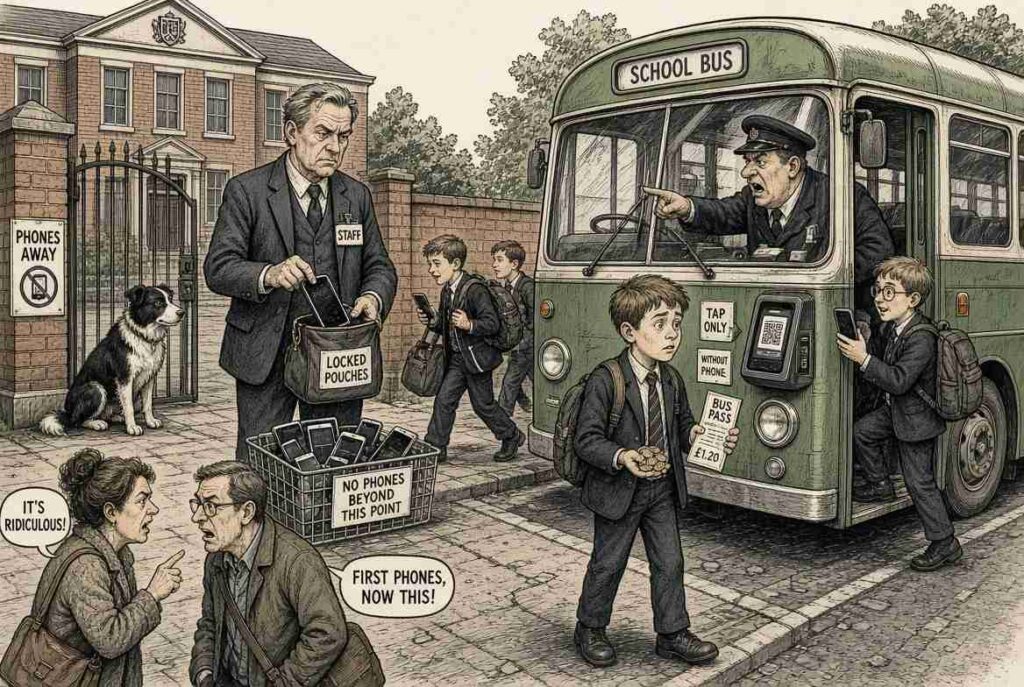
The bus discount involved caps fares for eligible young people, but registration through an app can be required to unlock the cheapest price. Trentbarton said it was developing a physical alternative and already offered other youth discounts.
That sentence tells us Britain retains one of its greatest national traditions:
rediscovering the card.
Human civilisation invented physical identification thousands of years before the App Store.
We had passports.
Library cards.
Bus passes.
Tickets.
Pieces of paper.
At some point around 2017, management consultants concluded all civilisation would improve if everything required downloading something.
You can no longer simply be twelve.
You must create an account proving you are twelve.
Enter email.
Confirm email.
Choose password.
Password must contain eight characters, one number, one hieroglyphic and the maiden name of a Byzantine empress.
Accept cookies.
Reject marketing.
Receive verification text.
Update operating system.
Restart phone.
Miss bus.
This is called convenience.
The obvious defence is that apps can make systems cheaper and easier to manage. They provide automatic verification, account administration and payment tools.
The obvious comic difficulty is that an 11-year-old standing in Derbyshire wanting to get to school has somehow become the systems administrator for regional transport.
Imagine applying this logic elsewhere.
Children without chainsaws pay more to enter woodland.
Children avoiding gambling apps must pay full price at the swimming pool.
The NHS launches an anti-caffeine campaign but makes GP appointments available exclusively through Costa loyalty points.
Why Schoolchildren Pay for Policy Made in Separate Rooms
It is not malicious.
That is what makes it so beautifully British.
Nobody woke up planning to penalise responsible parents.
One organisation digitised fares.
Another discouraged phones.
A third encouraged school attendance.
A fourth discussed child safety.
Every policy individually made sense inside its own PowerPoint presentation.
Then reality placed them on the same bus.
The result was a policy traffic accident.
Researchers at the fabricated University of Common Sense have developed a technical term for this phenomenon: bureaucratic crossfire.
This occurs when citizens obey two government recommendations simultaneously and discover they have violated a third.
Professor Sheila Clipboard explained:
“The system is working exactly as designed. Unfortunately, it was designed in separate rooms.”
Her research identified other common symptoms.
Government encourages cashless payment while worrying about digital exclusion.
Government promotes online public services while demanding people reduce screen time.
Government encourages public transport while occasionally making its pricing system resemble the cockpit of an Airbus.
“The child isn’t missing the bus, the bus is missing the child, and the child is charged for the privilege,” said Vivienne Pratfall, London satirist and reluctant owner of four unused travel apps.
Ministers say the fares are on the right track, though the vehicle in question is a bus, which has never once been on a track. The child faces a fare-ly stiff bill for failing to app-ly herself, and campaigners have called the arrangement a triumph of the digital divine. A transport spokesman said the scheme would ticket the box for modern convenience, and a shocked headteacher reported that the pupils were bussing to school with phone-ish anxiety. Parents were reassured that the new fares are a completely optional necessity, and that no child would be left behind, provided the child had something to be left behind with.
A Fix for Schoolchildren: The Radical Technology Known as Both
The solution need not be dramatic.
Allow a physical youth card.
Let drivers recognise valid identification.
Create equivalent digital and non-digital access.
In other words, deploy the radical new technology known as both.
Britain occasionally behaves as though every problem requires choosing between 1840 and 2040.
Either everybody carries a smartphone or we return to a village constable stamping paper beside a candle.
There is a middle ground.
A plastic card.
It fits in a pocket.
No battery required.
Its revolutionary interface consists of showing it to somebody.
The user experience is extraordinary.
Young passengers already face enough complexity.
They must wake early, remember homework, navigate adolescence, avoid social catastrophe and determine whether the bus labelled “NOT IN SERVICE” is somehow the one they need.
We need not add authentication architecture.
A satirical survey of 1,000 parents conducted while they were looking for missing school shoes found that 99% supported affordable public transport.
The remaining 1% were still installing the app.
The irony is almost elegant.
Adults are spending millions warning children that smartphones have become too central to childhood.
Then basic services repeatedly inform those same children:
Sorry.
There’s an app for that.
Eventually Britain may succeed in creating the first generation of smartphone-free children.
They will be healthy, attentive and emotionally resilient.
They simply will not be able to afford the bus home.
The real story: the Guardian reported that schoolchildren without smartphones can face higher bus fares in England because some discounted youth fares are unlocked through app registration. A Derbyshire family told the paper their 11-year-old daughter could pay an extra £546 a year after they chose a basic phone for her instead of a smartphone. The operator Trentbarton said it was developing a physical alternative and already offered other youth discounts, while England has separately introduced restrictions intended to reduce smartphone use in schools.
Humorous Observations on Schoolchildren, Smartphones and Bus Fares
- Schoolchildren are discouraged from owning smartphones while some bus discounts require smartphones, because modern government policy is apparently written by two departments communicating exclusively through semaphore.
- Britain has somehow built a society where an 11-year-old may require advanced mobile technology to obtain the economical price of sitting on a bus.
Sources
This is UK satire with a bus pass, a piece of British satirical journalism drawn from a real fares story. Like all UK satirical news, the professors, surveys and crossfire are there for the laughs, and no eleven-year-olds were harmed in the making of this comedy.
For the American take on the news, read the latest at Bohiney.com.
Auf Wiedersehen, amigo!

Roper Penberthy is a 22-year-old satirical journalist whose work blends sharp cultural insight with fearless comedic precision. Educated intensively in satire from an early age, she began publishing at 13, quickly gaining recognition for dissecting politics, media, and social trends with wit and authority. Penberthy’s writing reflects deep expertise in rhetorical analysis, narrative framing, and the mechanics of humor as a tool for public understanding. Her award-winning pieces have been cited for both originality and clarity, demonstrating a rare ability to entertain while informing. Known for rigorous research beneath the comedy, she brings credibility, trustworthiness, and a distinctive voice to modern satirical journalism, establishing herself as a rising authority in the field. EMAIL [email protected]