British Celebrities Defeat AI Copyright Plan, Government Learns Elton John Still Has Nuclear Deterrent
Technology Lobby Discovers Parliament Can Ignore Thousands of Creators but Becomes Nervous When Paul McCartney Starts Writing Letters
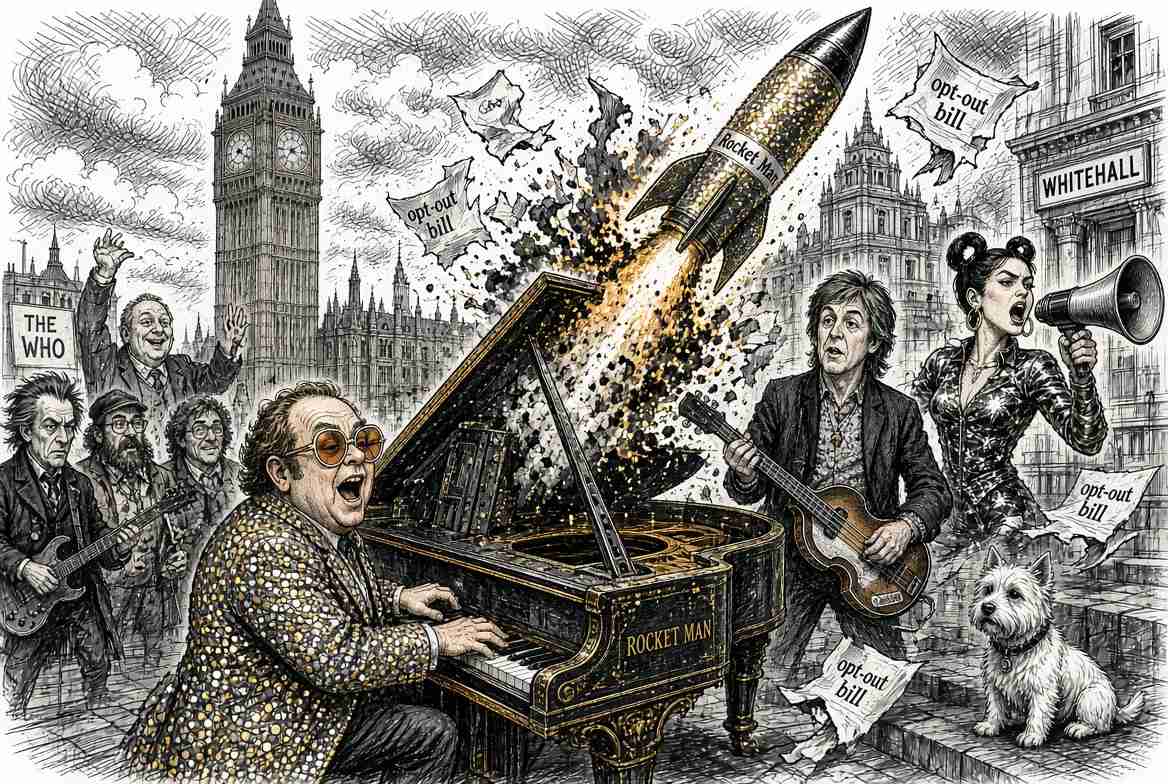
LONDON – Britain backed away from proposals that would have made it easier for AI companies to use copyright-protected work without prior permission after a major creative-industry campaign involving Sir Elton John, Sir Paul McCartney, Thom Yorke, Björn Ulvaeus and other prominent artists.
The artificial-intelligence industry has therefore discovered the final benchmark test.
Can your model defeat Elton John when annoyed?
Apparently not.
This represents an important development in AI safety.
Researchers have spent billions asking whether machines can pass university exams, write software, generate video and reason autonomously.
Nobody tested whether they could survive a British musician saying:
“Absolutely not.”
A Genuine Economic Question
The copyright dispute concerns a genuine economic question.
AI developers want enormous quantities of data for training.
Creators want control and compensation when copyrighted work is used.
Governments want both a thriving technology industry and thriving creative industries.
This is difficult.
Therefore Britain initially considered solving the problem through the ancient governmental technique of publishing a proposal nobody liked.
Then musicians appeared.
Politicians understand lobbying.
Lobbying arrives wearing a suit.
Celebrity campaigning arrives with footage.
This changes everything.
A software executive can explain model-training economics for 45 minutes before a parliamentary committee.
Paul McCartney can look disappointed for three seconds.
Game over.
The British state is psychologically incapable of withstanding a Beatle looking disappointed.
AI Copyright UK Satire: Hansard Needs More Elton
Elton John reportedly described the government as “absolute losers” over the proposal.
This is not normal legislative terminology.
Hansard does not contain enough Elton John.
Imagine every select committee operating this way.
Minister: “Our assessment suggests…”
Elton: “Losers.”
Chair: “Compelling. Amendment carried.”
Your Work Is So Valuable We Need It Free
There is a larger irony.
Technology companies argue that training advanced models may require access to enormous bodies of human-created material.
Artists respond that the creative work has value precisely because humans spent years producing it.
This has created the first industrial dispute where management’s position can sound like:
“Your work is so valuable that we need all of it, which demonstrates why obtaining it cheaply is crucial.”
If a burglar used this argument, insurance companies would become confused.
“I took the paintings because I deeply respect art.”
The AI industry counters that training can involve statistical learning rather than simply storing and reproducing works, and that overly restrictive regimes could harm innovation.
Fair enough.
But explaining this to musicians was always going to be difficult because the entertainment industry already endured decades of people discovering technologically exciting methods of not paying musicians.
Cassette copying.
Napster.
File sharing.
Streaming economics.
Social video.
Now a computer arrives wearing a small hat and announces:
“I have studied everything you ever made.”
Musician: “Did you pay?”
Computer: “I said studied.”
The creative industries were never going to greet this sentence peacefully.
A fabricated copyright barrister from the law firm Sue, Grabbit & Howe explained that the dispute concerns three traditional British values:
innovation, property rights and celebrities being considerably better at television than civil servants.
“Every complex policy debate eventually reaches the same point,” she said. “Somebody asks what Stephen Fry thinks.”
Australia is now being warned by British campaigners not to repeat the same approach.
This means Britain has achieved a rare international policy export.
Not the law.
The argument.
Britain traditionally exports parliamentary government, common law, football and bands.
We can now export irritated copyright holders.
“The government tried to give a robot the keys to the catalogue and found out the catalogue had a bouncer called Elton,” said Vivienne Pratfall, London satirist and unpublished songwriter.
Ministers said the proposal was a work in progress, and musicians said it was a work in regress. Campaigners struck a chord and the government lost the plot, or, as one flustered official put it, lost the score. The developers insist their models merely learn from the greats, which is a sound argument for anyone who has never heard a sound argument. One technology executive called the outcry a chorus of disapproval, and another called it a disapproval of chorus. Parliament has agreed to respect the artist, not the scrape, and it will keep copyright and carry on until the robots learn to ask nicely, song a sorry and Elton their own defence.
The Elton Test
There is a productive compromise somewhere.
Clear licensing.
Practical rules.
Transparency.
Compensation mechanisms.
Innovation that does not require pretending centuries of human creativity spontaneously appeared in a cloud server.
The serious policy will be technically difficult.
The satirical policy is easier.
Before government introduces any copyright reform, ministers must perform the Elton Test.
Place Elton John in a room.
Explain the proposal.
If he removes his glasses slowly, reconsider.
If Paul McCartney joins the meeting, withdraw legislation.
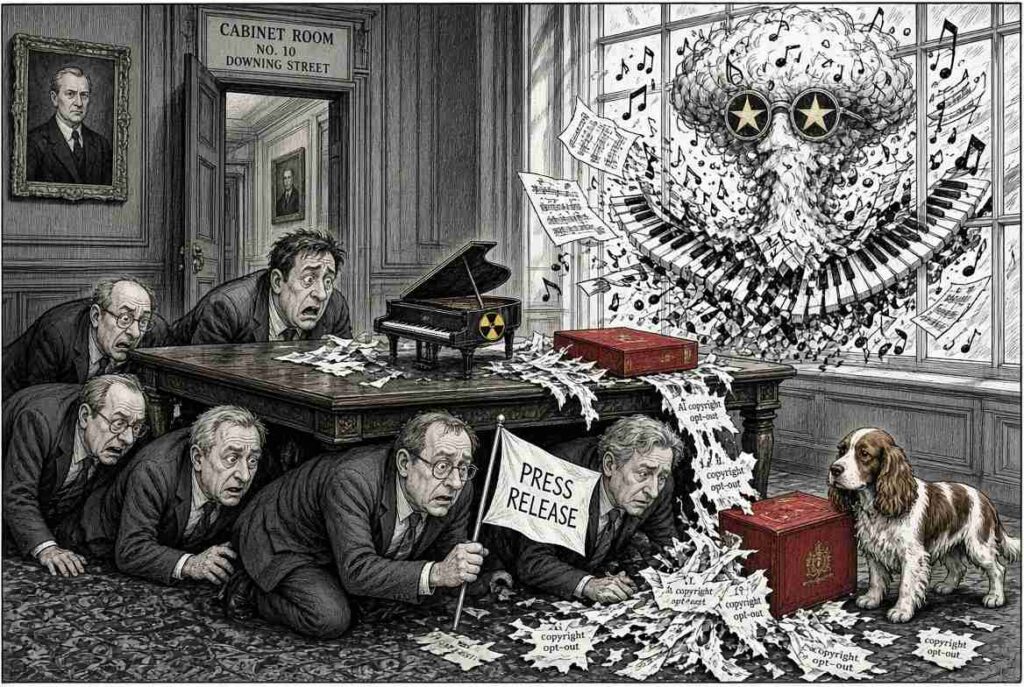
If both remaining members of ABBA appear, evacuate Whitehall.
Technology moves quickly.
Politics moves slowly.
Music royalty has tour dates.
Policy must therefore adapt.
For now Britain has discovered that artificial intelligence may transform civilisation, employment and culture.
But it still cannot beat a sufficiently angry piano player.
The real story: the Guardian reported that British campaigners are warning Australia against an AI copyright approach that the UK has now backed away from. Britain dropped proposals that would have made it easier for AI companies to use copyright-protected work without prior permission after a creative-industry campaign involving Sir Elton John, Sir Paul McCartney, Thom Yorke, Björn Ulvaeus and other prominent artists. Elton John reportedly called the government “absolute losers” over the plan, while AI developers argue that training involves statistical learning and that overly restrictive rules could harm innovation.
Humorous Observations on the AI Copyright UK Satire
- British musicians successfully fought proposals allowing greater AI access to copyrighted work, proving Parliament can withstand lobbying until Elton John becomes irritated.
Sources
This is British satire with a backing band, a piece of London satirical journalism drawn from a real copyright row. Like all UK satirical news, the barristers, computers and Elton Test are there for the laughs, and no piano players were provoked in the making of this comedy.
For the American take on the news, read the latest at Bohiney.com.
Auf Wiedersehen, amigo!

Paige Shiver has established herself as a cornerstone of modern British satire through her work at Prat.UK, where she serves as a lead political commentator and cultural critic. With over a decade of experience in investigative journalism and comedy writing, Shiver specializes in deconstructing the absurdities of Westminster and the nuances of the UK’s social landscape.
Her expertise is rooted in a deep understanding of British policy, allowing her to deliver biting critiques that are as factually grounded as they are humorous. Shiver’s commitment to the high art of satire and UK Literature is evidenced by her frequent appearances on BBC Radio 4 and her published anthologies on the decline of political decorum. At Prat.UK, her transparency and rigorous research ensure that even her most satirical takes provide valuable, trustworthy insights into the national conversation.
Paige Shiver @ PaigeShiver.com