Trump Visits Ireland, Solves 800 Years of History Before Lunch
Trump Says Irish Are Friendly and Vicious, Nation Proud President Has Finally Understood the Pub
President Donald Trump arrived in Ireland for a two-day visit and promptly wandered into one of Europe’s most delicate constitutional questions with the conversational confidence of a man deciding whether the clubhouse should serve soup.
Asked about Irish reunification during a meeting with Taoiseach Micheál Martin, Trump said he would “love to see” a unified Ireland, called the idea “fantastic,” and suggested that since he believes it will happen eventually, it “may as well happen now.” He added that Britain “would have something to say about it, obviously,” thereby compressing several centuries of history, identity, sovereignty and constitutional law into roughly the time normally required to ask for another coffee.
The 1998 Good Friday Agreement provides a formal mechanism for changing Northern Ireland’s constitutional status if sufficient public support exists for a referendum. Britain’s government responded to Trump’s comments by reiterating that its position had not changed and that no such vote would be called without clear evidence of majority support.
Good Friday Agreement Checks Whether “May As Well” Is Legally Binding
Constitutional lawyers were therefore left confronting an important new jurisprudential question: whether “may as well” has somehow become an internationally recognised mechanism of self-determination.
Under traditional diplomacy, disputed sovereignty normally involves treaties, referendums, negotiations, legal guarantees and patient consultation.
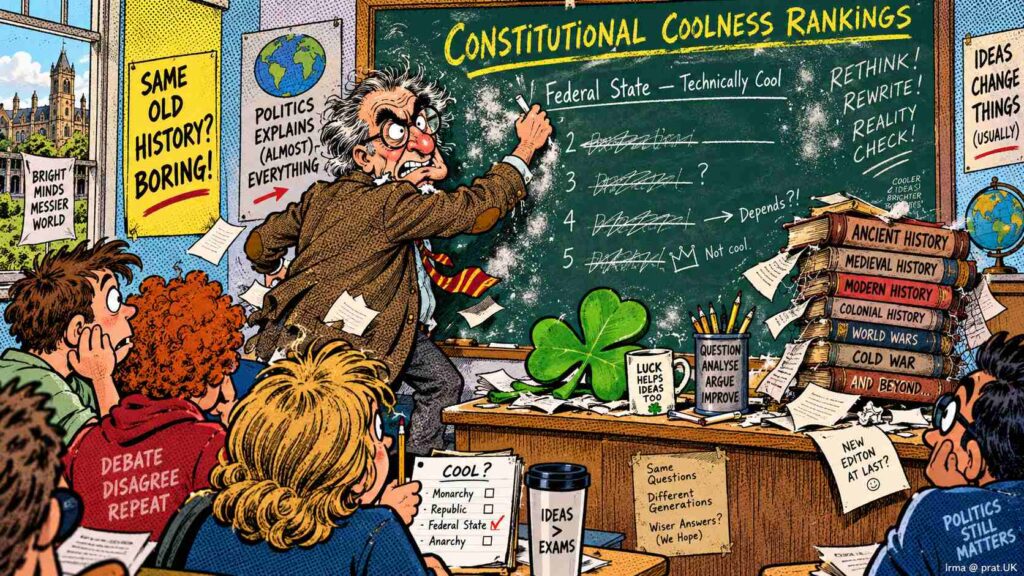
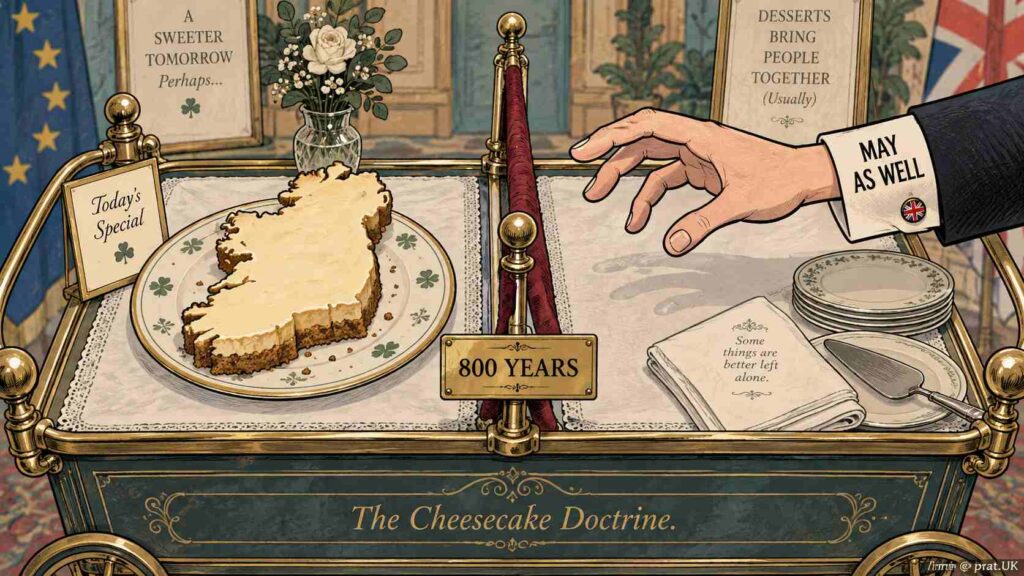
Under the emerging “may as well” doctrine, however, a major constitutional question can apparently be approached with the same logic used to order dessert.
“You’ve already eaten the steak,” the doctrine appears to reason. “The cheesecake is right there. May as well.”
Northern Ireland’s unionist leaders pushed back quickly, stressing that the constitutional future of Northern Ireland belongs to the people who live there and must be determined under the Good Friday framework.
This represents the principal inconvenience of democracy: the people who actually live somewhere frequently insist on participating in decisions concerning where that somewhere belongs.
Foreign Policy Now Available Between Golf Holes
Trump’s Ireland visit combines official meetings with attendance at the Irish Open at his Doonbeg golf property, creating the unusual spectacle of diplomatic questions sharing an itinerary with professional golf.
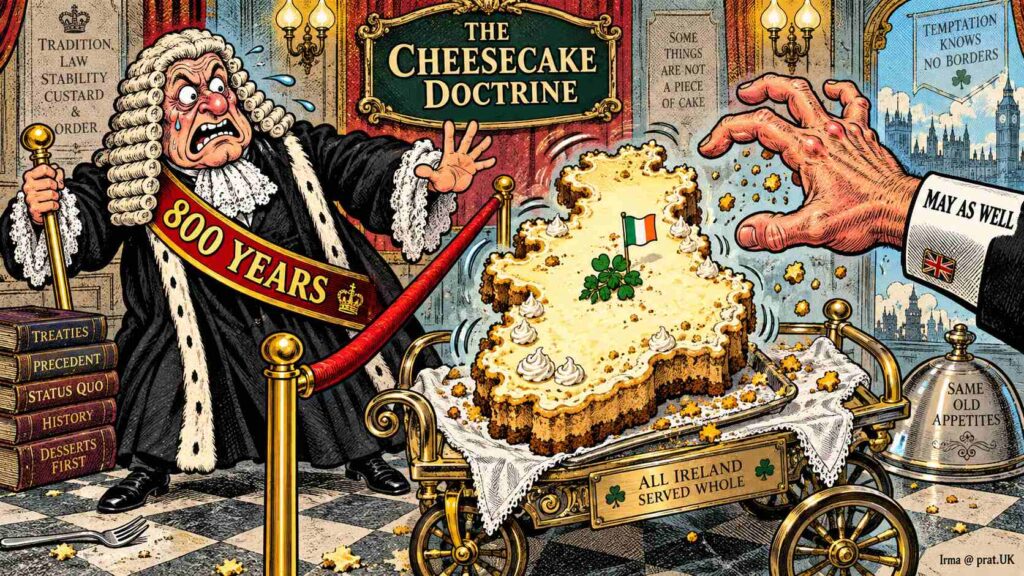
The resulting diplomatic rhythm is refreshingly efficient.
Meet taoiseach. Discuss trade. Consider reunifying Ireland. Meet president. Discuss international security. Drive toward golf course. Potentially settle several additional territorial disputes before someone reaches the ninth tee.
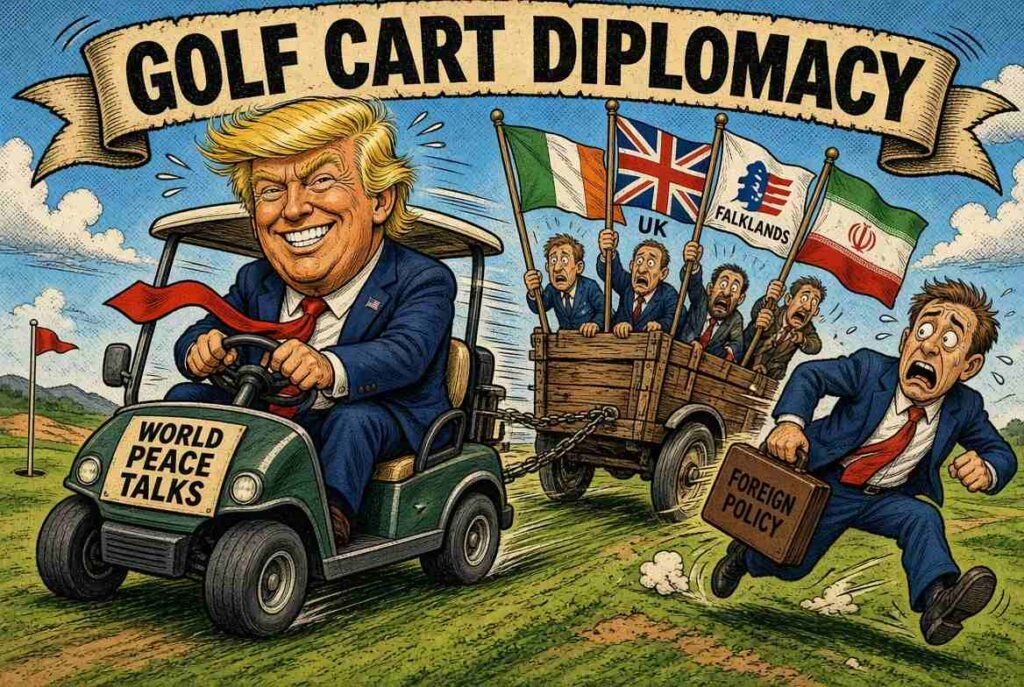
This could prove transformative for diplomacy. Instead of month-long negotiations in Geneva, world leaders could simply be issued golf carts.
“Israel and Palestine, you’re in Cart Seven. India and Pakistan, Cart Eight. Argentina and Britain, please keep pace with the group ahead.”
By sunset, the United Nations could conceivably be replaced by a starter holding a clipboard.
Irish Unity Officially Declared “Cool”
Trump also described a united Ireland as “very cool,” according to reporting from the visit. For generations, scholars have struggled with competing identities, partition, nationalism, unionism, constitutional structures and the lingering legacy of the Troubles.
Apparently the missing analytical category was cool.
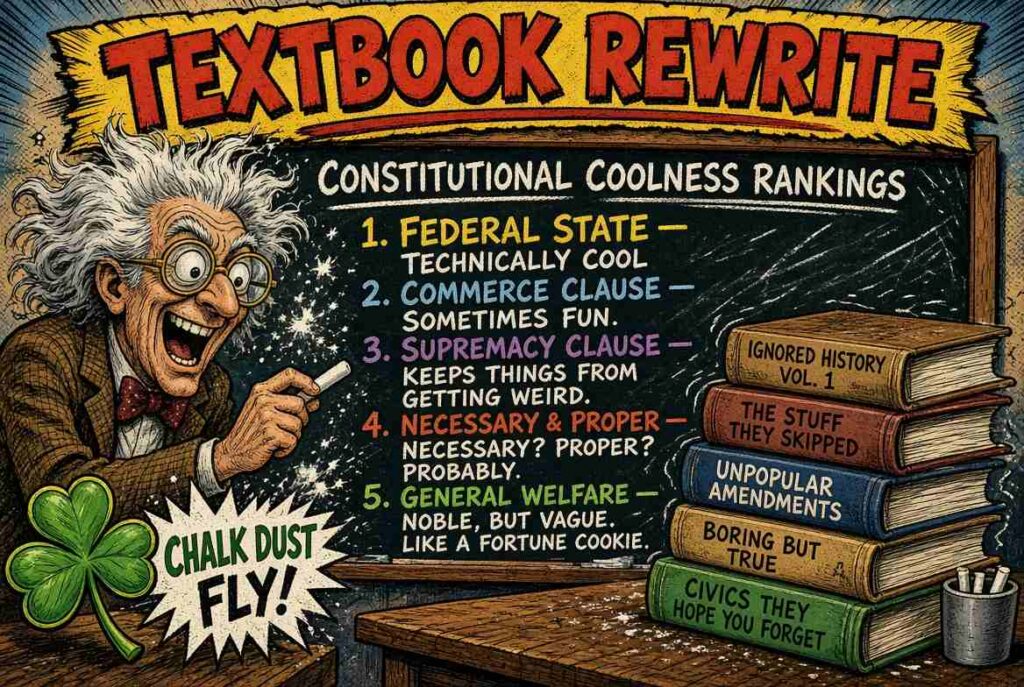
Political science departments may now require restructuring. Future constitutional textbooks could read: Unitary state — moderately cool. Federal state — technically cool. Confederation — depends on parking. Irish reunification — very cool.
The advantage is clarity. Diplomats have traditionally relied on phrases such as “constructive dialogue,” “bilateral engagement” and “peaceful constitutional settlement.” Nobody knows what any of those mean. Everybody understands “cool.”
Trump Expands Portfolio to the Falklands
Ireland was not the only territorial question to receive presidential attention. Trump also discussed the Falkland Islands dispute between Britain and Argentina, suggesting that if the issue became a crisis he might be able to help settle it.
Argentina claims sovereignty over the islands, while Britain administers them and maintains that the Falkland Islanders have the right to determine their own political status. The dispute led to war in 1982 and remains politically sensitive today.
Thus, within one trip, Trump had touched Ireland and the Falklands, two territorial questions separated by thousands of miles and several libraries of historical argument.
At this rate, mapmakers may begin printing atlases in pencil.
Iran Added to the Morning Schedule
Trump also spoke about the ongoing conflict involving Iran and has repeatedly presented himself as capable of producing negotiated settlements in major international disputes. The Iran conflict has continued through months of military and economic confrontation, with negotiations repeatedly discussed but remaining unresolved.
The emerging itinerary therefore looks ambitious: 9:00 a.m. Breakfast. 9:30 a.m. Irish reunification. 10:15 a.m. Falklands. 11:00 a.m. Iran. 12:00 p.m. Sandwich. 1:00 p.m. Golf.
Traditional diplomats might object that centuries-old conflicts require considerably more time. But that assumes diplomats have discovered something important during all those centuries.
Ireland Receives Unusual Compliment
Trump also praised the Irish using characteristically colorful language, describing them in terms that combined friendliness with toughness. The remark added another unusual layer to a visit already rich in unconventional diplomacy.
Ireland may nevertheless have appreciated the underlying sentiment. Few countries receive compliments suggesting simultaneously that they are hospitable enough to invite you inside and formidable enough to make you reconsider criticizing the furniture.
In a pub, this combination is practically a national security doctrine.
Eight Centuries Later, Everyone Still Gets a Vote
Despite the dramatic headlines, Trump’s comments do not alter the constitutional framework governing Northern Ireland.
The Good Friday Agreement remains the relevant structure. Any change in Northern Ireland’s status would depend on democratic consent through the mechanisms established under that agreement, while the British government says it currently sees no basis for calling such a referendum.
Which means the historic breakthrough may have to wait.
Eight centuries of argument have survived kings, rebellions, parliaments, partition, revolution and countless politicians.
They can probably survive lunch.
This is political satire built around documented public remarks and events. The constitutional and historical background is real; the absurd extensions, mock legal doctrines, imagined schedules and diplomatic jokes are satire.

Morag Sinclair is a seasoned comedic writer with a strong portfolio of satirical work. Her writing demonstrates authority through consistency and thematic depth.
Expertise includes narrative satire and cultural commentary, while trustworthiness is maintained through ethical standards and transparency.