Britain Invents Tourist Tax After Discovering Foreigners Still Had Money When They Left
English mayors to receive new power ensuring visitors experience local government as thoroughly as they experience local attractions
MANCHESTER. England’s regional mayors are being handed powers to impose a levy on overnight visitors, after officials discovered tourists were occasionally leaving British hotels with small quantities of money still in their possession.
The Overnight Visitor Levy is part of Prime Minister Andy Burnham’s devolution programme. Mayors would be able to impose charges on overnight accommodation and use the revenue for local services and infrastructure. Hospitality groups have warned that a 5% levy could damage jobs and economic output.
Government described the proposal as empowering local communities.
Tourists described it as another line on the bill.
England’s Tourist Tax and the New Art of Municipal Taxation
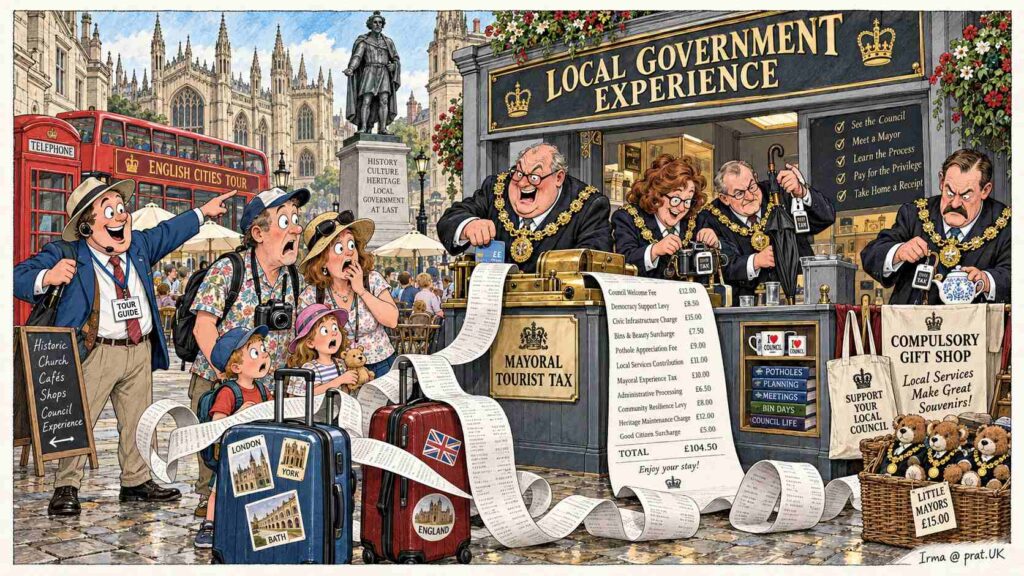
Professor Sheila Extractor, fictional chair of Municipal Revenue Studies at the University of Little Piddlington, said the levy represented “an exciting transition from national taxation to artisanal taxation.”
“Visitors increasingly want authentic local experiences,” she explained.
“In Manchester they want football. In York they want history. In Bath they want Roman architecture. Now each destination can provide a locally sourced surcharge.”
UK hospitality already faces 20% VAT, considerably higher than rates common elsewhere in Europe.
Officials therefore concluded the obvious competitive response was another tax. It is the fiscal equivalent of treating a sunburn with a second sunburn.
A fabricated London Prat survey of 400 imaginary tourists found 72% would accept a £5 nightly levy, provided councils promised not to use the money to design another logo.
Another 18% said they would sleep in their rental car.
The remaining 10% were American and believed VAT was a television channel.
Edinburgh has already introduced a 5% visitor levy capped at five nights, giving English authorities the confidence that taxation can successfully cross Hadrian’s Wall. Hadrian, it should be said, built his in stone. England is building hers in small print.
The Municipal Hamster Wheel of Overnight Visitor Levies
The government insists local revenue could fund cleaner streets, cultural attractions and transport.
This establishes a beautiful cycle.
Tourists visit because a town is attractive.
Government charges tourists because the town is attractive.
Fewer tourists visit.
Government uses the tax revenue to make the town attractive enough to attract tourists again.
Economists refer to this as the “Municipal Hamster Wheel.”
A fictional German visitor in London said he welcomed the policy.
“I came for Buckingham Palace,” said Klaus Meier.
“I did not realise I would also be sponsoring pavement maintenance in Camden.”
What a £220 Hotel Room Actually Costs in Britain
Hotels fear Britain could become even less competitive.
A £220 room already produces an invoice resembling a minor criminal indictment.
Room: £220.
Breakfast: £31.
Service charge: £14.
Tourist levy: £11.
Historic Destination Recovery Supplement: pending.
Local Cultural Vibrancy Contribution: almost certainly pending.
Environmental Pillow Adjustment: give it time.
The danger is that councils discover tourists cannot vote in local elections.
Politicians have searched for this demographic for centuries.
It combines taxable income with no electoral consequences, which in Westminster terms is roughly the constitutional equivalent of finding a unicorn that also pays its rates on time.
The ultimate policy may be a departure tax collected from anyone attempting to leave the borough before councillors locate another funding gap.
Ministers insist the scheme will be introduced carefully and after consultation.
In government language, consultation means citizens are invited to explain why something should not happen before officials announce the date it will happen.
Visitors should therefore enjoy England while they can.
Soon even the rain may be itemised.
Sources
- UK Government: Visitor Levy Consultation — a new Mayoral power to create visitor levies
- Reuters, via Global Banking & Finance Review: England’s mayors handed power to impose tourist tax
- Reuters: England’s mayors handed power to impose tourist tax in Burnham devolution drive
This is real policy. The UK government confirmed on 10 September 2026 that mayors across England will be given the discretionary, uncapped power to charge an Overnight Visitor Levy on paid accommodation, a plan championed by Prime Minister Andy Burnham as part of his wider devolution agenda. UKHospitality chief executive Allen Simpson has warned that handing single-sector, tax-raising powers to mayors risks repeated future increases, while Housing Secretary Angela Rayner has framed the levy as a way to let local leaders reinvest in their own areas.
Three Observations Too Absurd To Invent
- England is introducing a tourist tax modelled partly on Edinburgh, meaning the United Kingdom has now officially agreed that taxing visitors is a good idea, provided it is someone else’s council doing it first.
- The levy has no upper cap, which means the only thing standing between a weekend in York and a small personal recession is a mayor’s enthusiasm for regeneration schemes.
- Hospitality groups warned the tax could cost the sector up to £2 billion by 2030, a figure large enough that even the Treasury’s imaginary Whitehall source might struggle to spin it as fragile good news.
Auf Wiedersehen, amigo!
This is UK satirical journalism, built on a real story and finished with entirely fictional professors, surveys and Germans named Klaus. For readers who like their British satire served with a side of American satirical news, the sister publication is Bohiney.com.