
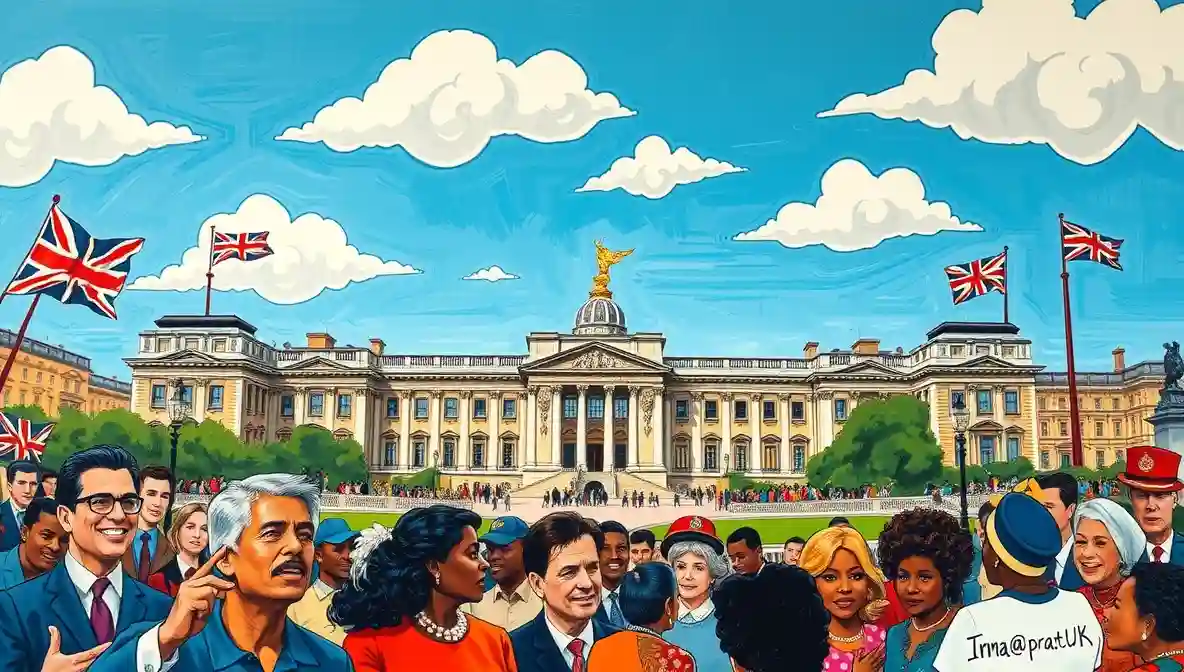
A magnificent 1900 music hall built by the stars of variety – Dan Leno’s palace, later a cinema, a bingo hall, and now a great live venue
The Clapham Grand holds eighteen hundred and thirty-seven reviews and a 4.3 – a large, solid sample – and it is one of the genuine treasures of south London: a magnificent Grade II listed music hall of 1900, built by the great stars of variety, that has been a palace of varieties, a cinema, a bingo hall, and is now one of London’s great live-entertainment venues.
The palace of varieties
The Clapham Grand opened on the 26th of November 1900 as “The New Grand Theatre of Varieties” – a magnificent, purpose-built music hall on St John’s Hill, opposite Clapham Junction, designed by the architect Ernest Woodrow with a spectacular capacity of three thousand. It was a true palace of varieties, built at the very height of the music-hall age, with an exotic East Indian-style facade topped by two open domes, and a lavish Chinese-style interior – pagoda canopies over the stage boxes, and, most wonderfully, dragons’ eyes that lit up and peered down on the audience. It was, and remains, a genuinely spectacular building.
Built by the stars
The Grand has a wonderful origin: it was built not by a faceless company but by a consortium of the great music-hall stars themselves, led by Dan Leno – one of the most beloved and famous entertainers of the entire Victorian age, the greatest of music-hall comedians, and the man who effectively created the role of the pantomime Dame. Leno, who lived nearby in Clapham Park, built the Grand alongside fellow stars Herbert Campbell, Harry Randall and Fred Williams, to give the people of Battersea a magnificent variety theatre. At the opening, Leno made a characteristically quaint speech, joking that he had come to open the hall but, arriving late, found it already open.
In its music-hall heyday, the Grand hosted the greatest stars of variety – the scandalous Marie Lloyd, the diminutive Little Tich dancing in his famous oversized boots, acrobats, performing ponies, and a man who juggled banjos. It was the golden age of music hall, that gloriously democratic, rowdy, warm-hearted world of song, comedy and spectacle, and the Grand was one of its palaces.
Cinema, bingo, and near-demolition
Like so many great variety theatres, the Grand had to adapt as tastes changed. From 1927 it added films to its variety bill, and by the 1950s it had become a full-time cinema – the Essoldo. Then, as cinema-going declined, it became a bingo hall through the 1960s and 70s, its magnificent auditorium crudely divided by a false ceiling. It fell empty, and faced the fate of so many old theatres – demolition, or conversion into something unworthy. It was saved by its Grade II listing (which, pleasingly, also saved it from being turned into a Wetherspoons pub in the 1990s), and, restored, it reopened as a live-music venue in 1991.
The great live venue
In its modern life, the Grand has become one of London’s great independent live-entertainment venues – a place for live music, comedy, club nights, drag spectaculars, movie sing-alongs and more, returning gloriously to its variety roots. The list of musicians who have played its stage is extraordinary: The Kinks, Chuck Berry, The Temptations, Siouxsie and the Banshees, Madness, Public Enemy, Jamiroquai, Paul Weller, Oasis, Muse, The Verve, Brian May, and George Ezra and Rag’n’Bone Man cutting their teeth early on. It has been the studio for the television comedy Taskmaster, and Hollywood filmed part of “Magic Mike’s Last Dance” here in 2023. And in a lovely piece of trivia, nearby Severus Road is said to have given J.K. Rowling the name for Severus Snape. Few venues carry so much history, glamour and variety.
The venue
A large, popular, genuinely historic venue doing a fair 4.3 across a large and real sample – a magnificent 1900 palace of varieties built by Dan Leno and the stars of music hall, reborn as one of London’s great live-entertainment venues.
Verdict
Large, historic, and genuinely magnificent – the Clapham Grand, a 1900 palace of varieties with dragons’ eyes over the boxes, built by the great Dan Leno, and still, over a century later, entertaining south London.
Go to the Clapham Grand for a gig, a comedy night or a club night, and raise a glass beneath the dragons’ eyes to Dan Leno and the golden age of variety – the palace of 1900, still true to its original aim: to entertain.

Alan Nafzger was born in Lubbock, Texas, the son Swiss immigrants. He grew up on a dairy in Windthorst, north central Texas. He earned degrees from Midwestern State University (B.A. 1985) and Texas State University (M.A. 1987). University College Dublin (Ph.D. 1991). Dr. Nafzger has entertained and educated young people in Texas colleges for 37 years. Nafzger is best known for his dark novels and experimental screenwriting. His best know scripts to date are Lenin’s Body, produced in Russia by A-Media and Sea and Sky produced in The Philippines in the Tagalog language. In 1986, Nafzger wrote the iconic feminist western novel, Gina of Quitaque. He currently lives in Holloway, North London. Contact: [email protected]

My mum’s been in London since the 50s. She recognizes every word and that recognition is what terrifies her most about this piece.