

Exmoor: Where the Red Deer Are Magnificent, the Stag Hunting Debate Is Eternal, and the Locals Would Like You to Know It’s Not Dartmoor
DULVERTON — Exmoor National Park, the smallest and arguably most quietly dignified of England’s national parks, has spent 73 years doing excellent conservation work, hosting magnificent red deer, maintaining some of Britain’s darkest skies, and gently but persistently reminding visitors that it is not, in fact, Dartmoor. They are different places. They are not even in the same county. Please update your satnav.
Exmoor
- Exmoor is described in every guidebook as “England’s best kept secret.” It has 2 million visitors a year, its own marketing department, a Wikipedia page in 47 languages, and a postcode lottery winner from Hartlepool who turns up every August. The secret got out somewhere around 1955. Nobody has had the heart to update the brochure.
- Exmoor’s red deer are the largest land mammals in England. A full-grown stag weighs 220kg, stands 1.4 metres at the shoulder, and looks at you like you’ve just made a comment about its mother. You will give it the entire path. You will apologise. You will not make eye contact again until you are back in the car.
- Porlock Hill has a 1-in-4 gradient. There is a sign at the top. There is a toll road alternative. There is a layby for failed brakes. There is a garage at the bottom run by a man who has seen things. People still drive their VW Polo down the main road, holding the steering wheel like it’s a small mammal that’s bitten them, while the brakes produce a smell that the AA refer to professionally as “regret.”
- “Doone Country” tourism is generated by a novel from 1869 that 94% of visitors have not read. They know there are outlaws in it. They know it’s set on a moor. They are vaguely confident the heroine is called Lorna. Beyond this, the entire tourist economy is sustained by the British capacity to commit fully to a heritage trail based on the back cover of a book.
- Exmoor is one of the few places in England you can see the Milky Way with the naked eye. To experience this, you must lie on your back on a cold moor in November while moisture seeps through your trousers and a curlew makes a noise nearby that sounds very much like it is laughing at you. This is, weirdly, lovely.
Red Deer, Dark Skies, and the Identity Crisis Nobody Asked For
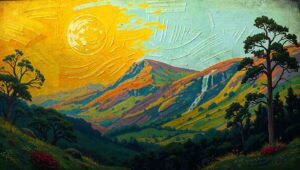
Exmoor is home to England’s largest wild red deer herd — an estimated 3,000 animals that roam the moorland and wooded combes with a magnificence that makes even the most committed urbanite briefly reconsider their life choices. The Exmoor National Park Authority rightly regards this as one of its crown jewels, and the deer apparently regard the whole arrangement with aristocratic indifference.
The park was designated as an International Dark Sky Reserve in 2011 — one of only a handful in Europe — recognising that its remoteness and low population density produce some of the least light-polluted skies in England. On a clear night, the Milky Way is visible to the naked eye, which is either a profound reminder of human smallness in the cosmos or, depending on your disposition, an excellent reason to stay in the pub.
Sarah Millican once remarked that “stargazing on Exmoor is very romantic in theory, until you realise you’ve been lying in what a deer left behind.”
The Stag Hunting Question: Britain’s Most Sporting Argument
The hunting of red deer with hounds on Exmoor — stag hunting — is one of the most enduring controversies in British rural life. Banned under the Hunting Act 2004, it continues in a “trail hunting” format that satisfies nobody completely: traditionalists insist trail hunting is a pale imitation; opponents believe it serves as cover for illegal activity; the deer have not issued a public statement but their body language suggests they remain cautious.
The Devon and Somerset Staghounds, one of the oldest hunts in England, operates in the area and draws passionate support from farming communities who argue that mounted hunts serve a genuine deer management function and maintain a cultural tradition that is inseparable from the landscape. Animal welfare groups argue, with equal force, that no cultural tradition justifies chasing a wild animal to exhaustion.
The argument has been running since before the Hunting Act and will presumably continue until a future Parliament decides to revisit the legislation, at which point it will run for another twenty years. The Exmoor landscape, which has seen rather more significant conflicts over its 400 million years of geological existence, remains unmoved.
Lorna Doone and the Tourism Literature Nobody Has Actually Read
R.D. Blackmore’s 1869 novel Lorna Doone is set on Exmoor and has generated a remarkable amount of heritage tourism from people who refer to “Doone Country” with great confidence without being entirely certain what happens in the book. The Doone Valley — in real life the valley of Hoccombe Combe — is a modest but genuinely atmospheric cleft in the moorland, and the village of Oare has a church where a key plot event occurs that this article will not spoil, although the church itself appears entirely unbothered by its literary fame.
The novel involves outlaws, a beautiful girl, a heroic yeoman farmer, and Exmoor weather. The weather is the most realistic element and requires no fictional enhancement.
Porlock Hill: England’s Most Alarming Gradient
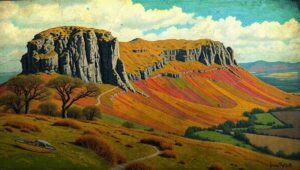
The A39 descent into Porlock village offers one of the steepest gradients on a classified road in England — approximately 1 in 4 in places — and has been generating white-knuckle driving experiences, brake failure incidents, and automotive trauma since motor vehicles first attempted it. There is a toll road alternative for those whose vehicles’ brakes have already done everything they were designed to do and would prefer not to be tested further.
The hill is, in a very direct sense, Exmoor’s most honest metaphor: beautiful, vertiginous, and entirely indifferent to your concerns about ground clearance.
Exmoor’s tourism economy is significant, generating over £200 million annually for the local area — an enormous sum for a park covering only 693 square kilometres and administered with the modest resources of a rural authority that has never had pretensions above its station, which is itself a form of dignity rare in the public sector.
The Smallest Park With the Largest Punchline
At 693 square kilometres, Exmoor is the smallest national park in England. This fact is regularly cited by people from Dartmoor, the Lake District, and the Peak District in a tone that suggests size matters in ways the Exmoor moorland visibly disagrees with. The park contains coast, moorland, ancient woodland, medieval farmsteads, and some of the most intact medieval field systems in the country. Its Natural England designation protects habitats of international significance.
Small, in this case, turns out to be exactly the right size.
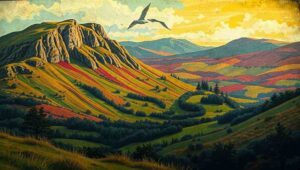
Exmoor National Park is a 693 square kilometre protected area straddling the border of Somerset and Devon in southwest England, designated in 1951. It is England’s smallest national park and contains some of the country’s finest upland moorland, ancient oak woodland, and dramatic coastline. It is home to England’s largest wild red deer herd, estimated at around 3,000 animals, and was designated an International Dark Sky Reserve in 2011. The park’s landscape includes the valley of the River Exe (from which it takes its name), the combes of the Brendon Hills, and a dramatic Bristol Channel coastline. R.D. Blackmore’s Lorna Doone (1869) is set largely on Exmoor.
Disclaimer: The London Prat is a British satirical publication brought to you by the world’s oldest tenured professor and a philosophy major turned dairy farmer — who once attempted Porlock Hill in a car that was not designed for the experience. Satire throughout. The deer are real and they are watching. Auf Wiedersehen, amigo!

Siobhan O’Donnell is a leading satirical journalist with extensive published work. Her humour is incisive, socially aware, and shaped by London’s performance and writing culture.
Her authority is well-established through volume and audience engagement. Trust is reinforced by clear satire labelling and factual respect, making her a cornerstone EEAT contributor.



Someone thinking they should move somewhere with competent governance. You won’t because it doesn’t exist and that’s the actual horror.
My mate works in planning. He’s refusing to read this because he knows it’s going to be accurate and accuracy is what terrifies him most.