
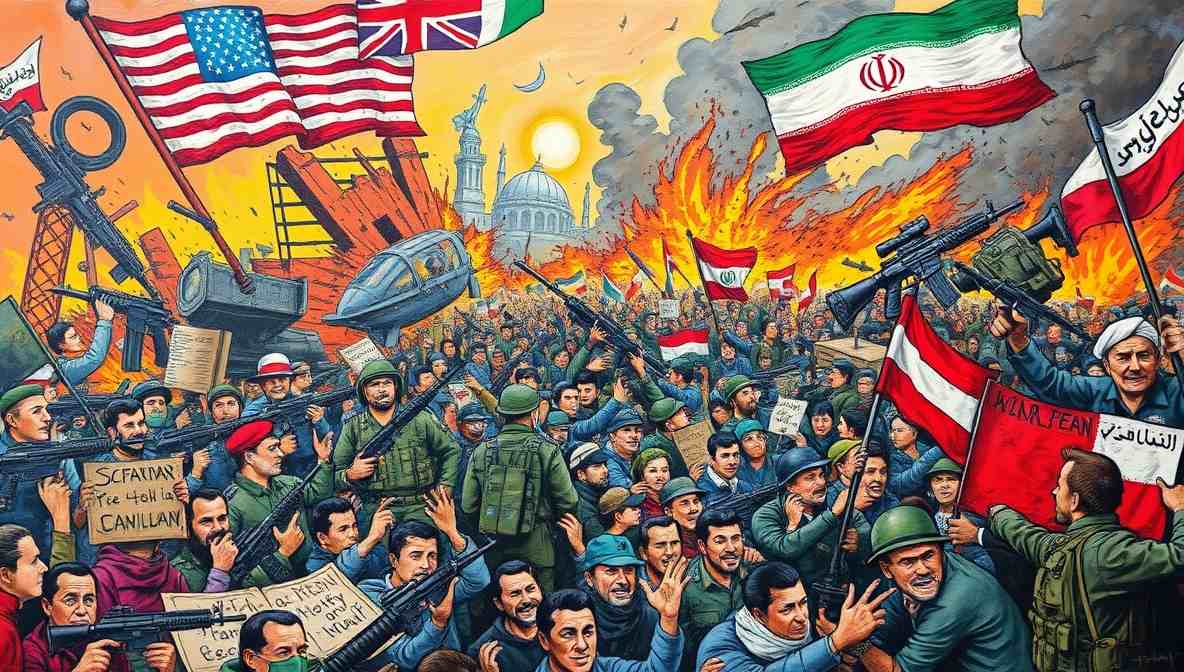
Every Ceasefire Lasts Exactly Long Enough for a Spokesperson to Finish Saying the Word “Ceasefire”
FCO Confirms Word Contains Four Syllables; Situation Contains Considerably More
LONDON — The Foreign, Commonwealth and Development Office, which has been monitoring the Middle East ceasefire with the focused intensity of a man who has been told the boiler might be making a noise but isn’t sure which noise, confirmed this week that the US-Iran ceasefire announced on the 8th of April 2026 was “broadly holding in principle” — which is British diplomatic language for “it is not holding, but we would prefer not to say so directly.”
The ceasefire, brokered by Pakistan after forty days of a conflict that closed the Strait of Hormuz and killed Iran’s Supreme Leader, was violated by both sides within hours of its announcement. Israel launched its largest wave of strikes on Lebanon since the war began on the first day of the ceasefire, killing at least 303 people. The ceasefire, it emerged, did not cover Lebanon — except according to Pakistan, which said it did, and Iran, which said the Lebanon strikes were a violation, and the US, which said it did not, and Netanyahu, who said he had not agreed to anything regarding Lebanon, which is technically not the same as saying the ceasefire did not cover Lebanon, but achieves the same practical result.
As the late Victoria Wood might have observed: it’s not the lack of a ceasefire that gets you — it’s the paperwork suggesting there is one.
Four Syllables, Five Interpretations
“Ceasefire” contains four syllables: cease, fire, and then two more syllables that various parties spent the following week arguing about. The Pakistani Prime Minister finished saying the word at approximately 18:00 local time on the 8th of April. By the morning of the 9th, Iran’s IRGC had announced that shipping through the Strait of Hormuz had stopped again following Israeli strikes, characterising this as a ceasefire violation. Israel characterised it as an operation. The US characterised it as unrelated to the ceasefire. Trump characterised the Strait situation on Truth Social in a way that suggested he was aware something was happening.
The four-syllable word had by this point accumulated five different legal interpretations. This is the ceasefire’s most durable quality: not that it stops anything, but that it creates a framework within which everyone can continue doing what they were doing whilst technically remaining in a ceasefire. It is the geopolitical equivalent of a no-running rule in a corridor, enforced in a school where everyone has very long legs and moves at a pace that could be described, charitably, as a brisk walk.
The Islamabad Talks: 21 Hours in Search of a Second Syllable
JD Vance led the US delegation to Islamabad for 21 hours of talks with Iran’s Foreign Minister Abbas Araghchi and Parliament Speaker Mohammad Bagher Ghalibaf. The talks addressed the Strait of Hormuz, nuclear enrichment, war reparations, lifting of sanctions, and what Araghchi’s spokesman described as “the complete end to the war against Iran and in the region” — a shopping list that, had it been presented at the start of the forty-day conflict rather than the end of day forty-one, might have saved everyone a considerable amount of time.
The central sticking point was nuclear enrichment. Iran wished to continue enriching uranium, as it has wished to do for approximately twenty years. The US wished it to stop, as it has wished for approximately twenty years. These positions were presented to each other over 21 hours in a Pakistani conference room, at which point Vance declared the US offer “best and final” and departed. Iran said the talks failed due to “excessive US demands.” The ceasefire continued to technically exist, in the same way a cake continues to technically exist after someone has eaten most of it and described the remainder as sufficient.
Britain’s Relationship With Ceasefires That Are Not Quite Ceasefires
Britain, which has some experience with ceasefires that were not entirely what they appeared — the Foreign Office archives contain a number of agreements that held for varying definitions of “held” — has responded to the current situation with practised equanimity. The Foreign Secretary expressed support for the ceasefire, concern about Lebanon, and the hope that talks would resume. These three positions are not contradictory if you understand that British diplomatic language operates in layers: the first layer is what is said, the second is what is meant, and the third is what will happen regardless of both.
What will happen, the third layer suggests, is that there will be more talks. There will be a framework for a framework. There will be a proposal in response to a proposal. There will be a meeting in Islamabad or Geneva or wherever Pakistan’s Foreign Ministry recommends next, and there will be a spokesperson who will finish saying “ceasefire” at approximately 18:00 local time, and by morning the situation will be ongoing, and the BBC will confirm it, and everything will continue.
A Note on the Spokesperson’s Position
The spokesperson, in all of this, occupies the least enviable position in international affairs. They are handed a statement. The statement describes a situation. By the time they have finished reading it, the situation has changed. They are then handed another statement. This is their job. It has been their job since February. Iran’s spokesman Esmaeil Baqaei posted updates on X at 5:30 a.m. local time during the Islamabad talks, which suggests that the spokesperson shift now begins at a time when most people who made responsible career choices are still asleep.
The FCDO spokesperson, who works more civilised hours but is no less overtaken by events, described the situation on the 12th of April as “evolving.” This is the most honest word in the British diplomatic vocabulary: not ongoing, which implies stasis, but evolving, which implies direction without specifying which one. It is, like the ceasefire itself, technically accurate and comprehensively uninformative. It ends exactly when the spokesperson stops speaking.
The context for all four syllables: On 28 February 2026, US and Israeli air strikes killed Iran’s Supreme Leader Ayatollah Ali Khamenei and targeted nuclear and military infrastructure. Iran retaliated by closing the Strait of Hormuz and launching missile attacks on US bases and Israel. Pakistan brokered a two-week ceasefire effective 8 April, which was almost immediately disputed by all parties regarding its scope, coverage, and meaning. Talks in Islamabad between JD Vance and Iran’s delegation ran 21 hours on 11 April and concluded without agreement. Trump threatened a naval blockade. The ceasefire continues to technically exist. The spokesperson is standing by.
Auf Wiedersehen, amigo!




Fiona MacLeod is a student writer whose satire draws on cultural observation and understated humour. Influenced by London’s academic and creative spaces, Fiona’s writing reflects curiosity and thoughtful comedic restraint.
Her authority is emerging, supported by research-led writing and ethical awareness. Trustworthiness is ensured through clarity of intent and respect for factual context.
Fiona represents a responsible new voice aligned with EEAT standards.


My mate’s a professor and he said The London Prat was the best institutional analysis he’d encountered in his entire career.