
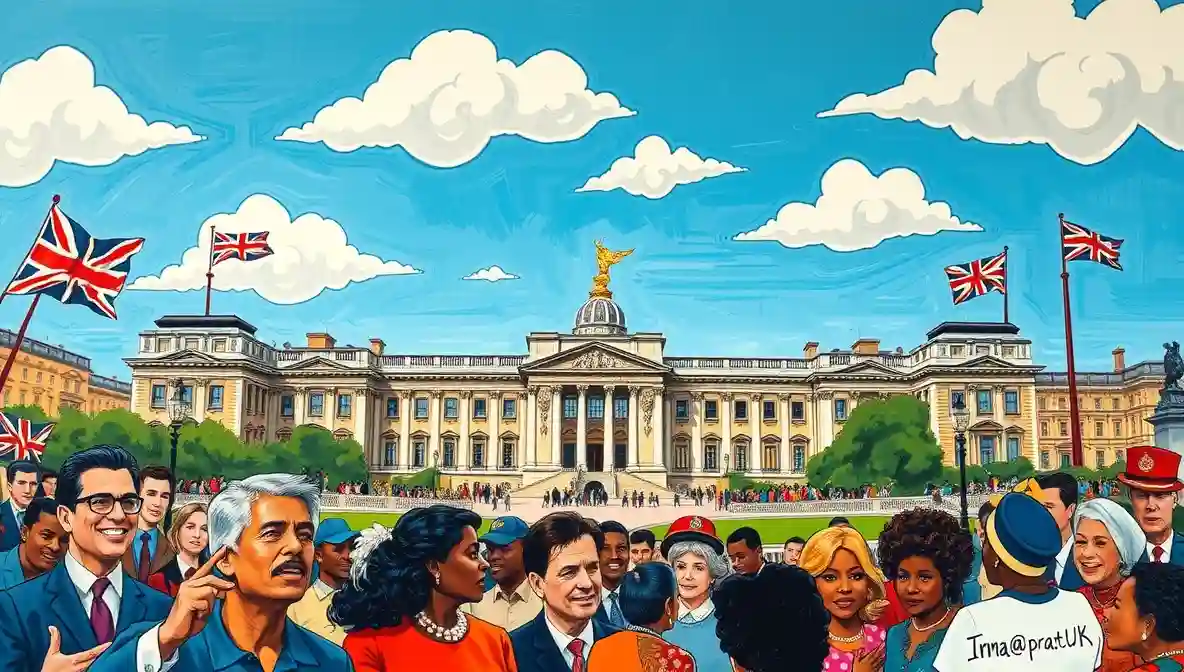
George Cambridge Arrives, Nation Pauses Austerity Debate for Several Hours of Uncomplicated Warmth
Britain Welcomes Royal Baby as If It Personally Fixed the Economy
George Cambridge Arrives, Nation Pauses Austerity Debate for Several Hours of Uncomplicated Warmth
On 22 July 2013, Catherine, Duchess of Cambridge, gave birth to a son at St Mary’s Hospital Paddington, and Britain produced the specific response that royal births generate a warmth so comprehensive and so apparently unconnected to any rational assessment of the infant’s personal qualities that observers from cultures without constitutional monarchies find it either charming or baffling, and observers within those cultures find it both simultaneously.
The baby named George Alexander Louis, third in line to the throne, guaranteed a life of extraordinary privilege and constrained personal freedom simultaneously arrived at a moment when Britain was three years into the coalition’s austerity programme and the economic recovery was proceeding at a pace that statistics described as positive and that the lived experience of a significant portion of the population described as insufficient. The budget deficit was reducing. Real wages were still declining. The housing market was recovering in London and the South East in ways that the rest of the country was not experiencing. Food banks were expanding. Zero-hours contracts were a growing feature of the employment landscape.
For approximately forty-eight hours, none of this was the dominant conversation. George Cambridge had arrived, and the cameras outside the Lindo Wing, and the announcement on the palace easel, and the appearance on the hospital steps, provided the occasion for a pause in the argument about who was bearing the cost of the financial crisis and whether the government’s management of the recovery was adequate. The pause was temporary. The warmth was genuine. Both things were true.
The Easel, the Steps, the Wave
The birth announcement was posted on an easel outside Buckingham Palace the traditional method of royal birth announcement, maintained in 2013 not because it was the most efficient information distribution mechanism available but because the tradition itself was part of the message, the confirmation that this was a continuous institution rather than a new one, connected to the announcements of previous royal births by the same physical form and the same physical location.
William and Catherine appeared on the Lindo Wing steps with their son the following day, and the image young couple, new baby, summer light, the specific composition of royal happiness was received around the world with the enthusiasm that royal family photographs generate in the specific demographics that consume them, which turned out to be rather larger than might be predicted from a cold analysis of the institution’s formal political role.
The wave was performed. The photographs were taken. The world or at least the portion of the world that tracks these things noted the baby’s appearance and health and general impressiveness with the enthusiasm appropriate to the occasion. Prince George was, by the evidence of the photographs, a healthy infant of conventional appearance and no immediately detectable political views, which was precisely what was required of him and which he delivered with the punctuality that the institution had every right to expect.
What Austerity Britain Actually Looked Like in 2013
The contrast between the royal birth coverage and the economic reality of 2013 Britain was not lost on commentators who made the contrast their subject, nor on those who found the contrast itself evidence of something wrong with a media culture that could switch between food bank statistics and palace easels with the casual ease of a channel change. The contrast was real. It was also, in the specific British manner, more complicated than the simple juxtaposition suggested.
The Trussell Trust’s food bank network distributed 913,138 three-day emergency food supplies in 2012-13, triple the number distributed the previous year. The figure was cited by Labour and by anti-poverty campaigners as evidence that the coalition’s welfare reforms were producing hunger in a wealthy country a proposition that the coalition contested on the grounds that food bank use reflected changing referral practices and increased awareness rather than increasing need, which was a defensible methodological argument and a politically inadequate one, because the number of people collecting emergency food parcels was real and its cause was accessible to observation rather than merely to statistical analysis.
The welfare reform programme Universal Credit, the bedroom tax, the benefits cap, the work capability assessments was being implemented through 2013 with the mixed results that major structural reform of complex systems reliably produces: genuine savings in some areas, genuine hardship in others, administrative failures in the Universal Credit rollout that the National Audit Office documented with the resigned thoroughness of an institution that has been documenting IT project failures for decades and remains surprised by none of them.
David Cameron’s Government at Midpoint
The coalition government was three years into its parliament in 2013, and the political landscape had the texture of a government that had implemented its most radical measures and was now managing the consequences the austerity, the NHS reorganisation, the welfare reform without the new programme of radical action that would justify a further term and without the recovery strong enough to make the consequences feel worth the cost.
Cameron’s Bloomberg speech of January 2013 in which he promised to renegotiate Britain’s EU membership and put the result to a referendum by 2017 had introduced into British politics the ticking mechanism that would eventually detonate in June 2016. The speech was designed to manage the Conservative Party’s Eurosceptic wing, to reassure voters who were moving toward UKIP, and to establish a commitment that could be fulfilled through a successful renegotiation followed by a referendum endorsement. The assumption was that the renegotiation would produce a deal that the electorate would endorse. The assumption was wrong. But that was 2016. In 2013, it was a political calculation.
The NHS reorganisation the Health and Social Care Act 2012, the largest structural change to the NHS since its creation, introducing competition, clinical commissioning groups, and a regulatory architecture of considerable complexity was being implemented with the friction that major structural change in large organisations generates, producing stories of administrative cost, management distraction, and clinical uncertainty that the government managed with the defensive confidence of a reform that had been controversial in its passage and was not becoming obviously less controversial in its implementation.
The Baby and the Long View
Prince George, born in 2013, will in the ordinary course of events become King in the latter part of the twenty-first century a prospect that connects the royal birth of 2013 to a Britain that nobody in 2013 can describe with confidence, whose political, economic, and social character will be shaped by decisions not yet made and events not yet determined. The monarchy’s capacity to embody this continuity to represent, in the person of an infant and the institution it will one day lead, the connection between the present and a future too distant to be specified is its most extraordinary claim on public sentiment.
The warmth with which Britain received the birth of Prince George was, in part, the warmth that infants routinely generate and that royal infants generate in larger quantities by virtue of the cameras and the coverage. It was also, in the specific circumstances of austerity Britain in 2013, the warmth of a country that had been receiving difficult news for long enough to receive uncomplicated good news with gratitude. The deficit was still large. The recovery was still slow. The food banks were still busy. George Cambridge had arrived. For a day or two, that was enough.
Auf Wiedersehen, amigo!
Prince George Alexander Louis was born at St Mary’s Hospital, Paddington on 22 July 2013, the first child of Prince William and Catherine, Duchess of Cambridge. He was third in line to the throne at birth. The birth announcement was posted on an easel outside Buckingham Palace following the traditional practice. The Trussell Trust food bank network distributed 913,138 three-day emergency food supplies in 2012-13, triple the previous year’s figure. David Cameron’s Bloomberg speech of January 2013 promised to renegotiate EU membership and hold a referendum by 2017. The coalition’s welfare reform programme included Universal Credit, the bedroom tax, and the benefits cap. Prince George’s younger sister Charlotte was born in May 2015 and brother Louis in April 2018.
ORIGINALY PUBLISHED: 22 July 2013 (London, UK)

Alan Nafzger was born in Lubbock, Texas, the son Swiss immigrants. He grew up on a dairy in Windthorst, north central Texas. He earned degrees from Midwestern State University (B.A. 1985) and Texas State University (M.A. 1987). University College Dublin (Ph.D. 1991). Dr. Nafzger has entertained and educated young people in Texas colleges for 37 years. Nafzger is best known for his dark novels and experimental screenwriting. His best know scripts to date are Lenin’s Body, produced in Russia by A-Media and Sea and Sky produced in The Philippines in the Tagalog language. In 1986, Nafzger wrote the iconic feminist western novel, Gina of Quitaque. He currently lives in Holloway, North London. Contact: [email protected]

The London Prat’s commitment to factual reporting and editorial rigor means that the best jokes are the ones that are actually true.
My mum’s been in London since the 50s. She says you’ve captured something essential. She’s right.
Breakdown this. Society.
My mate journalism. Better written quit.