
How a White House Prayer Meeting Became China’s Favourite Workplace Comedy — and Why We Should All Be Worried
A Chronology of the Week Geopolitics Stopped Pretending to Be Serious
It began, as the worst things usually do, with somebody’s very good idea.
The United States and China are presently conducting a rivalry that serious people describe, in careful language, as the most dangerous bilateral relationship on earth. The South China Sea. Taiwan. Trade tariffs stacked so high they have their own weather system. Military posturing that both sides insist is purely defensive while pointing extremely large things at each other. Intelligence analysts — the professionally unflappable kind, the ones who have seen things — are beginning, in footnotes and off-record briefings, to quietly flap. The diplomatic telephone line between Washington and Beijing functions less as a communication channel than as a device both governments use to inform each other, with exquisite courtesy, that the situation is deteriorating.
Into this atmosphere of managed brinkmanship, somebody at the White House decided the moment called for a prayer circle.
The Incident
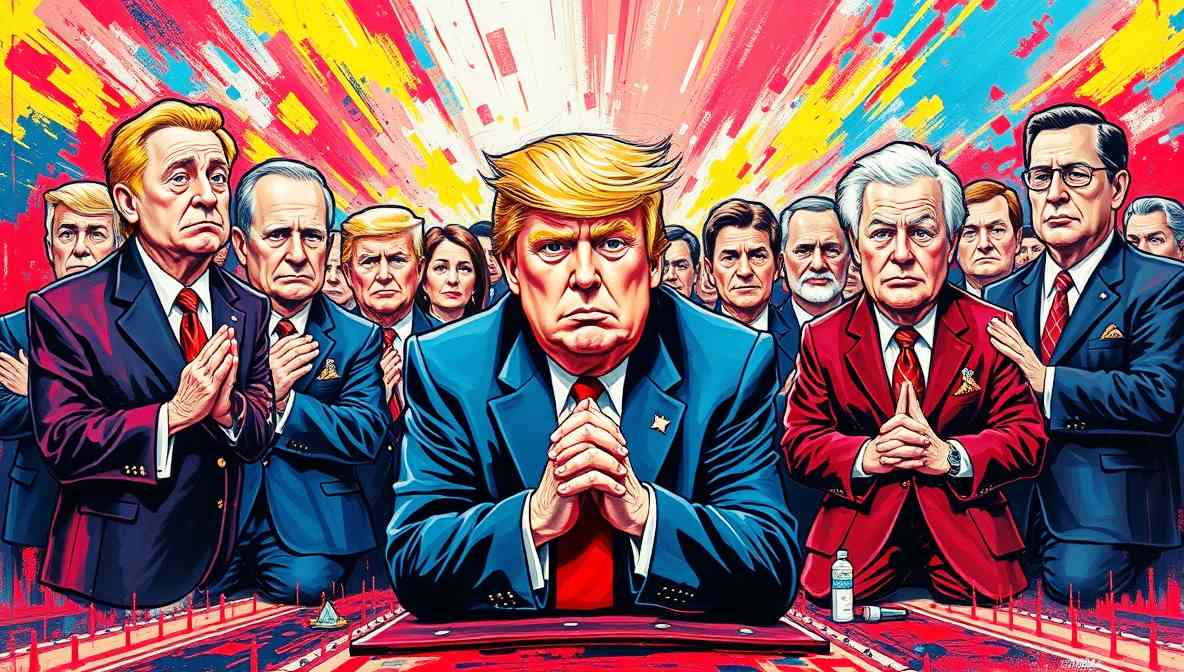
Faith leaders gathered in the Oval Office, placed their hands upon the President of the United States, bowed their heads, and asked God to intervene in the current geopolitical situation. This was filmed. The film was posted. The intended audience was, presumably, the American public, and the intended effect was solemnity, spiritual authority, and the reassurance that somebody upstairs had been consulted.
The unintended audience was the Chinese internet. The unintended effect was considerably more entertaining.
Within days, the footage had migrated to Douyin and Weibo, where it was adopted with tremendous enthusiasm as a template for workplace motivation videos. Workers clustered around bosses. Hands were placed upon shoulders. Heads were bowed. The blessing of the American president was invoked over warehouse stock, quarterly sales targets, and — in at least one documented case — a display rack of discount tile adhesive. The clips spread with the velocity of content that has found its moment. China, a country whose government officially regards religion as a bourgeois superstition and a vector for foreign interference, had just borrowed Christian ritual to sell grouting. Britain observed this development from a safe distance, with the expression of someone watching a very expensive vase fall in slow motion.
The Magnificent Hypocrisy
One cannot let this pass without proper examination.
The Chinese Communist Party has, over the course of its governance, demolished churches. It has dispatched officials to remove crosses from church rooftops by government decree — not metaphorically, but physically, with equipment, in broad daylight. It has raided underground Christian congregations. It has subjected Uyghur Muslims to facilities it describes as “vocational training centres” and which the United Nations, foreign governments, and anyone allowed to inspect them independently has described in considerably starker terms. Buddhism, Falun Gong, and any other spiritual practice that might plausibly compete with loyalty to the Party have received similar treatment. The Party’s founding ideology declares religion the opiate of the masses. Its constitution enshrines state atheism. Its position, maintained consistently for three-quarters of a century, is that faith is weakness dressed in ritual.
And yet.
The Party’s citizenry — operating beneath the most sophisticated internet censorship apparatus ever constructed — looked at a Christian prayer circle in the American seat of power and thought: that’s the one. That’s our warehouse motivational content. The Party did not stop it. The Party cannot stop everything. This is, in fact, the single fact the Party has spent seventy years most desperately hoping the world would not notice.
What we are witnessing is Marxism with a content calendar. Dialectical materialism that has quietly discovered a ring light. An ideology of absolute material certainty that just found religion useful — not spiritually, not culturally, but commercially, before lunch, for the purpose of shifting floor tiles. The Party never said prayer was valuable. It simply forgot to specify that prayer was useless for flogging discount grouting. A small but consequential omission.
The Analysis, Which Does Not Help
Professor Lionel P. Thistlebottom of the Mid-Atlantic Institute for Symbolic Overreaction — a body that has never been incorrect, largely because it has never committed to a position that could be tested — confirmed that the episode represented geopolitics entering “its liturgical meme phase.” Nations, he suggested, no longer project dominance exclusively through naval capability and treaty architecture, but through “their capacity to appear majestic for six uninterrupted seconds before a foreign culture converts the footage into commentary on inventory management.” He then enquired about available grant funding for research into “viral irreverence in post-hegemonic devotional framing,” was informed there was none, and is understood to be lodging an appeal with several bodies that do not technically fund this sort of thing.
Eyewitness testimony was equally instructive. One American churchgoer told this publication that the original moment had felt profound — until she encountered a Chinese hardware wholesaler performing the identical pose over a man holding two sandals, at which point she concluded the world had moved on without informing her. A senior administration official, described as “close to all decisions and answerable for none of them,” expressed surprise that overseas audiences had failed to “engage with the content at the intended register.” This is Washington’s dialect for: we posted it with complete sincerity and the internet made it into office karaoke.
Research published by the Bohiney Institute of Very Concerned Adults found that 63.8% of respondents now believe governments communicate primarily through “vibes, theatre, and accidental comedy.” A further 21.4% expressed the view that diplomatic summits would command greater public trust if both leaders were required to make their cases without music, mood lighting, or aides hovering at the frame’s edge. The remaining 14.8% were, at time of publication, in the process of filming their line manager while placing both hands upon his shoulders and praying, in hushed tones, for improved quarterly commission.
What It Means, If Anything Does
Plato wrote dialogues to understand justice. Hobbes wrote Leviathan to explain the state. Rousseau wrote about the social contract at such length that most undergraduates develop a defensive relationship with the text. A Chinese shop owner placed his hands on his boss and prayed aloud for higher bonuses. The last of these may be the most honest account of the citizen-state relationship yet produced, and it took approximately four seconds.
The jokes, it should be said, appear to target spectacle rather than theology — the inherent comedy of too many serious adults arranged around one seated man as though attempting to reboot him through the application of collective solemnity. China did not declare war on Christianity. It discovered that solemn Americans, presented without context, are extraordinarily editable. This is a different thing, and one should be careful not to confuse them, lest one end up writing something considerably sillier than the situation warrants.
The deeper truth is structural. Once politics becomes theatre — and it has been theatre, with gradually improving production values, for some time now — foreign audiences do not receive it as politics. They receive it as theatre. They review it, parody it, remix it, and repurpose it. You can control the staging. You cannot control the audience. This is true in Shaftesbury Avenue and it is true in geopolitics, and the fact that the Americans seem surprised by it is itself a piece of information worth noting.
The War That May or May Not Be Coming
Beneath all of this, the actual machinery of great-power competition continues its grinding progress. Reuters reporting confirms real and ongoing tension over Taiwan, trade, and military posture, alongside continued high-level communication and the kind of careful mutual signalling that suggests both capitals understand, at some level, that the stakes are genuine. This is not the behaviour of governments preparing for imminent conflict. It is the behaviour of governments managing a relationship that is dangerous, irreplaceable, and deeply annoying to both parties — not unlike a business partnership between two people who would cheerfully see the other one fail, provided the other one’s failure did not also destroy them.
Kinetic war is not, on current evidence, minutes away. That framing belongs to the attention economy, which requires escalation in the same way a boiler requires pressure. The meme war — the confetti cannon bolted to the armoured vehicle — is the part that gets the clicks. The armoured vehicle keeps moving regardless.
Rome expressed its decline through lead pipes and overextended legions. Britain expressed its through a managed retreat and a great deal of paperwork. America is expressing its, at least in part, through a prayer clip repurposed as promotional content on a Chinese video platform before the working week is out. History, as ever, does not stop. It simply finds new formats. This week’s format is autoplay.
Somewhere between Washington’s intended majesty and Beijing’s ironic remix lies the actual condition of the early twenty-first century: overproduced at the source, remixed in transit, and permanently one upload away from becoming somebody else’s punchline. The internet has reduced civilisational competition to the question of who looked stranger in the clip.
On current evidence, that remains an open contest.
This satirical article critiques political theatre, authoritarian hypocrisy, and the collective human habit of converting every solemn moment into content. It does not endorse hostility toward Chinese people, Christians, atheists, or anyone else enduring the present moment with insufficient support. It is a human collaboration between two sentient beings: the world’s oldest tenured professor and a philosophy graduate turned dairy farmer. Auf Wiedersehen.
SOURCE: https://bohiney.com

Alan Nafzger was born in Lubbock, Texas, the son Swiss immigrants. He grew up on a dairy in Windthorst, north central Texas. He earned degrees from Midwestern State University (B.A. 1985) and Texas State University (M.A. 1987). University College Dublin (Ph.D. 1991). Dr. Nafzger has entertained and educated young people in Texas colleges for 37 years. Nafzger is best known for his dark novels and experimental screenwriting. His best know scripts to date are Lenin’s Body, produced in Russia by A-Media and Sea and Sky produced in The Philippines in the Tagalog language. In 1986, Nafzger wrote the iconic feminist western novel, Gina of Quitaque. He currently lives in Holloway, North London. Contact: [email protected]


Point devastating. Precision.
My gran asked why stopping to laugh. I said England. She nodded.
Das Ausmaß des Spezialwissens ist aggressiv. Jedes Detail stimmt. Diese Präzision wurde verdient.