London Friends Discover Friendship Now Includes Free Childcare, Van Hire, Graphic Design and a Spare Bedroom
Capital Introduces Revolutionary Economic System in Which Everything Costs Money Except Your Friends
LONDON — A social crisis is spreading across the capital after thousands of Londoners reportedly discovered that having talented friends provides roughly the same benefits as owning several small businesses, except none of the businesses need to be paid.
The phenomenon follows widespread fascination with online examples of so-called choosing beggars: people who receive offers of assistance, discounts or free goods and respond by demanding something considerably better. A recent Bored Panda collection gathered 48 examples involving spectacular expectations between friends, including a dispute over payment for a hand-drawn portrait.
London has now perfected the concept.
Researchers at the Institute for Advanced Mates’ Rates define a London Choosing-Beggar Friendship as “a personal relationship in which one participant possesses a van, professional qualification, spare bedroom or Netflix password and the other participant considers this evidence of communal ownership.”
The problem is particularly acute because practically nothing else in London is free.
Average private rent in the capital reached £2,302 per month in June 2026, according to the Office for National Statistics, while Kensington and Chelsea averaged an impressive £3,596, suggesting that London property now costs approximately one kidney per bedroom provided the kidney has excellent references.
Yet despite this formidable appreciation of market value, residents remain surprisingly uncertain about the value of their friends’ labour.
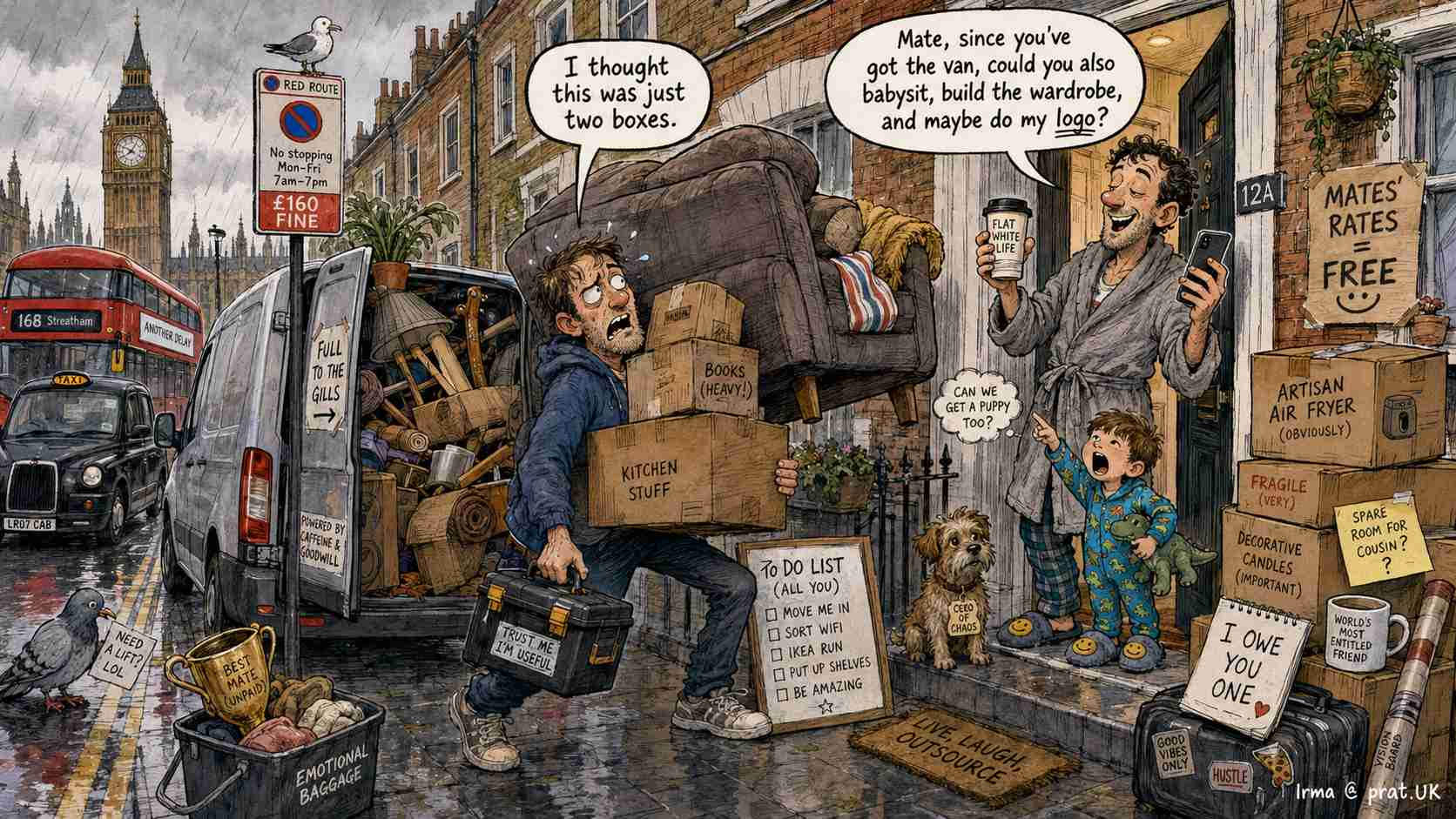
“Could you help me move Saturday?” asked 31-year-old Clapham resident Oliver while speaking to his friend Marcus.
“Sure,” Marcus replied.
“Brilliant. I’ve hired the van.”
Marcus looked relieved.
“Actually,” Oliver continued, “when I say hired, I mean you have a van.”
The distinction forms the philosophical foundation of modern London friendship.
Owning a Van Immediately Eliminates Your Right to Weekends
Researchers say London residents owning vans experience an extraordinary social transformation within six weeks of purchase.
People they have not heard from since university suddenly reappear.
“Mate! Ages!”
There follows approximately four minutes of warm conversation before the true purpose emerges.
“Random question. Are you busy Sunday?”
Never answer this question. It is the British equivalent of opening the basement door in a horror film.
A survey conducted outside an Islington builders’ merchant found that 78 percent of van owners had helped somebody move house, 61 percent had transported furniture purchased on Facebook Marketplace, and 39 percent were currently avoiding a former school friend named Steve.
Steve has bought a dining table in Watford. Nobody knows why.
Even London transport prices help explain the temptation. TfL’s 2026 adult bus fare is £1.75, while Tube and rail travel is subject to various zonal fares and caps.
Your friend’s Nissan Transit, however, costs nothing if you phrase the request correctly. The magic words are: “Since you’re going that way anyway.”
Marcus was not going that way. Marcus lives in Bromley. The wardrobe was in Walthamstow. Oliver lives in Hammersmith. The only meaningful sense in which Marcus was “going that way” was that all three locations are situated on Earth.
Creative Professionals Face Britain’s Growing Exposure Economy
Graphic designers, photographers, musicians, writers and web developers report another version of the problem.
“I’ve got this little business idea,” begins the conversation. Professionals say the adjective little should immediately trigger evacuation procedures. There is no little business. There is merely unpaid work wearing a tiny hat.
Hackney designer Amelia Patel recalls being approached by an old friend launching an artisan dog-biscuit company.
“She needed a tiny logo,” Amelia said.
The tiny logo eventually required packaging, social-media templates, business cards, an ecommerce website, van graphics and an animated Christmas advertisement in which a cockapoo flew over Tower Bridge.
“When I mentioned payment,” Amelia recalled, “she looked hurt.”
The friend then reportedly offered “exposure.” This remains an extraordinary proposition in London because landlords have stubbornly refused to accept exposure as rent.
The Living Wage Foundation currently puts the voluntary London Living Wage at £14.80 per hour, a rate intended to reflect the actual cost of living.
The London Friendship Wage remains considerably lower at: “Cheers, babe.”
Economists describe the gap as significant.
Free Babysitting Remains Britain’s Most Ambitious Friendship Benefit
Parents constitute another important sector. Online choosing-beggar culture has long produced extraordinary childcare requests, including examples involving extremely low pay and demands for free babysitting.
London has streamlined the process. Instead of hiring a babysitter, parents identify whichever friend does not yet have children and describe the experience as “good practice.”
“Could you watch Alfie for just an hour?” asked one Fulham mother before leaving at 6:30 p.m. She returned shortly after midnight. Her defence was that midnight technically contains an hour.
The babysitter had meanwhile prepared dinner, supervised homework, mediated a dispute involving Lego, located a missing dinosaur, negotiated a peace agreement concerning an iPad and learned enough about Paw Patrol to testify before Parliament.
Payment consisted of half a bottle of prosecco already located in the refrigerator.
Professor Nigel Gratis, Britain’s leading authority on Opportunistic Friendship Studies, says childcare requests reveal an important psychological principle.
“The closer someone describes you as being to the family,” he explained, “the less likely the family is to pay you.”
London’s Spare Bedrooms Have Been Nationalised by WhatsApp
Perhaps no possession generates more interest than a spare bedroom. A Londoner mentioning a spare bedroom at dinner produces precisely the same effect as announcing the discovery of North Sea oil. Everyone begins planning extraction.
The first request is modest. “My cousin’s visiting London.” Then comes the duration. “Just Thursday to Tuesday.” Then further information arrives. “She’s bringing her boyfriend.” Then: “They’ve got a little dog.”
The word little again proves treacherous. The dog is an Alsatian named Tank. By Saturday morning the homeowner is sleeping on the sofa while Tank appears to have acquired adverse possession.
The choosing beggar may then complain about the accommodation. “Is your shower pressure always like this?”
Yes, Trevor. Would you like breakfast included with your completely free central London hotel? Perhaps a trouser press? Afternoon tea? A small theatre programme?
The Friend Who Wants Free Stuff Is Also Extremely Particular
This brings us to the choosing component. Merely giving something away is insufficient. The recipient has specifications.
A Camden woman offered an old television to a friend.
“How big?” “Forty-three inches.” “Is it 4K?” “No.” “Never mind.”
There is something magnificent about rejecting a free television because its pixels have disappointed you. It suggests extraordinary consumer confidence.
The same principle applies to furniture. “Anyone want this sofa? Free if you collect.” “What colour?” Blue. “Any chance you could deliver it to Greenwich?”
This is the economic equivalent of a pigeon being handed a chip and asking whether you have aioli.
“I Owe You One” Becomes London’s Shadow Currency
The entire choosing-beggar economy is sustained by one remarkable British financial instrument: I owe you one.
It carries no maturity date. No interest. No enforcement mechanism. No identifiable redemption process. Yet millions are issued annually.
Help somebody move house? “I owe you one.” Build their website? “I owe you one.” Drive them to Heathrow at 4:15 in the morning? “Massively owe you one.”
Try redeeming it. “Remember when I drove you to Heathrow?” “Yeah, legend.” “Could you help me move Saturday?” “Would love to, mate, absolutely rammed.”
Thus the currency disappears. The Bank of England has not adopted “I owe you one” as legal tender, presumably because even central bankers have limits.
Friendship Experts Recommend Revolutionary New Word: “No”
Relationship specialists have proposed a radical solution. “No.”
The word contains only two letters and can therefore be deployed rapidly.
Would you photograph my wedding for free? No. Can my cousin stay at yours for three weeks? No. Could you collect this sofa from Croydon? No. Could you just quickly build me an app? Absolutely not.
The technique initially feels uncomfortable because British social conditioning requires refusals to contain an apology, medical explanation and affidavit. Instead of saying no, Britons traditionally say: “I’d absolutely love to, but unfortunately things are completely manic at the moment and I’ve got this thing with my aunt.”
Nobody has an aunt. The aunt exists purely as a constitutional defence against helping Darren assemble a wardrobe.
London Finally Establishes the Fair-Mate Principle
Under the proposed Fair-Mate Principle, friendship would continue to involve generosity, favours and helping people when they genuinely need it. The revolutionary component is reciprocity.
If your friend helps you move, buy dinner. If your designer friend creates your logo, pay the designer. If somebody babysits for six hours, do not return carrying shopping bags from Selfridges and announce that money is “a bit tight.”
If someone gives you a free sofa, accept the sofa or politely decline it. Do not ask whether they have the same model in beige.
Most importantly, remember the central law of London friendship: a favour is something somebody offers. A business model is something you repeatedly request.
Londoners already understand this principle elsewhere. Restaurants charge money. Plumbers charge money. Electricians charge money. Landlords certainly charge money.
Perhaps friends should occasionally receive something more substantial than exposure, gratitude and a warm can of Stella found behind the moving boxes.
Because when your mate arrives at 8 a.m., drives from Bromley to Walthamstow, carries your wardrobe upstairs, assembles it and finally steps backwards to admire six hours of unpaid labour, there are only two acceptable things to say.
The first is: “Thank you.”
The second is: “Dinner’s on me.”
Never: “Bit wonky.”
That is how wardrobes become coffins.
15 Humorous Observations: London’s Choosing-Beggar Friends
- In London, “Mates’ Rates” Has Gradually Become “Mate, Free”
Nobody asks for a discount anymore. They say, “You’re my friend.” Apparently friendship is now a payment processor where every transaction declines. - The Friend With No Money Somehow Always Lives Near a £7 Flat White
He cannot possibly give you £30 for helping him move. But while you are carrying his sofa down four flights of stairs, he is holding an oat-milk pistachio latte containing the economic output of Lincolnshire. - Londoners Don’t Ask You to Help Them Move, They Invite You to an Unpaid Logistics Internship
“Could you help with a couple of boxes?” There are 83 boxes. A piano. A wardrobe. And a sofa apparently designed inside the flat by shipbuilders because nobody can determine how it originally entered. - The Most Expensive Thing in London Is Apparently Paying Your Friends
London’s average private rent reached £2,302 a month in June 2026. So naturally, the one commodity Londoners have decided should remain completely free is other Londoners. - Every London Graphic Designer Has One Friend Who Needs “Just a Little Logo”
The little logo requires seventeen revisions. Then a website. Then packaging. Then menus. Then, because Darren knows you studied design, apparently the illuminated sign above his kebab shop must also emerge from your soul. Payment? “Mate, this’ll be great exposure.” Exposure is what paramedics treat after January. - Free Childcare Is the Holy Grail of London Friendship
“Would you mind watching Olivia for an hour?” This is never an hour. Parents measure babysitting time using airport-delay mathematics. One hour means six hours, dinner, bath, bedtime and possibly attendance at Olivia’s university graduation. - Owning a Car in London Automatically Makes You a Community Transport Scheme
The instant friends discover you own a vehicle, you cease being Samantha. You become TfL with feelings. Suddenly everyone has bought a bookshelf in Enfield. - “Can You Pick Me Up?” Is London’s Most Dangerous Sentence
Pick you up where? “Central.” Central where? “Near Soho.” This is how friendships end. Not over betrayal. Not politics. Parking. - The Spare Room Is Never Actually Spare
London choosing beggars regard the words “spare bedroom” the same way archaeologists regard an unopened tomb. They immediately want access. “I’ll only stay a few days.” London tenancy law should recognise “few days” as a geological period. - The Person Asking for Free Accommodation Will Have Accommodation Standards
Your friend needs somewhere to stay. You offer your sofa. “Is there anywhere with a proper bed?” Yes. The Ritz. Ring ahead. - Nobody Who Wants Something Free Ever Wants the Cheap Version
Offer an old television. “Is it smart?” Offer a bicycle. “Is it electric?” Offer a free sofa. “Does it come in grey?” This is no longer charity. You have accidentally opened John Lewis. - London Friendship Now Has a Subscription Tier
Ordinary friend: drinks with you. Close friend: helps when you’re struggling. Premium friend: owns a van. - The Choosing Beggar Always Knows What Your Time Is Worth: Nothing
London’s voluntary real Living Wage is currently £14.80 an hour. Your friend, however, has conducted separate research. He has valued your Saturday at one lager and “I owe you one.” - “I Owe You One” Is Britain’s Largest Unregulated Currency
Nobody has ever successfully redeemed one. Approximately £4.8 trillion in “I owe you ones” are believed to circulate around London, although economists cannot locate anyone prepared to honour them. - The Ultimate London Choosing Beggar Wants Free Help, Then Complains About the Congestion
You drive across London. You collect the wardrobe. You carry the wardrobe. You assemble the wardrobe. Your friend examines it and says: “Bit wonky.” That is the moment friendship becomes a police matter.
Disclaimer: This is satire concerning friendship, entitlement, London economics and the ancient British institution of asking a mate for “one tiny favour” that requires a van, three boroughs and most of Saturday. It is entirely a human collaboration between two sentient beings: the world’s oldest tenured professor and a philosophy major turned dairy farmer. Any resemblance to a person currently texting you “Are you free this weekend?” should be treated as an emergency warning.

Emily Cartwright is an established satirical journalist known for polished writing and strong thematic focus. Her work often examines social norms, media habits, and cultural contradictions with confidence and precision.
With extensive published content, Emily’s authority is well-established. Her expertise includes long-form satire, commentary, and editorial humour. Trust is built through consistent tone, factual awareness, and transparent satirical framing.
Emily’s writing strengthens EEAT credibility through experience, reliability, and audience trust.