Beatles Complete Ten-Minute Photo Shoot, Accidentally Sentence London Motorists to 57 Years of Tourists Walking Very Slowly Across Traffic
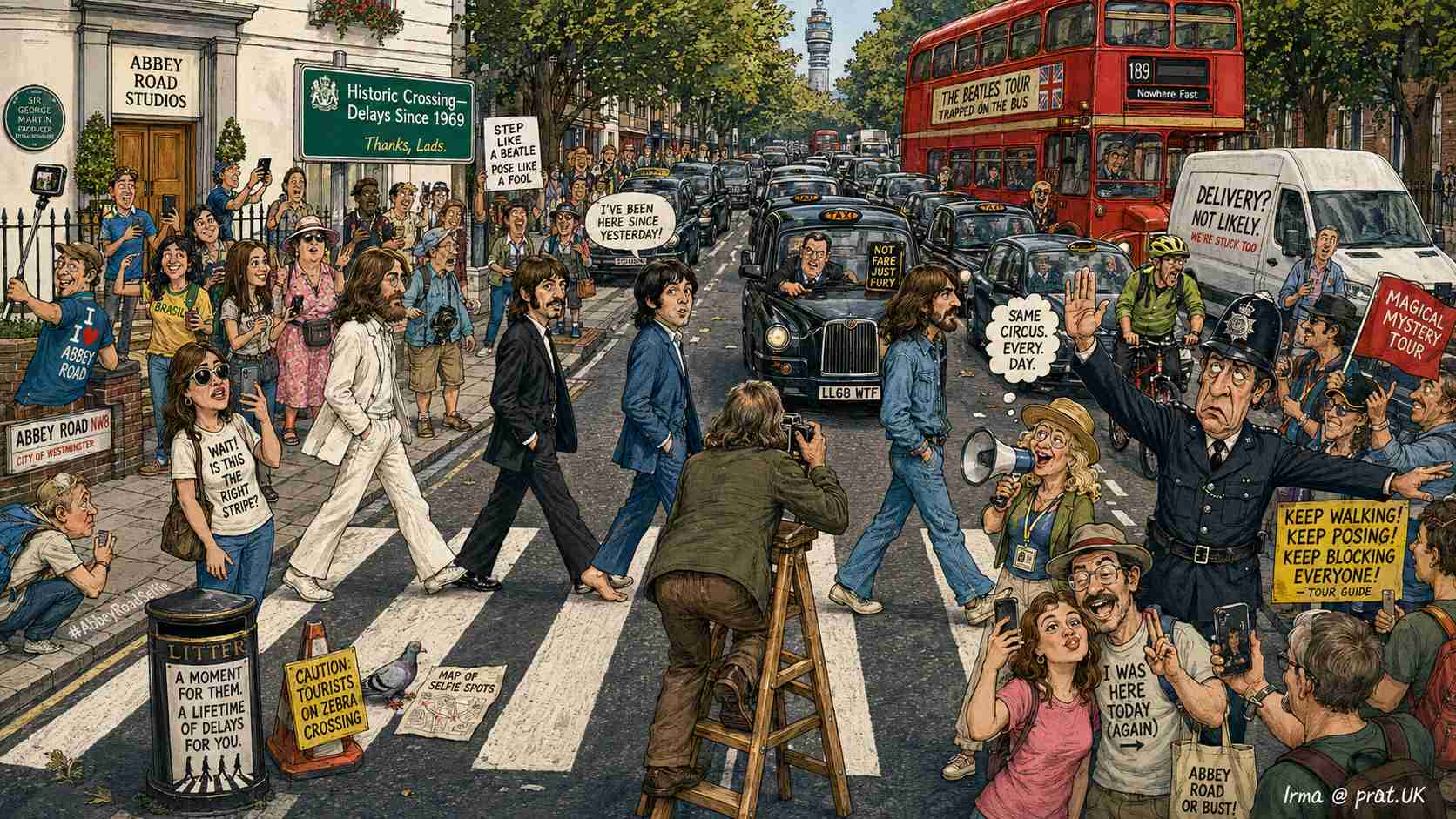
LONDON, August 8, 2026 — On this day 57 years ago, John Lennon, Paul McCartney, George Harrison and Ringo Starr walked across Abbey Road while photographer Iain Macmillan stood on a stepladder and a policeman stopped traffic, thereby establishing the modern principle that anything becomes culturally important if enough British people inconvenience motorists around it.
The photograph was taken on the morning of August 8, 1969, outside what was then EMI Studios. Macmillan had roughly ten minutes and shot only six photographs. Paul McCartney later selected the image in which all four Beatles happened to be walking in step.
This remains astonishing because modern musicians can take 4,700 photographs backstage at an awards show without producing one image anyone remembers by Wednesday. The Beatles required six.
Researchers at the London Institute for Excessive Cultural Interpretation estimate this means every Abbey Road exposure contained roughly 16.67 percent historical significance, an efficiency rate no British institution has achieved since.
“Today we’d require planning permission, diversity consultants, twelve production assistants and somebody whose entire job was keeping Ringo hydrated,” said cultural historian Dr. Penelope Brisket. “In 1969 they found four Beatles and told them to cross the bloody road.”
The Most Successful Cheap Album Cover in History
The original working title for the album was Everest, reportedly inspired by the brand of cigarettes smoked by recording engineer Geoff Emerick. A photograph involving the mountain was considered before the considerably cheaper solution of stepping outside the studio emerged.
Music economists now regard this as one of history’s great acts of fiscal restraint. The Beatles could have flown to Nepal. Instead, somebody looked through the window and said, essentially, “We’ve got pavement.” That philosophy subsequently disappeared from the entertainment industry.
A modern Abbey Road shoot would involve helicopters circling Mount Everest while Paul McCartney emerges from an environmentally sustainable ice sculpture accompanied by 400 dancers representing the emotional stages of vinyl. In 1969, the production meeting apparently ended when somebody located a stepladder.
London philosopher Nigel Weatherby argues that this explains the photograph’s enduring power. “Western civilisation spends enormous sums trying to manufacture authenticity,” Weatherby said. “Abbey Road suggests authenticity may simply be what happens when the budget committee says absolutely not.”
One Policeman Briefly Controlled Beatlemania
Abbey Road Studios records that one policeman held up traffic while Macmillan photographed the band crossing the zebra stripes. Not forty-seven Metropolitan Police units. No barricades. No exclusion zone. No helicopter. No emergency meeting of Westminster Council’s Subcommittee for Celebrity Pedestrian Movement.
One copper apparently stood there with the confidence of a man who knew British motorists in 1969 still recognised authority.
Eyewitness descendant Arthur Wilkins says his grandfather frequently discussed the incident. “He said traffic stopped because a policeman told it to,” Wilkins recalled. “We’ve checked the historical records and apparently motorists used to do that.”
Government transportation officials refused to confirm whether the technique could still work. “We would first require a consultation,” said one official. “Possibly an inquiry into the consultation.”
Paul McCartney Creates 56 Years of Barefoot Conspiracy Theory
Then there are Paul’s feet. McCartney crossed Abbey Road barefoot, launching one of rock history’s most enduring exercises in people refusing to believe a famous man might simply take his shoes off.
The resulting theories became part of the broader “Paul is dead” mythology, demonstrating humanity’s ancient intellectual principle that whenever a simple explanation is available, somebody on the internet will eventually discover Freemasonry.
Professor Alan Nafzger, reached while wearing two shoes and therefore considered alive under prevailing Beatles scholarship, said the fascination reveals something important. “If Paul had worn sandals, we’d have spent fifty years debating the sandals,” Nafzger said. “People don’t want reality. Reality rarely includes enough clues.”
John wears white. Ringo wears black. George wears denim. Paul wears a suit without shoes. Normal explanation: four musicians dressed differently. Rock-fan explanation: an elaborate symbolic funeral procession encoded by four men who couldn’t agree on a manager.
Britain Accidentally Creates Tourism Using Road Paint
The lasting achievement may belong not to the Beatles but to the crossing itself. Most tourist attractions require architecture. The Eiffel Tower required thousands of tons of iron. The pyramids required decades of labour. The Great Wall of China required dynasties. Britain painted several white rectangles across a street. Done.
Every year visitors arrive determined to recreate four musicians walking normally. The ritual requires participants to enter the crossing, line up incorrectly, take fourteen attempts, discover somebody blinked, reverse direction, return for another photograph and remain completely astonished that London contains automobiles.
Taxi driver Colin Mercer described the scene as “the only place in Britain where pedestrians see an approaching vehicle and become more determined to remain in the road.”
American tourist Debbie Kowalski said recreating Abbey Road had been on her bucket list for decades. “We practised the walk at the hotel,” she said. “My husband played Ringo.” Asked what playing Ringo involved, Kowalski replied, “Mostly keeping up.”
French tourist Étienne Marchand attempted the crossing three times before declaring the experience authentically British. “It is raining, there is traffic, everyone is annoyed and nobody admits they are annoyed,” Marchand said. “Magnifique.”
The Sixth Photograph Defeats 7,000 Modern Photographs
Macmillan took six exposures during the brief session, and the chosen image was the one where the Beatles’ strides aligned. This was photography before photographers could immediately examine a screen and say, “Let’s do 900 more.”
Today’s smartphone has effectively abolished the possibility of stopping. Nobody takes a photograph anymore. People initiate photographic military campaigns. Birthday cake? Forty-seven pictures. Dog wearing sunglasses? Three hundred. Lunch? Entire intelligence archive.
The Beatles produced one of the world’s most recognisable album covers before anyone had time to ask whether John wanted another one with a little more energy. A survey conducted by the Institute for Unnecessary Retakes found that 82 percent of modern adults believe six photographs are insufficient to document “a decent sandwich.”
The Beatles Walk Away, Historians Immediately Detect Symbolism
Abbey Road Studios notes that the selected photograph also fitted the Beatles’ desire to show themselves walking away from the studio where they had spent much of the previous seven years.
Naturally, this creates irresistible symbolism. They are walking away. The band is nearing its end. An era is closing. Four artists are departing the place where they transformed popular music. Or lunch was that direction. Both remain possible.
This is the trouble with cultural history. The minute somebody becomes legendary, even crossing the road starts getting footnotes. Had Lennon stopped to tie his shoe, universities would now offer seminars titled “The Interrupted Journey: Laces, Late Capitalism and Lennon.” Had Harrison forgotten something inside the studio, doctoral candidates would argue his turning around represented Britain’s unresolved relationship with empire. Had Ringo been hit by a bicycle, someone would call it performance art.
Britain Asked to Leave Crossing Exactly As It Is
Officials marking today’s anniversary have reportedly been advised against improving anything. Suggestions for an Abbey Road visitor centre, interactive multimedia experience, Beatles pedestrian app, holographic crossing assistant and £41 million interpretive pavilion were rejected after residents pointed out that the attraction is already functioning perfectly well as a road.
This may be the photograph’s greatest lesson. Four musicians. One photographer. One stepladder. One policeman. Six pictures. Ten minutes. No title printed on the cover. No band name required. And 57 years later, humanity is still talking about it.
Which raises an uncomfortable question for every marketing department on Earth: what if the secret to becoming unforgettable is doing less? Fortunately, nobody in marketing is prepared to risk it.
15 Humorous Observations From the Abbey Road Crossing
- The Beatles Needed Ten Minutes to Create a Cultural Monument. Modern musicians need six months, twelve stylists, three drone operators and a behind-the-scenes documentary. The Beatles required a zebra crossing and a policeman who probably wanted lunch.
- Six Photographs Were Enough. Photographer Iain Macmillan took only six shots. Today six photographs are what somebody takes accidentally while trying to unlock an iPhone.
- Britain Accidentally Invented the World’s Most Famous Traffic Obstruction. Four men crossed a road once in 1969. Fifty-seven years later, motorists are still paying for it.
- The Policeman May Have Been the Most Important Uncredited Beatle. One officer stopped traffic while Macmillan photographed the band. Without him the album might have been called Abbey Road Accident Report.
- Paul Was Barefoot. Millions decided this was symbolism. Perhaps Paul simply hated shoes. Humanity refuses to accept that famous people occasionally have feet.
- The Original Album Idea Was Everest. The working title was inspired by engineer Geoff Emerick’s cigarettes. Then somebody apparently calculated the airfare and discovered there was a road outside.
- Greatest Cost-Cutting Decision in Rock History. “Should we photograph the Beatles in Nepal?” “No.” “Outside?” “Brilliant.”
- The Best Photograph Was the One Where Everybody Walked Properly. McCartney selected the frame where all four were walking in step — surviving the same test as a kindergarten field trip: nobody wandered off.
- The Beatles Were Walking Away From Their Studio. Naturally, people interpret this as profound symbolism. Britain interprets walking away from work as either artistic symbolism or Friday afternoon.
- John Wore White, Ringo Black, George Denim and Paul a Suit. Four different wardrobes somehow became iconic. Try that at a wedding and somebody’s aunt starts a family feud.
- Nobody Put the Band’s Name on the Front. Apparently when you’re the Beatles, branding consists of assuming everybody knows who you are. Coca-Cola executives still wake screaming at the thought.
- The Zebra Crossing Became More Famous Than Many Bands. Imagine spending twenty years learning guitar only to discover your biggest rival is municipal road paint.
- Tourists Have Been Recreating It Ever Since. Few other artworks encourage admirers to stand directly in traffic.
- The Volkswagen Beetle in the Background Got Accidental Immortality. Somewhere a car appeared on an album cover without an agent, publicist or sponsored-content agreement.
- Britain Created a Global Attraction Without Building Anything. Four pedestrians, white stripes, existing pavement. Heritage achieved for approximately the price of stopping traffic.
Disclaimer: This story is satire inspired by the historic Abbey Road photo session of August 8, 1969. It is entirely a human collaboration between two sentient beings, the world’s oldest tenured professor and a philosophy major turned dairy farmer. Any resemblance between British traffic management and organised government activity should not be interpreted prematurely.
Further reading: Abbey Road Studios — The Crossing | The British Museum | BBC Culture

Carys Evans is a prolific satirical journalist and comedy writer with a strong track record of published work. Her humour is analytical, socially aware, and shaped by both academic insight and London’s vibrant creative networks. Carys often tackles media narratives, cultural trends, and institutional quirks with sharp wit and structured argument.
Her authority is reinforced through volume, consistency, and reader engagement, while her expertise lies in combining research with accessible humour. Trustworthiness is demonstrated by clear labelling of satire and an ethical approach that values accuracy and context.
Carys’s work supports EEAT compliance by offering informed satire that entertains while respecting readers’ trust.