
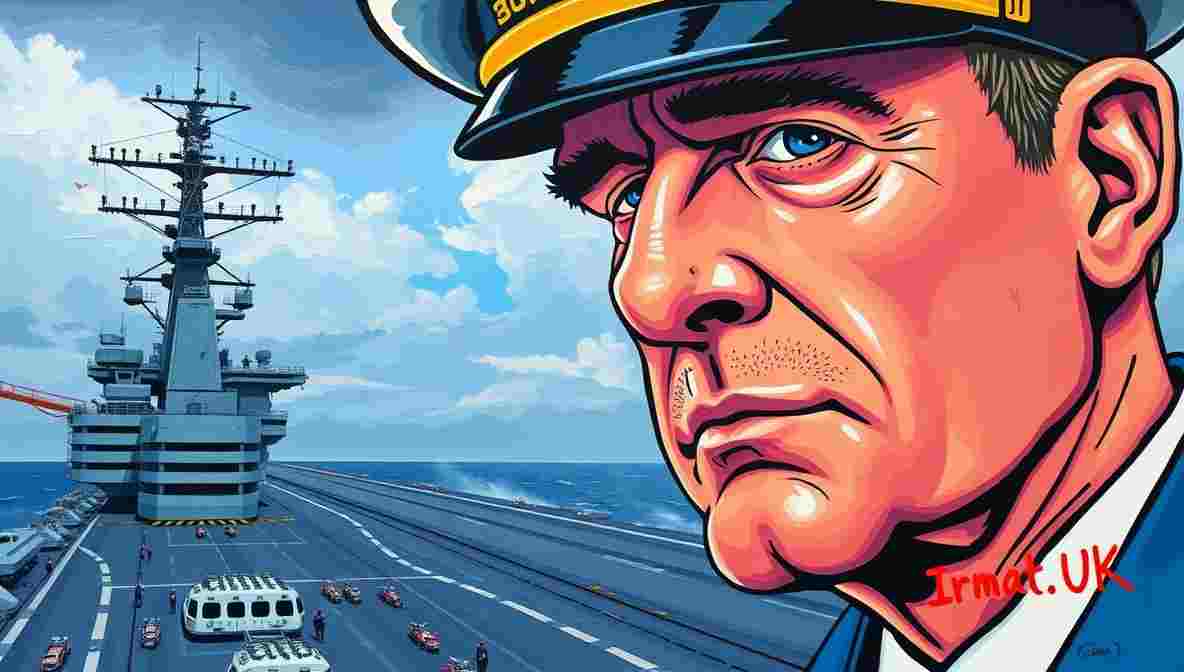
Trump Rejects UK Aircraft Carriers, Politely Suggests Britain Return to Its Original Role of Writing Strongly Worded Letters
The centuries-old “special relationship” between the United States and Britain took a brief coffee break this week after President Donald Trump announced that America does not need the United Kingdom’s aircraft carriers in the current Middle East conflict, explaining that the war was already “basically won.”
The announcement came shortly after British officials revealed they were preparing the aircraft carrier HMS Prince of Wales for potential deployment to the region. Trump responded with the geopolitical equivalent of “thanks, but we already ate,” writing that the U.S. did not need help from countries that “join wars after we’ve already won.”
Diplomats described the exchange as “awkward,” while historians described it as “the most British-American conversation since 1776.”
The Royal Navy’s Generous Offer: Britain’s Floating Airports Nobody Asked For
According to British defense officials, the United Kingdom had been considering sending one or possibly two aircraft carriers to support U.S. operations against Iran.
These carriers, enormous floating airports that cost nearly $10 billion each, can launch fighter jets, helicopters, and the occasional tea kettle when the crew needs morale.
But Trump’s response effectively translated to:
“Lovely ships. Beautiful ships. Tremendous ships. Please park them somewhere else.”
A Royal Navy officer, speaking anonymously because he had just finished polishing the deck, said the rejection was disappointing.
“We spent three days rehearsing the entrance,” he explained. “The band was ready. The jets were going to fly overhead spelling ‘SPECIAL RELATIONSHIP.’ Now we’re just circling Portsmouth looking awkward.”
Britain Arrives at the Party Just After the Cake Is Gone
The dispute stems from Britain’s cautious approach to the conflict.
Prime Minister Keir Starmer initially refused to allow U.S. forces to use British bases for strikes on Iran, insisting on legal and strategic clarity before getting involved.
Later, the UK allowed American aircraft to operate from RAF bases for defensive missions after Iranian drone attacks in the region. Deputy Prime Minister David Lammy stated there was a “legal basis” for RAF participation in strikes on Iranian missile sites — a clarification that arrived approximately three news cycles after everyone had already moved on.
In Trump’s view, however, this meant Britain showed up to the fight just in time to help clean up the folding chairs.
Military analysts describe this phenomenon as “the diplomatic version of arriving with a casserole after everyone has already eaten.”
America Explains the War Is Already Won
Trump’s social-media declaration that the war was essentially finished caught many analysts by surprise, particularly those who believed wars usually involve multiple stages, complicated negotiations, and occasionally maps.
But Trump clarified the situation in simple terms:
“We’ve already won,” he said, implying that the remaining explosions were merely decorative.
One anonymous Pentagon staffer reportedly summarized the strategy this way:
“The President’s approach to war is similar to his approach to golf. If you declare victory loudly enough, eventually people stop checking the scorecard.”
Britain’s Strategic Weapon: Mild Disappointment and International Law

British officials responded to Trump’s comments with the traditional tools of British diplomacy: calm language, polite phrasing, and a tone suggesting someone has put milk in the tea before asking.
Translation: “Perhaps let’s not invade everything immediately.”
British voters appear to agree. One recent poll reportedly found that only about 8 percent of Britons support direct involvement in the conflict.
The other 92 percent reportedly prefer Britain’s traditional wartime strategy: watching from a safe distance while commenting on American television coverage.
The Aircraft Carrier That Nobody Asked For: A £6.2 Billion Awkward Moment
For the Royal Navy, the situation is especially awkward.
The Queen Elizabeth-class carriers, including HMS Prince of Wales, are among Britain’s largest and most expensive military projects — originally budgeted at £2 billion and ultimately costing over three times that — and designed to project global power.
Unfortunately, projecting global power becomes difficult when the global power you’re trying to help says:
“Appreciate it, but we’re good.”
A retired admiral described the feeling succinctly.
“It’s like bringing a very large casserole to a potluck and discovering the host ordered pizza.”
The Carrier That Can’t Quite Get Out of Port
Making matters more festive, HMS Prince of Wales has a distinguished history of breaking down at inconvenient moments — including a propeller shaft failure off the Isle of Wight that required the ship to be towed back to Portsmouth. The Royal Navy did not specify whether the tow truck arrived on time.
NATO Group Chat Turns Slightly Passive-Aggressive
Inside NATO circles, diplomats say the exchange reflects a growing tension in the alliance.
The United States tends to move quickly and loudly, like a bulldozer powered by cable news.
Britain prefers careful deliberation, legal review, and at least two parliamentary debates about whether the bulldozer has proper insurance.
The result is the geopolitical equivalent of a group chat where one friend sends 47 messages in all caps while another responds with: “Perhaps let’s take a moment.”
Trump has also previously criticized Britain’s deal to return the Chagos Islands — home of the joint US-UK military base at Diego Garcia — to Mauritius, and noted that Starmer “is not Winston Churchill.” Starmer’s office has not yet responded with a list of things Trump is not.
The Special Relationship, Now With Extra Sarcasm
Despite the public disagreement, officials from both countries insist the “special relationship” remains strong.
Indeed, the relationship has survived many disagreements over the years: Suez, Vietnam, Iraq, and who invented the sandwich.
Experts say it will probably survive this one as well.
After all, the U.S. and Britain still share many things: intelligence, military cooperation, and a deep mutual love of correcting each other’s spelling.
The Royal Navy’s New Mission: Floating Tea Festivals and Mobile Pubs

For now, Britain’s aircraft carriers remain on standby, ready to deploy should the United States suddenly remember that extra aircraft carriers are occasionally useful during wars. HMS Dragon, at least, is already en route to the Mediterranean to defend British interests — so Britain can confirm at least one ship left the harbour.
Until then, the Royal Navy has reportedly begun exploring alternative missions for the ships.
Possible assignments include:
- Floating tea festivals
- Emergency fish-and-chips distribution centres
- Touring the Atlantic as the world’s most expensive sightseeing cruise
One sailor reportedly suggested turning the carrier into a mobile pub.
“Frankly,” he said, “that would probably improve NATO morale.”
The Final Lesson of the Carrier Rejection
The episode reveals a timeless truth about international alliances:
Everyone wants help. Just not after they’ve already announced victory.
In the meantime, the HMS Prince of Wales remains quietly floating in British waters, engines humming, pilots ready, sailors standing by.
Waiting patiently.
Like the world’s largest Uber driver watching the app…
…while the customer insists they’ve already arrived.
President Donald Trump posted on Truth Social on March 7, 2026, publicly rejecting a reported British offer to deploy one or two Royal Navy aircraft carriers — including the HMS Prince of Wales — to the Middle East amid the ongoing US-Israel conflict with Iran. Trump declared the war “already won” and warned that the US “will remember” Britain’s hesitancy to get involved earlier. The dispute followed Prime Minister Keir Starmer’s initial refusal to allow American forces to use UK bases for offensive strikes, a decision made over concerns about international law. Britain later permitted defensive operations from RAF bases and has been flying Typhoon and F-35 jets over Jordan, Qatar, and Cyprus. The Queen Elizabeth-class carriers, which together cost over £6.2 billion to build, have also attracted criticism for recurring mechanical failures, including propeller shaft breakdowns that have sidelined both ships during previous NATO exercises.
Auf Wiedersehen, amigo!


Alan Nafzger was born in Lubbock, Texas, the son Swiss immigrants. He grew up on a dairy in Windthorst, north central Texas. He earned degrees from Midwestern State University (B.A. 1985) and Texas State University (M.A. 1987). University College Dublin (Ph.D. 1991). Dr. Nafzger has entertained and educated young people in Texas colleges for 37 years. Nafzger is best known for his dark novels and experimental screenwriting. His best know scripts to date are Lenin’s Body, produced in Russia by A-Media and Sea and Sky produced in The Philippines in the Tagalog language. In 1986, Nafzger wrote the iconic feminist western novel, Gina of Quitaque. He currently lives in Holloway, North London. Contact: [email protected]



Somewhere someone’s sending this to their director asking “is this how we sound?” knowing full well the answer is completely yes.
Written despair. Version.