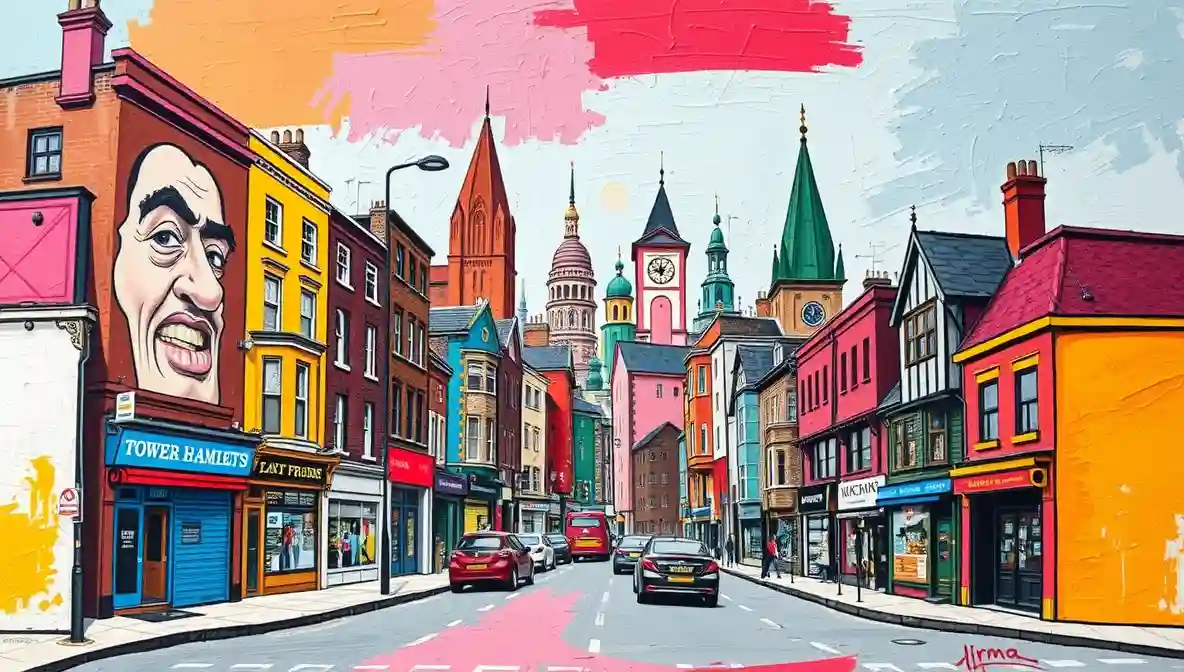
Named after a local road honouring the poet Walter Savage Landor, this pub is also home to a celebrated fringe theatre
The Landor in Clapham holds eight hundred and fifty-one reviews and a 4.2 – a large, fair sample – and it carries a literary name, honouring (through its road) the poet Walter Savage Landor, and it is also home to a celebrated fringe theatre, continuing the great London tradition of the pub-with-a-stage.
The poet in the name
The Landor takes its name from Landor Road, the Clapham street on which it sits – which is itself named after Walter Savage Landor, an English writer and poet of the late eighteenth and nineteenth centuries. Landor was a significant literary figure of his age – a poet, and above all a master of the “imaginary conversation,” a literary form in which he composed elegant, learned dialogues between historical and mythological figures. His “Imaginary Conversations” were much admired, and he was respected by his great contemporaries as a writer of exceptional style and classical polish.
Landor was also famous for his fiery, quarrelsome, passionate temperament – a man of strong opinions, violent enthusiasms, and frequent disputes, whose turbulent life and hot temper were as notable as his cool, classical prose. He lived long, wrote much, and quarrelled magnificently, a genuine character of the literary world. That a Clapham road, and now a pub, should carry his name keeps the memory of this once-celebrated writer alive, long after his works have faded from popular reading.
The theatre above
The Landor’s living distinction is its theatre. Like the Curtains Up in the Kensington survey, the Landor is a pub with a genuine, celebrated fringe theatre – the Landor Theatre, a small but highly-regarded venue that has staged a great deal of acclaimed work, particularly musicals, in its intimate space above the pub. It has been one of the notable fringe theatres of south London, a place where ambitious small-scale productions – especially musical theatre – have been staged to real acclaim.
This continues the great London tradition we have celebrated throughout this survey: the pub theatre, the intimate performance space attached to a drinking house, where new and ambitious work is staged, careers are launched, and the theatre renews itself away from the expensive West End. The Landor is a distinguished example, and there is a lovely aptness in a pub named for a poet also being a home for live theatre – the literary name and the living stage belonging naturally together.
The literary pub
There is a fine tradition of literary connections in London’s pubs, and the Landor belongs to it – a pub named, through its street, for a poet, and devoted, through its theatre, to the dramatic arts. It is the kind of cultural, literary, theatrical pub that London does so well, where a pint and a play go together, and where the name over the door honours a writer. The combination of the poet’s name and the working theatre makes the Landor a genuinely cultural institution, as well as a good local.
Walter Savage Landor himself, master of the imaginary conversation between great figures of the past, might have appreciated the irony of his name now presiding over a theatre where imaginary conversations of another kind – the dialogues of the stage – are performed nightly above a Clapham pub.
The pub
A large, well-established pub doing a fair 4.2 across a large and real sample, named through its road for the poet Walter Savage Landor, and home to a celebrated fringe theatre in the great London pub-theatre tradition.
Verdict
Large, cultural, and fittingly named – the Landor, honouring a poet and housing a theatre, where the literary name and the living stage belong together.
Have a pint at the Landor, then go up for the play – and raise a glass to Walter Savage Landor, the fiery poet of imaginary conversations, whose name now presides over a stage of real ones.

Alan Nafzger was born in Lubbock, Texas, the son Swiss immigrants. He grew up on a dairy in Windthorst, north central Texas. He earned degrees from Midwestern State University (B.A. 1985) and Texas State University (M.A. 1987). University College Dublin (Ph.D. 1991). Dr. Nafzger has entertained and educated young people in Texas colleges for 37 years. Nafzger is best known for his dark novels and experimental screenwriting. His best know scripts to date are Lenin’s Body, produced in Russia by A-Media and Sea and Sky produced in The Philippines in the Tagalog language. In 1986, Nafzger wrote the iconic feminist western novel, Gina of Quitaque. He currently lives in Holloway, North London. Contact: [email protected]