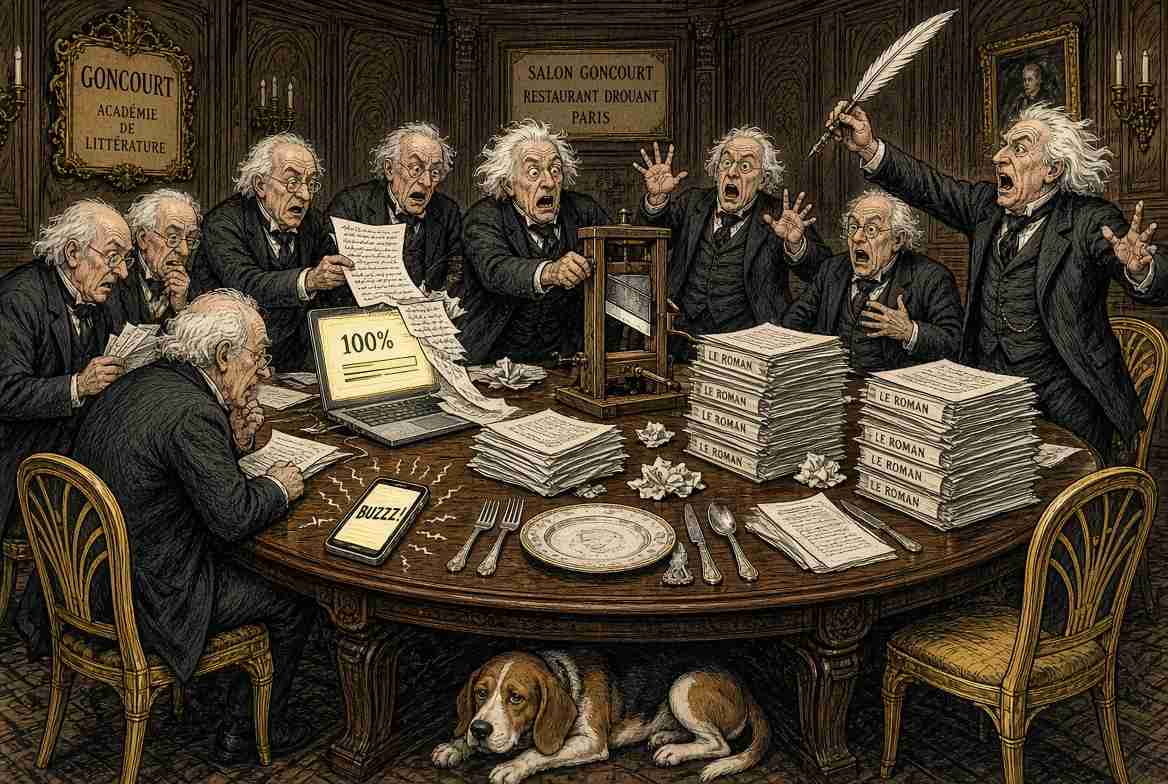
France’s Top Book Prize Drops a Novel Because One Robot Snitched on Another Robot, and Seven More Robots Can’t Get Their Stories Straight
Software says software probably wrote a bestseller, the Académie Goncourt blinks, and the only thing anyone has proven is that nobody agrees on anything
PARIS — Somewhere in this city, a literary establishment that once fought duels over semicolons has outsourced its judgment to a website with a percentage sign. Welcome to the strangest book scandal of the year, where the evidence is a number, the number changes depending on which number-machine you ask, and a man’s career hangs on the mood swings of a spellchecker’s cousin.
The Facts Behind the AI-Novel Scandal Rocking French Literature
The controversy centers on Thélyson Orélien, a 38-year-old Haitian-Canadian writer, and his debut novel C’était ça ou mourir (“It Was Either That or Die”). The book follows a Haitian teacher fleeing violence in Port-au-Prince and traveling through the Americas toward Canada. The French edition runs 272 pages, and translation rights have reportedly been sold in roughly 20 countries. That is a lot of countries to be embarrassed in at once.
- The Académie Goncourt has survived two world wars, and it has now been rattled by a website that answers “human or robot?” with the confidence of a fortune cookie.
- Seven detectors, seven verdicts. This is not forensic science; it’s a jury of seven people who each watched a different movie.
- If a detector changes its mind depending on the paragraph, it isn’t detecting AI. It’s detecting vibes and billing you for it.
- An X account with a tiny following just did what entire critical establishments haven’t managed in years: got France to talk about a book for a week.
- “I started writing it in 2017” is the most French possible way of saying “the robots weren’t invented yet, mon ami.”
What Happened: A Big Prize, a Tiny X Account, and a Very Bad Day
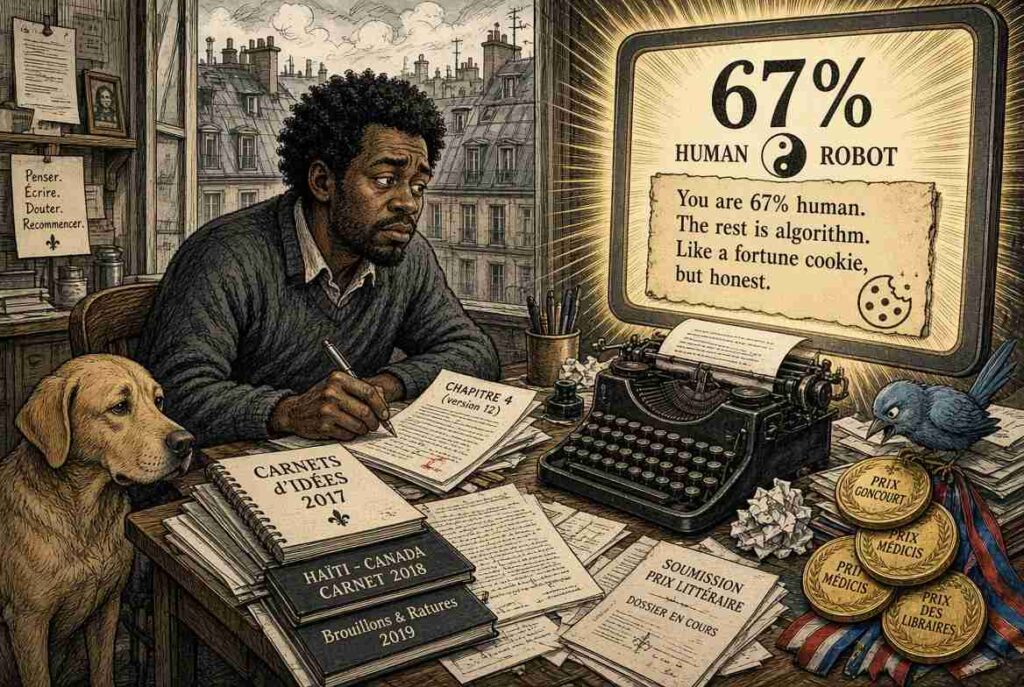
On September 21, 2026, Orélien won the Prix du Roman Fnac, a significant French literary award, and Fnac itself still identifies the novel as its 2026 winner. That same day, a small X account called Balance ton Claude claimed it had fed passages from the novel to the AI-detection service Pangram and repeatedly received verdicts of 100% AI-generated. The accusation spread faster than a rumor at a Paris dinner party, which is saying something, because Paris dinner parties are basically rumor-delivery infrastructure.
The novel had also been longlisted for the Prix Goncourt, generally regarded as France’s most prestigious literary prize. On September 25, the Académie Goncourt removed it from consideration, saying it wanted to protect the integrity of the prize and promote literature written by human authors. Translation: the jury saw a percentage, panicked, and reached for the eject button.
Has Anyone Proved AI Wrote the Novel? No, and That Is the Crucial Point
Orélien categorically denies using AI to write the book. He says he began writing it in 2017 and finished a first draft in 2019, before ChatGPT-style generative AI became widely available. That is a timeline that predates the chatbot boom, which, if you’re an AI, is the equivalent of “I was at my mother’s house.” He says he is assembling drafts and documentation to demonstrate his authorship.
His French publisher Grasset publicly expressed confidence in him. His Canadian publisher, Éditions du Boréal, said the AI allegations could not presently be confirmed or disproved, which is the most honest sentence anyone in this saga has produced.
AI Detectors Disagree: Pangram, AFP, and Seven Machines With Seven Opinions
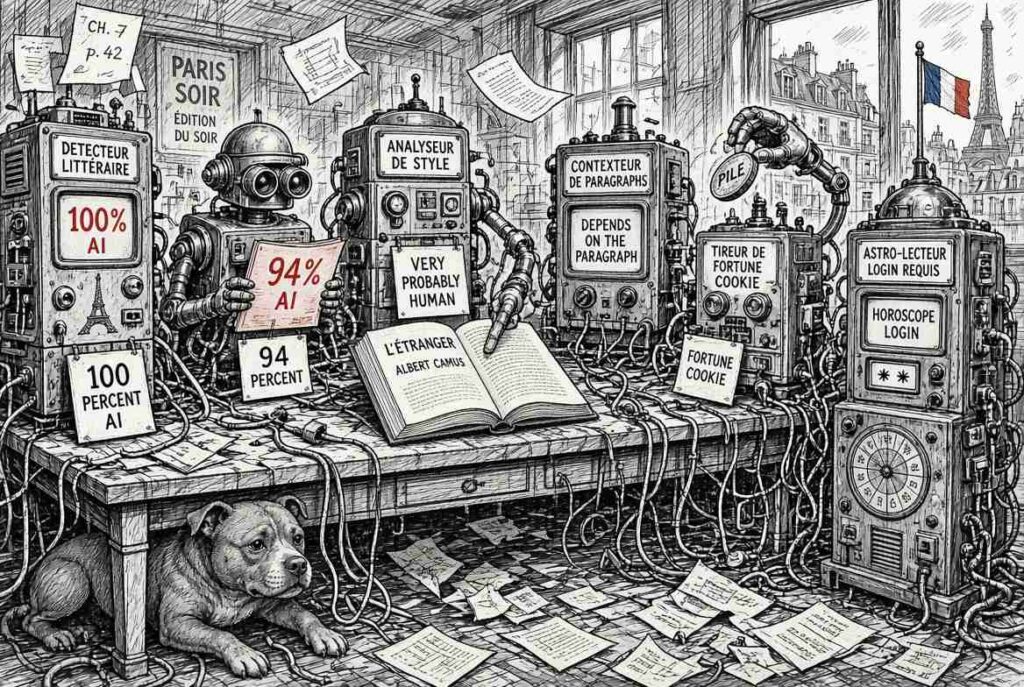
Here is where the story stops being a scandal and starts being a sitcom. Tests run by different journalists and detection programs produced contradictory answers:
- Pangram reportedly rated substantial portions of the book as AI-generated, including a 94% AI score when La Presse tested the entire novel.
- CBC reportedly obtained 100% AI results on excerpts.
- Franceinfo also produced high AI scores.
- AFP tested excerpts with another verification system that judged them very probably human-written.
- AFP then tried seven additional detectors: some said AI, some said human, and others changed their verdict depending on which passage they were fed.
Read that last bullet again. Detectors that flip their verdict based on the paragraph are not forensic instruments. They are horoscopes with a login page.
This is not a new problem. OpenAI launched its own AI-text classifier and later quietly retired it over low accuracy, and researchers at Stanford found that GPT detectors misclassified writing by non-native English speakers as machine-made. The industry’s own inventors could not make the thing work, yet a literary academy founded in 1900 is prepared to treat it like a DNA test.
So there is no universally accepted forensic result showing the novel was generated by AI. Removal from a prize list is not scientific proof. It is a press release with a guillotine.
The Separate Plagiarism Problem in Orélien’s Older Journalism
Orélien has a second and potentially more concrete problem, and this one does not require a robot to rat anyone out. The Montreal newspaper La Presse examined a column he published in 2013 and reported that almost the entire piece was a lightly altered translation of an article published days earlier by the Philippine Star. Franceinfo subsequently identified another older piece containing material reportedly copied from a 2014 essay by Colombian politician Rodrigo Botero Montoya.
Those allegations concern older journalism, not the novel itself. Boréal subsequently suspended promotional activity for the novel while saying plagiarism is unacceptable. Note the difference: for plagiarism, you can put two texts side by side like a grown-up. For the AI claim, you consult a slot machine.
How Successful Was the Book Before the Scandal? Enormously.
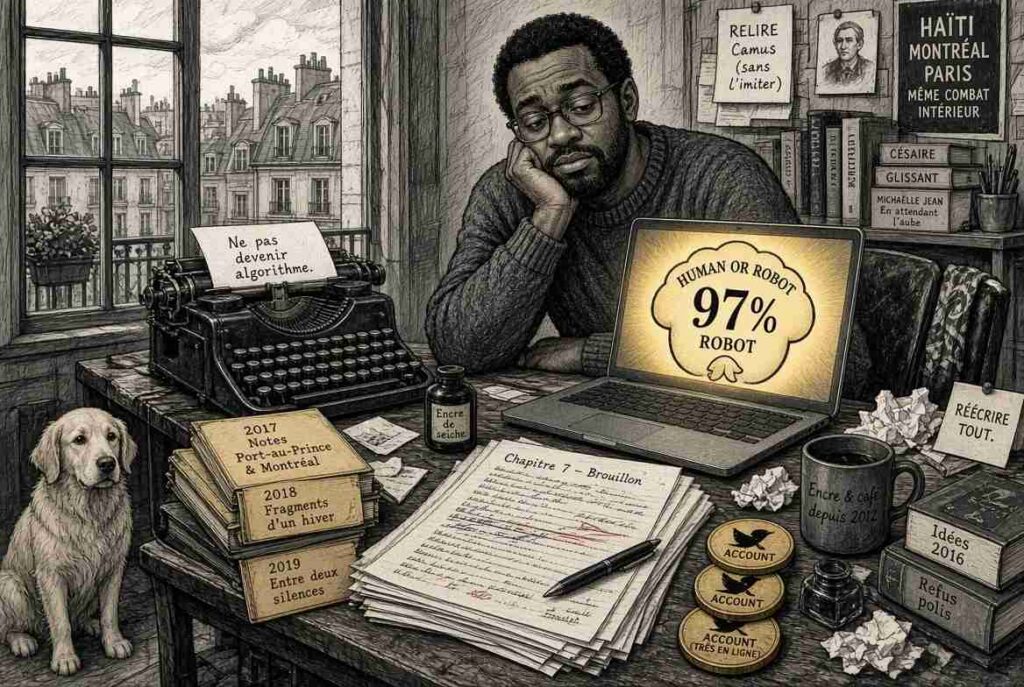
By mid-September it reportedly had sold roughly 32,000 copies in France, with later reports putting sales around 35,000 to 40,000. It became Boréal’s biggest-selling book since the Canadian publisher was founded in 1963 and had already won several French literary prizes, including the Fnac. For a literary debut, that is Beatles-at-Shea-Stadium territory. For a literary debut in France, it is also the exact moment everyone starts sharpening knives.
The Cleanest Factual Summary of the Orélien Novel Controversy
Established: Orélien wrote and published a bestselling, prize-winning novel; AI detectors subsequently flagged portions of it; the Académie Goncourt removed the book from its longlist; and credible plagiarism allegations have emerged concerning some of his much older journalism.
Not established: There is currently no conclusive proof that AI wrote the novel. Different AI-detection systems have produced substantially conflicting results, and Orélien denies the allegation.
Can Software Destroy a Literary Career by Guessing What Other Software Wrote?
That detector disagreement is probably the most important part of this story. It turns what initially sounds like “author caught using AI” into a considerably stranger question: can a literary career legitimately be destroyed because software says other software probably wrote something? For deeper reading on the wider argument, Le Grand Continent has published an essay on the algorithmically accelerated era of suspicion this case has opened.
Because if a percentage is enough, the rest of us should start nervously pasting our grocery lists into a detector. If “buy eggs, call mom” comes back 61% robot, we may need to speak to a lawyer, or at least a very confident human.
17 Humorous Observations About the Great French AI-Detector Meltdown
- Somewhere, a publicist is realizing that “the most controversial debut of the year” is a fantastic tagline and a terrible week.
- The plagiarism allegations are at least testable with two pieces of paper and a highlighter, a technology France has trusted since Gutenberg.
- Boréal’s best-selling title since 1963 now comes with an asterisk the size of the Louvre.
- Removing a book “to promote literature written by human authors” is a nice sentiment, right up until you realize the proof is a chatbot’s cousin with an accuracy claim.
- Any novelist with a clean, tidy, consistent writing style should now be terrified, because apparently competence reads as machinery.
- In the future, authors will submit manuscripts alongside notarized drafts, three witnesses, and a video of themselves crying at a keyboard.
- The true winner of the Prix du Roman Fnac may be whoever sells the next AI detector, at a discount, to a very nervous literary establishment.

Alan Nafzger was born in Lubbock, Texas, the son Swiss immigrants. He grew up on a dairy in Windthorst, north central Texas. He earned degrees from Midwestern State University (B.A. 1985) and Texas State University (M.A. 1987). University College Dublin (Ph.D. 1991). Dr. Nafzger has entertained and educated young people in Texas colleges for 37 years. Nafzger is best known for his dark novels and experimental screenwriting. His best know scripts to date are Lenin’s Body, produced in Russia by A-Media and Sea and Sky produced in The Philippines in the Tagalog language. In 1986, Nafzger wrote the iconic feminist western novel, Gina of Quitaque. He currently lives in Holloway, North London. Contact: [email protected]