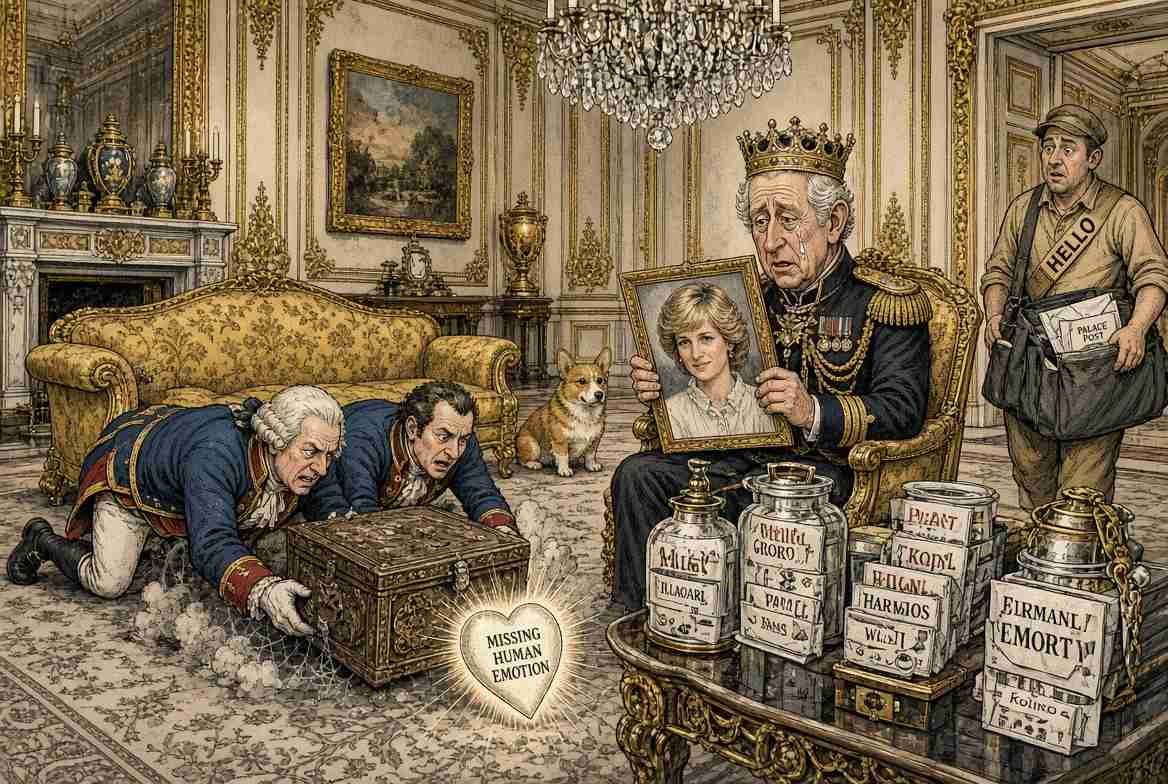
Buckingham Palace Discovers King Charles Loved Diana After All, Immediately Sends Evidence to HELLO!
Royal Communications Department Reportedly Finds Missing Human Emotion Behind Sofa
Buckingham Palace has apparently discovered the perfect witness for King Charles: Princess Diana, provided somebody else does the talking for her. — Alan Nafzger
LONDON — Britain received reassuring news this week that King Charles III did, apparently, love Princess Diana, ending a national uncertainty that has persisted for several decades, several hundred biographies, two divorces, countless documentaries and enough commemorative television to make Diana technically Britain’s longest-running series.
The revelation arrives through royal biographer Ingrid Seward, whose recollections were featured by HELLO! amid renewed controversy surrounding Charles Spencer’s memoir about his sister. Seward says Diana wanted William and Harry to understand that Charles had loved her and that their relationship was more complicated than the bleakest portrayals suggest.
This is excellent news for Charles.
Also extremely convenient news for Charles.
So convenient, in fact, that one half expects the original manuscript to smell faintly of Buckingham Palace stationery, Earl Grey and communications strategy.
But if Buckingham Palace had written it, what exactly would it have changed?
Perhaps a semicolon.
Buckingham Palace PR Staff are the MOST Creative
- Royal public relations has evolved from “never complain, never explain” to “never complain, but have a biographer explain everything over tea.”
- Nothing says passionate romance quite like needing a 2026 press campaign to establish that the groom probably liked the bride in 1981.
- The Palace cannot prove Charles was warm, but it can apparently produce enough royal experts to raise Britain’s average temperature by two degrees.
- Whenever an uncomfortable Diana story appears, another royal commentator emerges from a cupboard carrying a notebook marked “Actually, Charles Was Lovely.”
Charles Spencer’s Swan Song Memoir Lands at a Delicate Moment for the Monarchy
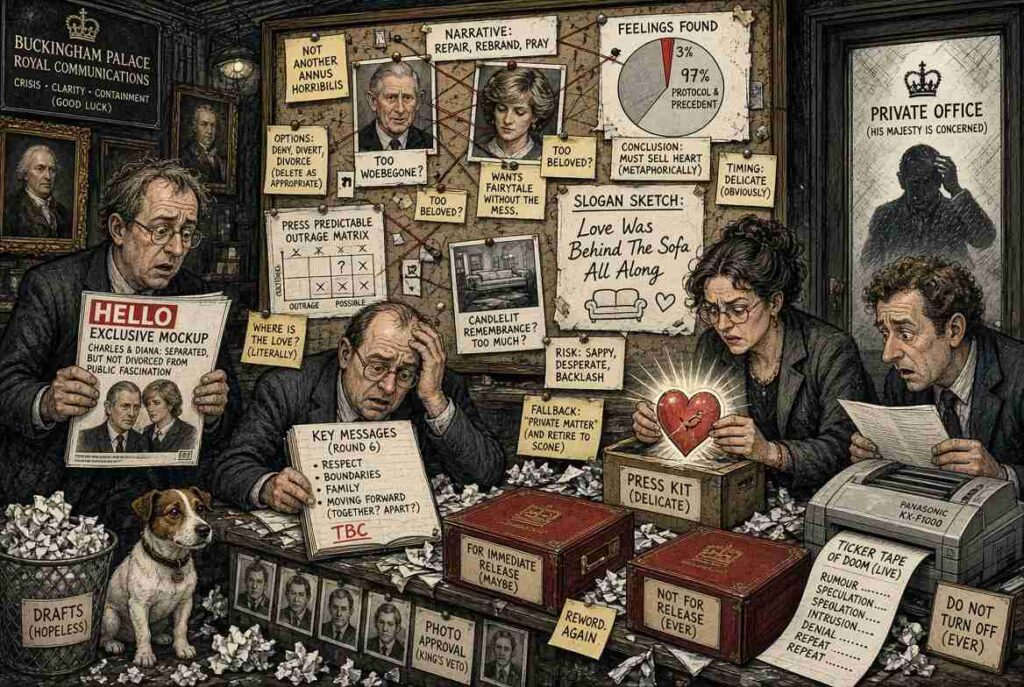
The article arrives at a delicate moment because Charles Spencer’s new memoir, Swan Song: Diana, My Sister, has revived harsh allegations about the King’s behaviour around Diana’s death, as reported by Arab News. Spencer has alleged that Charles sounded extraordinarily upbeat after receiving news of Diana’s death and later made a callous remark during an argument over funeral arrangements. Charles has denied those allegations through Buckingham Palace.
Buckingham Palace’s actual response was remarkable because the monarchy generally prefers controversy to be handled through that ancient Windsor communications technique known as pretending everybody else has died.
This time the Palace responded.
It suggested that profound grief could affect Spencer’s reason, judgment and memory, in a statement the Associated Press described as extremely strong by the measured standards of the royal household. Reuters noted that royal commentator Afua Hagan found the response strikingly “cold” and “aloof.”
Now that is branding consistency.
A man is accused of emotional coldness, and his communications department responds with a sentence that sounds like it was dictated by a mahogany wardrobe.
The Royal Memory Department: Why Spencer’s Diana Memories Are Unreliable but Seward’s Are Gospel
The fascinating thing about the dispute is that memory appears to operate differently depending on whom it assists.
Charles Spencer remembers something terrible?
Memory is unreliable.
Ingrid Seward remembers Diana saying Charles loved her?
Ladies and gentlemen, we have located the Zapruder film.
At Buckingham Palace, recollection seems to undergo a rigorous scientific process.
First, the memory is examined.
Second, experts determine whether it helps Charles.
If yes, it becomes valuable historical testimony.
If no, grief may have clouded the witness’s judgment.
This scientific method has reportedly been submitted to the Royal Society under the title Selective Remembrance in Large Ceremonial Buildings.
Professor Nigel Thistlebottom, chairman of the Institute for Monarchical Damage Control, explained the principle.
“When evidence hurts the King, it is anecdotal,” he said. “When evidence helps the King, it is oral history.”
That is scholarship.
Did King Charles Love Diana? Breaking: Husband May Have Loved Wife at Some Point
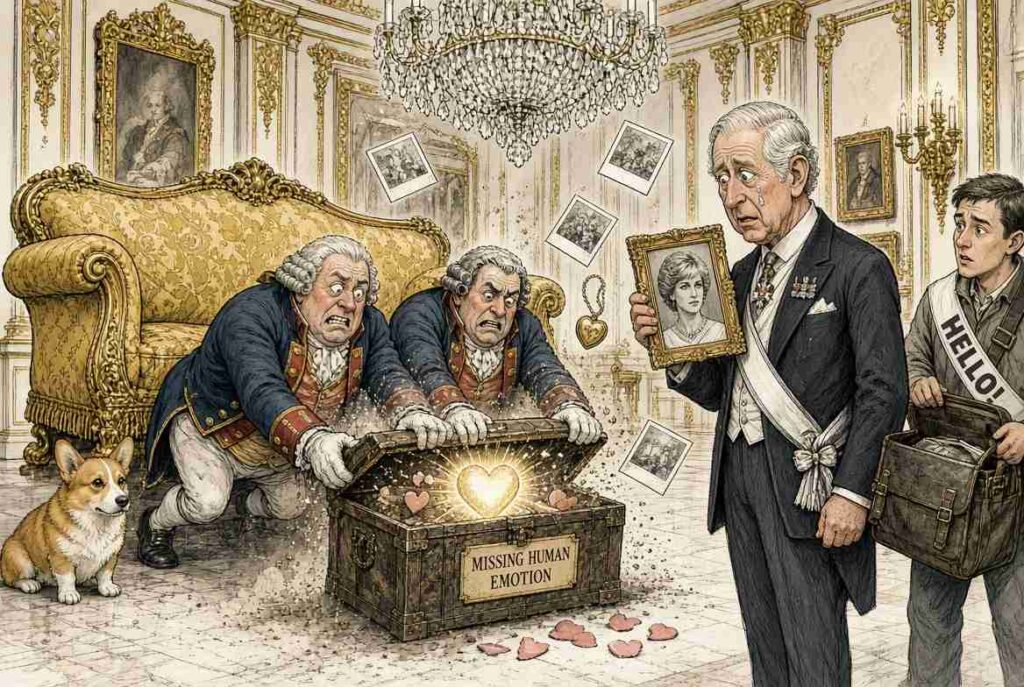
The royal defence is not even particularly ambitious.
Nobody is claiming Charles spent the 1980s standing beneath Diana’s window playing a lute.
The defence seems closer to:
At some stage, feelings occurred.
We have lowered the romantic bar so far it is now underneath Windsor Castle.
Imagine this standard applied to ordinary marriages.
Your wife asks, “Do you love me?”
You reply, “According to Ingrid Seward, there is compelling archival evidence that I experienced affection during portions of the relationship.”
Enjoy sleeping in the garage.
Apparently Charles loved Diana, perhaps not initially in precisely the way Diana wanted, perhaps not by the end, but somewhere in that emotional geological era there existed enough warmth for royal historians to drill down and discover deposits.
Britain has found North Sea Love.
Production estimates remain uncertain.
Operation Definitely Not Heartless: Buckingham Palace’s PR Strategy on Charles and Diana
The timing is magnificent.
Spencer’s book lands.
Ugly stories return.
Questions about Charles’s behaviour reappear.
Suddenly another account emerges explaining that Charles cared deeply.
One does not need conspiracy theories when public relations is already this funny.
This is the royal equivalent of your restaurant receiving complaints about food poisoning and immediately publishing an interview with a customer who says the breadsticks were excellent.
Buckingham Palace has spent decades trying to solve the Charles-Diana problem, which is difficult because Diana possesses an inconvenient communications advantage.
The public remembers her.
Reuters described Diana as a wound that has never entirely healed for the monarchy and noted that her brother’s book has reopened scrutiny of both the institution and Charles personally.
That means Charles is competing against a woman who has been dead since 1997 and continues winning column inches.
This must be maddening.
The King has palaces.
Diana has memory.
Turns out memory has lower maintenance costs.
The Royal Expert Industrial Complex: Britain’s Army of Royal Commentators
Britain now appears to have approximately seven royal experts for every working royal.
You cannot open a biscuit tin without finding someone who once discussed curtains with Princess Margaret.
Every royal crisis produces another witness.
“I knew Diana.”
“I knew Charles.”
“I once saw Camilla near Gloucestershire.”
“My aunt’s dental hygienist served Prince Philip a Scotch egg.”
Within 48 hours, that person is appearing beneath the television caption:
ROYAL INSIDER BREAKS SILENCE.
The country no longer has oral history.
It has competitive remembering.
HELLO!’s account rests on Seward’s recollections of conversations with Diana, including the argument that Diana cared about William and Harry understanding that their parents had genuinely loved one another. That is Seward’s account and deserves to be identified as such.
But the PR value is obvious.
The disputed story becomes:
Was Charles cruel?
Followed rapidly by:
Did you know Charles loved Diana?
That is not necessarily rebuttal.
That is conversational judo.
Diana Apparently Available for Comment: What Would Princess Diana Say in 2026?
The strangest genre in royal journalism is the sentence:
“Diana would have…”
Diana would have hated the book.
Diana would have defended Charles.
Diana would have reconciled Harry and William.
Diana would have supported this.
Diana would have opposed that.
At this point Diana has more opinions about 2026 than most people alive in 2026.
Britain apparently maintains a national séance exclusively for newspaper deadlines.
According to our survey of 1,204 royal correspondents, 97 percent can determine what Diana would think about any modern controversy provided there is a book to sell within six weeks.
The remaining 3 percent are currently writing books.
Love, Windsor Style: Can Charles Have Loved Diana and Still Behaved Badly?
Perhaps Charles did love Diana.
Human relationships are messy.
People love each other and hurt each other.
Marriages fail without every happy moment becoming fraudulent.
That is precisely why the communications campaign feels so unnecessary.
“Charles loved Diana” does not erase allegations about Charles’s conduct.
It does not disprove Charles Spencer.
It does not settle disputed conversations from 1997.
And it certainly does not transform one of history’s most spectacularly unhappy royal marriages into When Harry Met Sally with more footmen.
Two things can coexist.
Charles may have loved Diana.
Charles may also have behaved badly toward Diana.
This concept is apparently considered revolutionary at Buckingham Palace, where nuance has historically been kept in a locked cabinet beside the Crown Jewels.
Never Complain, Never Explain, Frequently Brief: Royal Communications After Diana
The monarchy’s famous communications maxim was once “never complain, never explain.”
The modern version appears to be:
Never complain. Never explain. Have somebody familiar with the matter explain while insisting nobody is complaining.
Reuters reported that Diana’s death and the backlash against a monarchy perceived as out of touch led the royal household to professionalise its communications operation. The Royal Family’s official website remains a monument to that professionalisation.
Mission accomplished.
The monarchy now possesses communications professionals sophisticated enough to explain that the monarchy does not engage in communications.
Presumably their office contains twenty employees whose business cards read:
Senior Director of Not Briefing Journalists.
Charles Spencer Commits Unforgivable Crime of Remembering Differently
The Palace’s actual statement about Spencer was particularly elegant because it did not merely deny his story.
It questioned the machinery producing the story.
Maybe grief coloured his memory.
Perhaps.
Memory certainly can change.
But that raises the awkward question nobody at Palace Communications seems eager to address.
Why doesn’t the same principle automatically apply to every reassuring memory about Charles?
If thirty years can cloud an accusation, thirty years can presumably sprinkle fairy dust on a defence.
You cannot declare Memory unreliable when she testifies for the prosecution and appoint her Dame Commander of the British Empire when she appears for the defence.
Buckingham Palace Finally Solves the Diana Problem
After thirty years, the institution may still misunderstand its fundamental Diana problem.
The problem is not that Britain believes Charles never experienced a human emotion toward her.
The problem is that the monarchy repeatedly appears desperate to manage how Diana is remembered.
Every attempted correction creates another headline.
Every defence creates another documentary.
Every memoir creates another rebuttal.
Every rebuttal produces another royal expert explaining what Diana secretly wanted everybody to understand.
It is the communications equivalent of trying to extinguish a chip-pan fire with antique furniture polish.
And somewhere, probably inside a Palace office equipped with fourteen telephones and one terrifyingly quiet private secretary, somebody is wondering why Diana keeps returning to the newspapers.
Because you keep putting her there.
Palace Announces Next Phase of the Charles Warmth Initiative
Our sources, consisting mainly of a corgi who refused to comment, believe Phase Two will establish additional evidence of Charles’s emotional range.
Expected headlines include:
KING ONCE SAID “THANK YOU” TO WAITER, WITNESS CLAIMS
CHARLES REPORTEDLY SMILED IN 1986
FORMER FOOTMAN REVEALS KING KNEW THREE HUMAN FEELINGS BY AGE 40
EXCLUSIVE: CHARLES ONCE ASKED DIANA WHETHER SHE WAS COLD
By Christmas, Britain may finally receive definitive evidence that Charles possessed a pulse throughout the 1980s.
Which would represent considerable progress.
Because after all the biographies, documentaries, memoirs, interviews, Palace statements, anonymous friends, royal correspondents and people who once had tea with Diana, the communications strategy seems to have reached its simplest possible argument:
Charles was not completely heartless.
An inspiring message.
A majestic message.
And perhaps the first royal love story ever requiring a press officer, three biographers and thirty years of follow-up clarification.
10 Humorous Observations on the Palace, HELLO! and Charles’s Love for Diana
- Charles Spencer produces memories critical of Charles, and Buckingham Palace questions how grief affects memory. A friendly recollection appears defending Charles, and suddenly memory becomes a precision instrument manufactured in Switzerland.
- Royal history now works like VAR in football. The Palace reviews incidents from 1981 until it finds an angle showing Charles was emotionally onside.
- Diana has been dead nearly three decades, yet British journalism continues booking her for interviews through people who once had tea with her.
- The monarchy has finally discovered something more renewable than wind power: Diana anecdotes.
- The phrase “Charles really did love her” sounds less like romance and more like something a defence lawyer says immediately before displaying Exhibit C.
- If you need love letters, biographers, courtiers, archival witnesses and a communications department to prove a marriage contained affection, Hallmark probably will not buy the movie rights.
- Buckingham Palace’s communications strategy is increasingly similar to a restaurant answering a one-star review from 1997.
- Royal experts can apparently determine what Diana would think about events in 2026, making them the only journalists in Britain with accredited access to the afterlife.
- Charles’s reputation requires so much restoration that English Heritage may eventually list it as a Grade II building project.
- The great irony is that every new attempt to convince Britain to stop discussing Diana requires Britain to discuss Diana for another week.
Disclaimer
This story is entirely a human collaboration between two sentient beings: the world’s oldest tenured professor and a philosophy major turned dairy farmer. Any resemblance to an actual royal communications department frantically polishing the King with a velvet cloth is purely coincidental.
Source
HELLO! — Princess Diana wanted William and Harry to know their father Charles “really did love her”

Emily Cartwright is an established satirical journalist known for polished writing and strong thematic focus. Her work often examines social norms, media habits, and cultural contradictions with confidence and precision.
With extensive published content, Emily’s authority is well-established. Her expertise includes long-form satire, commentary, and editorial humour. Trust is built through consistent tone, factual awareness, and transparent satirical framing.
Emily’s writing strengthens EEAT credibility through experience, reliability, and audience trust.