
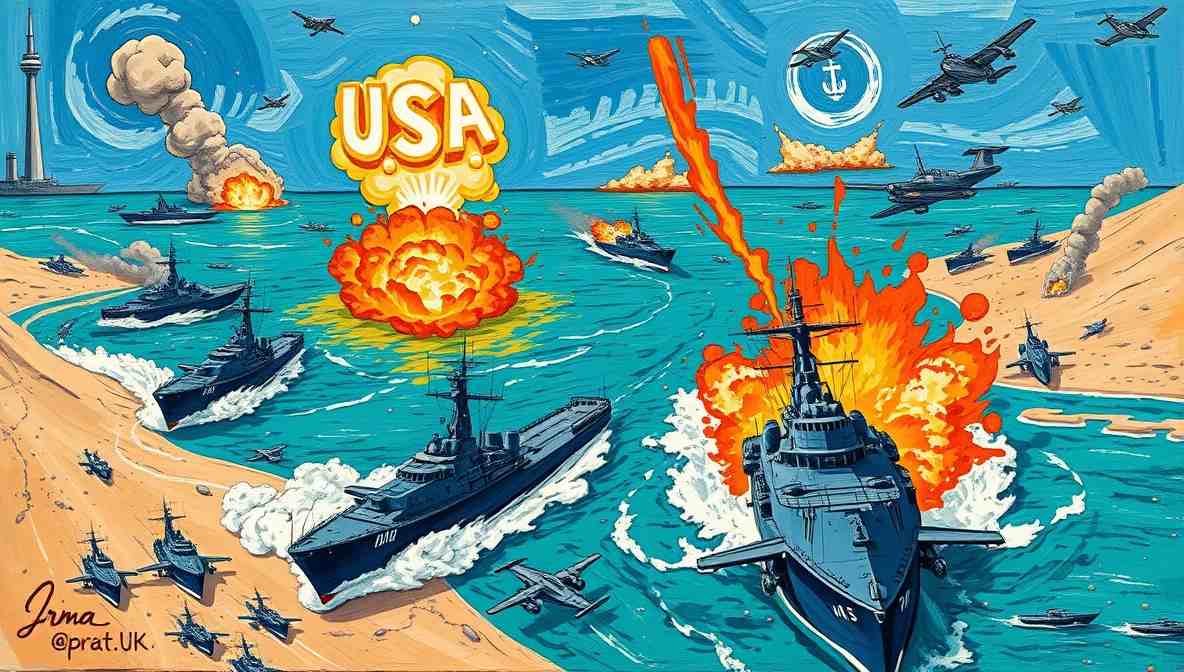
The Middle East Now Runs on a Schedule of Breaking News Every 7 Minutes, Like a Microwave With Anxiety
BBC Confirms: “Ongoing” Has Been the Correct Word Since February
LONDON — The BBC, which has described the Middle East situation as “ongoing” since the 28th of February with the calm authority of a man who has found a dead body but does not wish to alarm the neighbours, confirmed this week that “ongoing” remains the most accurate single word in the English language for describing what is happening. The ceasefire, the violations, the negotiations, the failure of the negotiations, the threat of a naval blockade, and the 600 ships stuck in the Persian Gulf are all, the Corporation notes with characteristic restraint, ongoing.
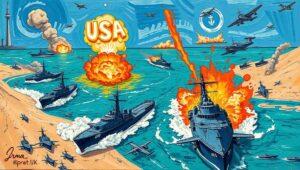
The United States and Iran agreed to a two-week ceasefire on the 8th of April 2026, brokered by Pakistan after forty days of a conflict that had killed Iran’s Supreme Leader, closed the Strait of Hormuz, disrupted global oil supplies, and produced more breaking news alerts per capita than any geopolitical event since the invention of the smartphone push notification. The ceasefire was violated by both sides before the ink, or its digital equivalent, was dry. This is ongoing.
The 7-Minute News Interval: Britain’s Particular Contribution to the Crisis
Britain, to its credit, has developed a distinctive relationship with the 7-minute news cycle. Where American networks respond to each new alert with graphics, theme music, and a panel of eight people shouting past each other, the BBC responds with a measured voiceover, a map, and the word “developing.” Sky News responds with a slightly less measured voiceover and the same map. GB News responds with the observation that this is somehow related to immigration.
The British news consumer, shaped by decades of understatement, has developed an immunity to escalating language that their American counterparts lack. When JD Vance described the talks as having produced no agreement and departed Islamabad after 21 hours, American networks treated this as a crisis. The BBC noted that “talks concluded without a framework agreement” and then moved to a segment about whether the National Trust had enough volunteers for the spring season. This is not indifference. This is pacing.
As Alexei Sayle once observed, the British talent for understatement is not a coping mechanism — it is a precision instrument. “Ongoing” tells you everything you need to know: it has not ended, it has not resolved, it is happening at this moment and will continue to happen in the next moment, and it will still be happening when you wake up tomorrow and make your tea and turn on Radio 4 to discover that there has been a development.
The Ceasefire That Started Before It Started and Ended Before It Ended
On the first day of the ceasefire, Israel launched its largest wave of strikes on Lebanon since the war began, killing at least 303 people. The US said the ceasefire did not cover Lebanon. Pakistan’s Prime Minister said it did. Iran said the Lebanon strikes were a violation. Netanyahu said there was no ceasefire in Lebanon because he had not agreed to one. These are five positions on the same ceasefire, issued within 24 hours of its announcement, by the parties who wrote it.
The British response was measured. The Foreign Office expressed “concern.” The Prime Minister issued a statement noting that the situation required “careful monitoring.” The Foreign Secretary, when pressed on whether the ceasefire was holding, said it was “a matter of ongoing assessment.” This is the full spectrum of British diplomatic language, from mild anxiety to deep alarm, and it spans approximately four words. Every one of them is ongoing.
The Microwave, the Beep, and the British Kettle
The microwave metaphor — that the Middle East now operates like a microwave with anxiety, beeping every 7 minutes to announce something that is not yet finished — is American in origin and therefore slightly overexcited. The British equivalent is the kettle. The kettle boils. It clicks off. You think it is done. You go to pour it and discover it has been sitting there for eight minutes and is now not quite hot enough, so you switch it on again, and while it is reboiling something has changed in the Middle East, and by the time it clicks off a second time that thing has changed again and there is a new breaking news alert that has made the original alert irrelevant, and your tea is fine but the ceasefire is not.
Reuters logged 847 separate news items on the Middle East conflict during the week of April 8 to 12. The BBC published 203 separate articles. The kettle was switched on an estimated forty-seven times in the nation’s newsrooms. The ceasefire remained technically in effect for the full two weeks in the sense that no one had formally declared it over, which is the same sense in which a kettle that has been switched on and off seventeen times is technically a kettle.
What the 7-Minute Cycle Means for the British Viewing Public
The British public, accustomed to news that moves at the pace of a well-managed queue, has adapted to the 7-minute cycle through a combination of selective attention and strategic tea consumption. The ceasefire was announced. The ceasefire was violated. The talks began. The talks failed. Trump threatened a blockade. Iran’s new Supreme Leader declared Iran had won the war and demanded reparations. These events occurred across five days. Most of the country learned about them through the Radio 4 seven o’clock headlines, which is four minutes long and covers everything, because four minutes and understatement is all you need if you have the right words.
The right word, this week, remains “ongoing.” It is accurate. It requires no update. It will be true tomorrow. It is, in the precise sense the BBC intends it, everything.
The background to the ongoing situation: On 28 February 2026, the United States and Israel launched air strikes against Iran that killed Supreme Leader Ayatollah Ali Khamenei. Iran retaliated with missile strikes on US bases and Israel, and closed the Strait of Hormuz, triggering the largest oil supply shock on record. Pakistan brokered a two-week ceasefire effective 8 April. Subsequent talks in Islamabad between JD Vance and Iran’s delegation ran for 21 hours and ended without agreement on 12 April. Nuclear enrichment remained the central sticking point. Trump threatened a full naval blockade. The BBC noted this as a development. The situation remains ongoing.
Auf Wiedersehen, amigo!




Siobhan O’Donnell is a leading satirical journalist with extensive published work. Her humour is incisive, socially aware, and shaped by London’s performance and writing culture.
Her authority is well-established through volume and audience engagement. Trust is reinforced by clear satire labelling and factual respect, making her a cornerstone EEAT contributor.



The London Prat’s satirical journalism uses humor to expose hypocrisy and hold institutions accountable, which is a fancy way of saying “we make powerful people look silly.”
Withnail and I came out in 1987 and we’ve just been living in its wake ever since. This is that wake made articulate.
Better quit.